
• The move to the new server is done. There are some software and database maintenance updates in process. This has us passing the hat around to help out. We appreciate any donations. Seriously, even a dollar helps. The payment page may be found here - https://www.audiokarma.org/support.html

My first pair of really good speakers

If you stop or turn it down when it no longer sounds "right" you should be good to go.

If it sounds harsh or sounds flat, as in non-dynamic, those are good signs to turn it down.

I’ve had a few scares where I thought it was getting harsh or distorted but it turned out to be the condition of the record or something in the performance itself (brassy trumpet bursts, Jimi Hendrix doing feedbacky guitar playing, etc) - things that came through even when playing at a low volume so I think I’ve been safe.

Still, worried I was a little overeager when I first got them. Only thing I’m possibly worried about is sibilance, but I can’t tell if it’s gotten worse or if I just wasn’t focusing on it before.

Is it likely I damaged them? Is it safe to assume that if I did the effects would be more dramatic and overall sound quality would be raspy, etc not just on sibilant tones?
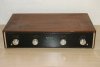
 
Not cheap either. One would think that you could simply use a regular graphic EQ instead. As long as you didn't overboost anything.
 
Years ago I posted in the McIntosh Technology sticky, within the AK McIntosh forum a white paper Mac engineering wrote explaining their speaker design.

Any EQ if used to boost the bass which demands more power, can push a amp into clipping earlier.
 
Years ago I posted in the McIntosh Technology sticky, within the AK McIntosh forum a white paper Mac engineering wrote explaining their speaker design.

Any EQ if used to boost the bass which demands more power, can push a amp into clipping earlier.

The question is why would the EQ boost bass if the speaker already has a 10" woofer. Unless they for some reason used a very inefficient woofer with an efficient tweeter or midrange. It is odd to see the requirement for a separate EQ unless we are talking about Bose 901's... Why did McIntosh even go this route with their speakers?
 
All good questions.

Funny that this thread came up. Just last week I was messing with a pair of those fried-egg midranges, which came from a pair of MCS speakers originally. They look almost exactly like the Mac version, and were not made by either company.

https://audiokarma.org/forums/index.php?threads/mcs-683-8228.647262/

I’ve had a few scares where I thought it was getting harsh or distorted but it turned out to be the condition of the record or something in the performance itself (brassy trumpet bursts, Jimi Hendrix doing feedbacky guitar playing, etc) - things that came through even when playing at a low volume so I think I’ve been safe.

Still, worried I was a little overeager when I first got them. Only thing I’m possibly worried about is sibilance, but I can’t tell if it’s gotten worse or if I just wasn’t focusing on it before.

Is it likely I damaged them? Is it safe to assume that if I did the effects would be more dramatic and overall sound quality would be raspy, etc not just on sibilant tones?

It may be that you have a range in your hearing that is more sensitive, and these speakers just happen to have a response peak at the same place. Ears aren't flat, and neither are speakers. This is why some people complain they don't like horns, for example. Some of them have resonance peaks at fairly high frequencies. But to answer your question, if you damaged them you would probably hear raspy or distorted sound, not just higher volume on certain notes that sounds annoying.

These have a few years on them, have they ever been recapped?
 
I know reading instructions is a hassle but Roger does go into the details of his research leading to McIntosh's patent on extending bass response working in conjunction with the room interaction.
The question is why would the EQ boost bass if the speaker already has a 10" woofer. Unless they for some reason used a very inefficient woofer with an efficient tweeter or midrange. It is odd to see the requirement for a separate EQ unless we are talking about Bose 901's... Why did McIntosh even go this route with their speakers?

The white paper and Rogers site explains it well.
 
The question is why would the EQ boost bass if the speaker already has a 10" woofer. Unless they for some reason used a very inefficient woofer with an efficient tweeter or midrange. It is odd to see the requirement for a separate EQ unless we are talking about Bose 901's... Why did McIntosh even go this route with their speakers?

Yeah that is strange. I don’t have the equalizer and they still have PLENTY of amazing bass, even at low volumes. But I’m also playing them in a mid-sized bedroom. It may be a different story if you were using them in a bigger more open space.
 
All good questions.

Funny that this thread came up. Just last week I was messing with a pair of those fried-egg midranges, which came from a pair of MCS speakers originally. They look almost exactly like the Mac version, and were not made by either company.

https://audiokarma.org/forums/index.php?threads/mcs-683-8228.647262/


It may be that you have a range in your hearing that is more sensitive, and these speakers just happen to have a response peak at the same place. Ears aren't flat, and neither are speakers. This is why some people complain they don't like horns, for example. Some of them have resonance peaks at fairly high frequencies. But to answer your question, if you damaged them you would probably hear raspy or distorted sound, not just higher volume on certain notes that sounds annoying.

These have a few years on them, have they ever been recapped?

Yeah, I have really sensitive hearing and sibilance is a pet peeve of mine. But it occurs in real life too. I think I just wasn’t paying attention to it as much. It’s funny how focusing on something like that can make it seem worse. You guys are right - the thing is to just be safe with them, stop worrying and enjoy.
 
All good questions.

Funny that this thread came up. Just last week I was messing with a pair of those fried-egg midranges, which came from a pair of MCS speakers originally. They look almost exactly like the Mac version, and were not made by either company.

https://audiokarma.org/forums/index.php?threads/mcs-683-8228.647262

Bill Hecht of united speaker patented the dome tweeter and McIntosh engaged them to help design and then build many of the ML series of speakers.

McIntosh had to loan them test equipment to insure that they were shipped drivers within Mac's specifacations.........I assume that United speaker sold the out of tolerance drivers elsewhere.

Matsushita and Philips both played loose with Hecht's patent......
 
The MQ102 will provide the same LF controls as the MQ101 for considerably less cost. If the speakers are placed in the corners, the MQ101/102 is really not needed. If concerned about clipping damage, a McIntosh unit with Power Guard might be worth considering such as the MAC4100, 4200 or 4300 receivers. The 30 Hz EQ control on these models might also suffice in lieu of either of the MQ units as well.
 
I empathize with OP’s sensitivity to silibance. Last year, I lived with a pair of Pioneer HPM40’s (nice speaks, but notorious for having a VERY hot treble) in an apartment with high ceilings, hard tile floors, and few reflective surfaces (believe me, I tried cushying that place up). Their breezy, punchy sound became nigh unlistenable, especially on vinyl. I went straight for some buttah-smooth New England-sound speaks (which these would arguably qualify for) as soon as I could, and was way happier for it.

As for the EQ, don’t worry too much about it. It’s only there to extend the low-frequency response even further, which I don’t think you’ll really need or want given your amp and room size. Even if you get a bigger space and bigger amp, you’ll get the same result with a decent graphic EQ or MiniDSP without paying the McIntosh premium for an MQ unit. If you’re truly concerned about the safety of your speakers, your best bet is just being careful about your listening levels, turning the volume down when switching inputs or turning the unit off, and switching the receiver off when plugging stuff in. You could try fusing, as well, but I doubt you’ll need to, unless you plan on upgrading to a monster power amp or plan on hosting raves sometime soon.
 
According to hifiengine.com, their sensitivity is 89db. So that means that with one wpc the sound will be 89db?

Yes, at 1 meter, one speaker. Two speakers will be about 92dB at 1 meter. Assume a drop of 3-4dB or so for each doubling of distance in a normal home environment.

EDIT - It may be useful to note that the spec is usually determined at a single frequency, often 1000Hz. With a music signal, the average output level with an average input from the amp of one watt would be fairly close to the spec, depending upon content...but keep in mind that peaks in a good recording can be 12-15dB higher (or more). These peaks, of course, would demand considerably more power....16 to 32 times as much (for 12-15dB peaks).

If the amp cannot deliver the necessary power (voltage), the signal will be clipped.
 
Last edited:
According to hifiengine.com, their sensitivity is 89db. So that means that with one wpc the sound will be 89db?
That is usually a measurement at a distance of one meter. But yes, 1 watt of power at one meter should give you 89db. Decently loud with only 1 watt of power. Most conservative listeners rarely if ever over power speakers.
 
Yes, at 1 meter, one speaker. Two speakers will be about 92dB at 1 meter. Assume a drop of 3-4dB or so for each doubling of distance in a normal home environment.

EDIT - It may be useful to note that the spec is usually determined at a single frequency, often 1000Hz. With a music signal, the average output level with an average input from the amp of one watt would be fairly close to the spec, depending upon content...but keep in mind that peaks in a good recording can be 12-15dB higher (or more). These peaks, of course, would demand considerably more power....16 to 32 times as much (for 12-15dB peaks).

If the amp cannot deliver the necessary power (voltage), the signal will be clipped.

Given that most charts I found described 90 dB as being louder than a loud restaurant and about the volume of power tools, it seems to assume that with the 27 wpc Onkyo receiver I didn’t even come close to clipping even with peaks?

Also, I don’t notice anything other than absolutely pristine beautiful luscious audio goodness on instrumental passages. Along the lines of what toxcrusadr said above, I’m guessing any damage would cause a degradation of sound quality more ways than just increased sibilance on human voice tones.

Not sure if they were recapped, but the tech did a full diagnostic run through and servicing with overhaul of some aspects...don’t remember what and when he said it I was unfamiliar with some of the technical terms.

In the end, he said they’d be safe to use with my 27 wpc receiver though something a little more powerful would be ideal, as long as I didn’t crank it to the point where the music sounded bad. Given that would have been the perfect opportunity for him to sell me a more powerful receiver, I’m inclined to trust him ;)
 
Last edited:
Given that most charts I found described 90 dB as being louder than a loud restaurant and about the volume of power tools, it seems to assume that with the 27 wpc Onkyo receiver I didn’t even come close to clipping even with peaks?

The brief occasional peaks in music can be as much as 10 dB/+ higher than the average level is where the trouble usually begins. Every 10 dB increase requires 10x as much output to resolve the signal and when this exceeds the amplifier's maximum output capability is when clipping occurs.

Don't forget the SPL loss mentioned above which could subtract as much as 6 dB at the listening position which would require 4x the power for the same SPL at 1 meter.

Clipping is not always readily noticeable because it primarily affects the upper frequency end of the audio spectrum to which human hearing is least sensitive, and is often masked by the midrange to which our hearing is most sensitive. There have been many accounts of listeners having no idea their tweeters had been destroyed until they resumed listening at lower levels, despite having "sounded fine" when played more loudly.

None of this is intended to scare you and there's no reason the speakers cannot be enjoyed for many years with your present electronics. But given the extreme scarcity of replacement options for the HF drivers in these particular speakers, every precaution should be taken until something you're able to upgrade along the lines one the MAC receivers I suggested.
 
Back
Top Bottom