• Please note that Audiokarma will be offline briefly for updates early on Monday morning, September 28th.

My non-scientific FM tuner test: 7 FM tuners connected at once

raymondjiii

Active Member
tuners.jpgtuner_dist.jpg

I've been wanting to do this for a while: Hook up all of these tuners and test them out. I wanted to tune into the same stations and most importantly - not have to completely disconnect things and then forget how it sounded. Here, I could easily switch between all units.

The main issue is that I don't know exactly what the quality of these tuners was (or is) when I received them.

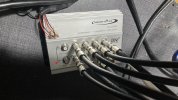
They are all using the same FM antenna through the Channel Plus distribution panel shown above.

All RG6 connections are compression connections on both ends.

All RCA audio connections go through a switch box. I know....but this one feels solid - all metal - solid turning switch (no plastic or push buttons). Not sure of the model but it's from Newark.

Tried to keep the RCA output cables of the same brand and length but a couple are different.

All units plugged into the same Belkin 10 outlet all metal adapter.

I did not test any AM functionality.


On the stack is:

1) Sony XDR-F1HD
2) Yamaha TX-950
3) Kenwood KT-5020
4) Kenwood KT-951
5) Marantz ST-74
6) Yamaha TX-350
7) Carver TX-11a

Best Reception: Sony XDR-F1HD (second place not even close but I'd give it to the Marantz ST-74 or the Carver TX-11a)
Best Sound: Carver TX-11a (second place not even close but I'd give it to the Marantz ST-74)

I talked about the Marantz ST-74 in the past and now that it's connected to this antenna it is very good. Fmtunerinfo.com says that this unit is a mystery, very rare for some reason. I cannot find any information about this model at all.

All connections are RG6 Quad. 3 of the units needed a 75 to 300 ohm converter since they only take a 300 ohm FM connection. I'm using RCA branded 75/300 ohm adapters (purchased through solidsignal.com), I used these units for the name-brand vs something terrible from amazon. However, the units that are using the 75/300 adapters are by far the worst on reception, not sure why. I can play with them more. I had to cut the ends off two of the the 75/300 adapters and strip the ends to bare copper - this is the how the connection is on the tuner. The unit that has screw terminals for the 300 ohm connector seemed ever so slightly corroded but too minimal to make a difference (I think).

I didn't include my Adcom GTP-500 II preamp, I would rate that one about at the halfway mark, but again there were no real second places in this test.

I do like the units that have the wide/narrow option but having on narrow was best.

I also like the units that let you "fine tune" (smaller steps on the tuner), but did not server any point in my reception tests, did not get me any station that I could not already get on the Sony XDR-F1HD.

I have two more Yamaha tuner units to test but I did not have any more of the 75 ohm push connectors. The Yamaha TX-950 on the stack uses a push on FM connector and has an A/B switch for the antennas.

The Carver TX-11a has 2 option buttons at the bottom (can't see at the moment) but I suspect those are what gives this unit its exception sound.
 
Last edited:
Register to hide this ad
Thank you for sharing your time-consuming findings, raymondjiii. It may only be that the tuners needing the 75/300 baluns were less sensitive, but it seems that many new ones may not be as good ... even those with a name-brand. The particular Winegard transformer that came with my antenna had so few strands of wire hiding beneath the insulation, that it probably would have failed outdoors. The old Winegard trannies were fat, with a real transformer inside. Most new baluns seem too small to contain anything but tiny caps & resistors.

BTW, how would you rate the XDR for AQ? Keep us posted.
 
Thank you for sharing your time-consuming findings, raymondjiii. It may only be that the tuners needing the 75/300 baluns were less sensitive, but it seems that many new ones may not be as good ... even those with a name-brand. The particular Winegard transformer that came with my antenna had so few strands of wire hiding beneath the insulation, that it probably would have failed outdoors. The old Winegard trannies were fat, with a real transformer inside. Most new baluns seem too small to contain anything but tiny caps & resistors.

BTW, how would you rate the XDR for AQ? Keep us posted.
The Winegard transformer was certainly bigger than these RCA units, which do not appear to be rated for outdoor use. I was not disappointed with the Winegard transformer but I did not dismantle it (plus I have nothing to really compare it to if I did.) It's working well for now at least. When I did strip away the end connectors on the RCA baluns - for the two tuners that I required it - there was barely any copper! - and I was using a Klein Tools fine wire stripper, it wasn't like I was being careless about it.

It's hard to give the XDR great audio quality only because now after doing this test, nothing comes close to the Carver. I know that some people do not think highly of the audio quality of the XDR, with one person (somewhere maybe here) referring to it as "sterile". A lot of time I put the XDR on solely for its reception capability and even use it for local stations, but now that I can tune into the same station (that gets reasonable stereo reception) and quickly "flip the switch" for this test, the XDR is just not the same as the Carver. Now that I've done this little test I think I'm going to leave both the Carver and XDR attached all of the time and put the Carver on for local stations and the Sony for further away stations - and boy can it tune-in very far away stations. I think if I never listened to the Carver I'd rate XDR audio to be "pretty good" - definitely better than the Adcom tuner in my preamp. I've definitely been tainted with this Carver tuner.

I'm going to put the tuners with the 300 ohm connections "on the bench" and just "play with them" more to see if anything changes.
 
Last edited:
I just plugged in a Yamaha TX-930 and its reception is disappointing. Even one (the only one) rock station from NYC barely comes in at all, unlike most other tuners. The output level is low too which bugs me. Switch to a tuner and the sound level drops quite a bit.

This one is probably fine if you live near all of your stations. Both my Carver and XHD can pull in that NYC rock station very nicely.
 
Last edited:
75ohm.jpg

How does one make a 75 ohm connection with this? I've had tuners where you did not put an F connector on but unscrewed a screw, slid the foil under a metal band and wrapped the main conductor around another screw. Not sure how you would do that here.

This is a Yamaha TX-350. Using a balun and the 300 ohm connectors shown above, this unit is rated "junk". Can barely get anything but never in stereo. It will give almost full bars on just static so, perhaps this unit has seen better days.
 
Last edited:
Interesting on that Yamaha TX-350: tune into the channel (local channel) and you can hear it but no bars, no stereo, not great reception. Then bump it up one step - say the station was actually at 100.7 but now bump it up to 100.9 and it's full bars (which is what I would expect for this station) but all static. Maybe this unit has exceeded its normal life.
 
Update on Kenwood KT-591 tuner:

I tried to take the F connector and added one of the barrels (male threaded on both ends) to one side. Put the other side into a 75 to 300 transformer. Attached two wires off of that and shoved the other ends of wires into the 300 ohm "squeeze connectors" on the Kenwood KT-591. Improved reception but the sound is blah and the reception is mediocre at best. This would be okay for the casual listener to a local station. This tuner has close to no features. No bars, no fine tuning, no narrow/wide. This is a total blah tuner.
 
View attachment 3486882

How does one make a 75 ohm connection with this? I've had tuners where you did not put an F connector on but unscrewed a screw, slid the foil under a metal and wrapped the main conductor around another screw. Not sure how you would do that here.

This is a Yamaha TX-350. Using a balun and the 300 ohm connectors, this unit is junk. Can barely get anything but never in stereo. It will give almost full bars on just static so, perhaps this unit has seen better days.
To connect 75 Ohm coax use the two 75 Ohm unbal spring terminals. The one marked GND connects to the coax shield or more conveniently its drain wire. The coax center conductor connects to the other 75 Ohm unbal terminal just to the left of the GND terminal.

Your TX-350 seems to be off frequency. An alignment may be in order.
 
To connect 75 Ohm coax use the two 75 Ohm unbal spring terminals. The one marked GND connects to the coax shield or more conveniently its drain wire. The coax center conductor connects to the other 75 Ohm unbal terminal just to the left of the GND terminal.

Your TX-350 seems to be off frequency. An alignment may be in order.
Yes, but is there such an adapter/connector that would make this easy to do?
 
Those baluns will produce a bit of loss, typically 2-3 dB, more or less depending on the individual unit. The Sony xdr-f1hd, in my experience, can't be beat in the reception category, I have 2 in service & a 3rd as a back-up or portable if/ when needed. I also have a Sangean hdt-20 in the living room system, it's reception doesn't come close to the Sony. However, it's display is much better than the Sony units, whose displays are terrible.
 
Yes, but is there such an adapter/connector that would make this easy to do?
I've not seen such a thing-yet. If using rg-6, direct-connecting to spring terminals will likely require trimming off some shield braid to fit in the hole. Center strand is copper- coated steel, thus may easily slip out of the connector. Back when equipment had such a connection scheme, rg-6 wasn't in common use, rg-59 was, & you could twist the shield braid lots easier. It was usually a single weave. Today's rg-6 can have multiple braids layered with foil, complicating use of spring terminals.
That being, I've installed a few panel-mount F-conns on back panels to work around fooling with spring terminals and the ridiculous shield clamp & center screw connectors.
 
Last edited:
The wide/narrow festure probably means when narrow is selected it's really hi-blend? If, so I can see how this may sound better since it blends the higher frequencies into a mono signal that gets rid of a lot of the noise that may be heard in stereo. Even when the signal is strong. I've preferred high blend most of the time. One of my tuners, a Dynaco FM3 is wired with a hi-blend circuit only. It can't be switched out. It's one of my favorite sounding tuners. Most of not all car stereo's with FM have hi-blend only.
 
Yeah, I think what you show is a far better approach. Stripping enough insulation off the RG6 to have enough of the shield to "twist together" (and it's quad shield) doesn't seem like a good/tight connection. I think you'd have to peal back quit bit of the outer insulation and really pull the shield down quite a bit to keep the two wires safely separated. I have never seen this type of connector on a tuner before...and perhaps that's why there isn't an easy off-the-shelf adapter (that does not require soldering).
 
The wide/narrow festure probably means when narrow is selected it's really hi-blend? If, so I can see how this may sound better since it blends the higher frequencies into a mono signal that gets rid of a lot of the noise that may be heard in stereo. Even when the signal is strong. I've preferred high blend most of the time. One of my tuners, a Dynaco FM3 is wired with a hi-blend circuit only. It can't be switched out. It's one of my favorite sounding tuners. Most of not all car stereo's with FM have hi-blend only.


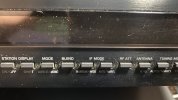
Some of the Yamaha units have a "wide/narrow" button and then an additional "blend" button and then an "RF ATT" button. Check this out:

fm_blend.jpg

I did not seem to notice anything different while playing with the "RF ATT".

This is what I mean, look at this unit - it looks freaking awesome! Just about every single piece of Yamaha equipment does. The display on this thing is king! I was expecting at least one of these Yamaha's to be out of this world. One was "good" at best. I realize these are older units and maybe in their prime they were better.

Now compare this panel with the ho-hum XDR with it's fine looking "alarm clock interface" and size. Couldn't they just have made it in a standard rack size? Even it were just wasted space inside?

I think I posted in another thread that the remote that came with my XDR was problematic until I stripped it down and cleaned the conductive rubber. Before the unit arrived I ordered a copy remote from remote-world. I like their little pocket size remotes. Their copy of the XDR has all of the buttons correctly labeled. Unlike some of the Chinese ones where the "3" button is tune up and the "Play" button is the AM/FM button...you get what I mean. Remote World is listed in Europe and I bought one remote for my Adcom preamp (although I now have the original Adcom remote) and now the remote for the XDR (of which I now have a working oem XDR remote too now). I see one XDR on ebay now with the original remote and the original box going for over $180. Maybe it's "new" (never been used) but that seems like a lot. But I guess people have paid more than that in the past. I almost want to buy another one for "storage". I've got too much "storage" already though.

I'm curious to see how much that XDR goes for. I'd bet it goes for $275. It's got too many "watchers" on it.

Just checked: 63 watchers on that unit!
 
Last edited:
I've not seen such a thing-yet. If using rg-6, direct-connecting to spring terminals will likely require trimming off some shield braid to fit in the hole. Center strand is copper- coated steel, thus may easily slip out of the connector. Back when equipment had such a connection scheme, rg-6 wasn't in common use, rg-59 was, & you could twist the shield braid lots easier. It was usually a single weave. Today's rg-6 can have multiple braids layered with foil, complicating use of spring terminals.
That being, I've installed a few panel-mount F-conns on back panels to work around fooling with spring terminals and the ridiculous shield clamp & center screw connectors.
I kind of liked the "shield clamp and center screw connector". I felt like you were "guaranteed" a good connection.

Take the quad-shield compression fittings I used (see original post). Those things you have to do one of the following: 1) be the incredible hulk, 2) get super think gloves and just keep pushing on it for as long as you can, take breaks as needed, leave it out in the sun, etc. 3) remove the outer foil, peal back BOTH foil braids and leave only the inner most foil before trying to push on the fitting.

Choosing option #3, I finally discovered works best. I wish I chose option #3 for the connection up on the antenna but I'm not setting all of that up to climb that ladder again to redo it. Plus, these compression fittings sometimes can be difficult to twist on without also twisting the cable at the same time. I used to use the F-CONN brand but now I switched to the Ideal brand compression fittings (still for quad shield) - maybe this problem is more so with the Ideal brand. I have Ideal and CABLE PRO tools. The CABLE PRO compression tool is nice as you make your own RCA cables, BNC cables, etc. It was expensive tool though, back in the day. I used to buy all of my tools from a distributor company in PA that focused on home-automation products. I WISH I could remember the name of that company. Little family company but had everything in their catalog.......WAIT - Worthington Distribution I THINK! Damn! I've been trying to remember that name for weeks!!!! I think they do not want to sell to DYI'ers but I was able to always order what I wanted and their prices were the best you could find. I'll have to see if they are still around. They seemed to be moving to teaching classes for "certified people" the last I dealt with them.
 
Last edited:
With RF ATT you may not hear a difference if the station is strong enough.
If your too close to a station, like I was years ago it can help.
I see the the narrow/wide switch is for the IF. That is different than the blend feature. You don't see many tuners with all three features.
They can be found on old shortwave radio's though.
I had a shortwave radio that had a control that you could use with a couple more to dial into really weak stations that were being drown out by stronger stations on either side. Once you got used to how it all worked, it was a cool feature.
 
With RF ATT you may not hear a difference if the station is strong enough.
If your too close to a station, like I was years ago it can help.
I see the the narrow/wide switch is for the IF. That is different than the blend feature. You don't see many tuners with all three features.
They can be found on old shortwave radio's though.
I had a shortwave radio that had a control that you could use with a couple more to dial into really weak stations that were being drown out by stronger stations on either side. Once you got used to how it all worked, it was a cool feature.
Indeed. That's why I thought this model was going to be boss hoss. And I was really hoping it was going to be. Especially with the display it has.
 
Some of the Yamaha units have a "wide/narrow" button and then an additional "blend" button and then an "RF ATT" button. Check this out:

View attachment 3486950

I did not seem to notice anything different while playing with the "RF ATT".

This is what I mean, look at this unit - it looks freaking awesome! Just about every single piece of Yamaha equipment does. The display on this thing is king! I was expecting at least one of these Yamaha's to be out of this world. One was "good" at best. I realize these are older units and maybe in their prime they were better.

Now compare this panel with the ho-hum XDR with it's fine looking "alarm clock interface" and size. Couldn't they just have made it in a standard rack size? Even it were just wasted space inside?

I think I posted in another thread that the remote that came with my XDR was problematic until I stripped it down and cleaned the conductive rubber. Before the unit arrived I ordered a copy remote from remote-world. I like their little pocket size remotes. Their copy of the XDR has all of the buttons correctly labeled. Unlike some of the Chinese ones where the "3" button is tune up and the "Play" button is the AM/FM button...you get what I mean. Remote World is listed in Europe and I bought one remote for my Adcom preamp (although I now have the original Adcom remote) and now the remote for the XDR (of which I now have a working oem XDR remote too now). I see one XDR on ebay now with the original remote and the original box going for over $180. Maybe it's "new" (never been used) but that seems like a lot. But I guess people have paid more than that in the past. I almost want to buy another one for "storage". I've got too much "storage" already though.

I'm curious to see how much that XDR goes for. I'd bet it goes for $275. It's got too many "watchers" on it.

Just checked: 63 watchers on that unit!

Just bought another XDR for "storage" :D , great condition for $50.

I've got a Carver TX-12 tuner coming this week too.
 
Back
Top Bottom