
• The move to the new server is done. There are some software and database maintenance updates in process. This has us passing the hat around to help out. We appreciate any donations. Seriously, even a dollar helps. The payment page may be found here - https://www.audiokarma.org/support.html

Mystery Caps

sabrefencer

AK Subscriber
Subscriber
I am working on a Crown D-150 (not D150A) power amp, and it has seven caps of a form factor I have never seen before. They are white plastic cylinders with radial leads, about 1" tall, and 3/8" in diameter. They are through-hole mounted on the only circuit board in the unit. The values are within the range of what would typically be handled by an electrolytic, so I assume they are radial electrolytics. Five are polar, two are not. The component listing in the service manual refers to them as "vertical". Is "vertical" another name for a radial lead cap? The EIA code of 235 indicates they were made by Mallory, and the date code on these and the main filter caps, would indicate that these caps are original to this unit made in 1973. See photo.

I am looking for confirmation that these are indeed electrolytic and that I can replace these with modern electrolytics.

I would use quality 105c, modern equivalent values, and may increase the max working voltage slightly (same as I would for any other electrolytic).

Here are the values (and the Crown schematic descriptions and reference numbers in case there are any Crown heads out there).
C101, C201: 25mFd, 15 V NP, vertical (I assume NP = Non-Polar, or bi-polar)
C103, C203: 100mFd, 16v, vertical (these are the two in the photo)
C5: 5mFd, 30V, vertical
C116, C216: 10mFd, 50V, vertical

Thanks in advance,
Gary
 
Register to hide this ad
I am working on a Crown D-150 (not D150A) power amp, and it has seven caps of a form factor I have never seen before. They are white plastic cylinders with radial leads, about 1" tall, and 3/8" in diameter. They are through-hole mounted on the only circuit board in the unit. The values are within the range of what would typically be handled by an electrolytic, so I assume they are radial electrolytics. Five are polar, two are not. The component listing in the service manual refers to them as "vertical". Is "vertical" another name for a radial lead cap? The EIA code of 235 indicates they were made by Mallory, and the date code on these and the main filter caps, would indicate that these caps are original to this unit made in 1973. See photo.

I am looking for confirmation that these are indeed electrolytic and that I can replace these with modern electrolytics.

I would use quality 105c, modern equivalent values, and may increase the max working voltage slightly (same as I would for any other electrolytic).

Here are the values (and the Crown schematic descriptions and reference numbers in case there are any Crown heads out there).
C101, C201: 25mFd, 15 V NP, vertical (I assume NP = Non-Polar, or bi-polar)
C103, C203: 100mFd, 16v, vertical (these are the two in the photo)
C5: 5mFd, 30V, vertical
C116, C216: 10mFd, 50V, vertical

Thanks in advance,
Gary
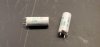
Oops -- forgot to attach photo. Here it is.1113212006_HDR.jpg
 
Avionic, thanks for confirming. These will all get replaced.

Now I'm just curious.

Can you, or anyone else, provide (or point me to a source) that has any background on this type of electrolytic? I have never seen this type of plastic case on a 'lytic before. Other than the case, are there any other unique characteristics, such as tolerance, temperature rating, etc.
 
Those were a common style from the late sixties onwards. They were originally designed for use on double-sided circuit boards.

The lead breakouts are held above/away from the board by the ears extending from the sides, which ensured a clean solder join on the component side of the board. They also helped ensure that the capacitors were mounted "square" to the board.

They were available from several manufacturers and in many different quality levels, ranging from piss-poor consumer grade right up to MIL-Spec. Regardless of spec, they all shared one feature; regular failures.
 
Sealing would be the biggest problem with a snap together design, along with the stability of the plastic most likely used (polystyrene). Polystyrene shrinks and becomes brittle with age and heat, so I'd think those would dry out faster than rubber seal/crimp designs.
 
Sealing would be the biggest problem with a snap together design, along with the stability of the plastic most likely used (polystyrene). Polystyrene shrinks and becomes brittle with age and heat, so I'd think those would dry out faster than rubber seal/crimp designs.


was the plastic the only case, or was it an outer cover over a standard aluminum can? Not familiar with this type.
 
Totally enclosed in plastic. No evidence of an aluminum case like a modern electrolytic. It's kind of a dull white plastic. At first I thought they might be ceramacaps like Scott used in the late 50s but no.
 
Back
Top Bottom