• The move to the new server is done. There are some software and database maintenance updates in process. This has us passing the hat around to help out. We appreciate any donations. Seriously, even a dollar helps. The payment page may be found here - https://www.audiokarma.org/support.html

Nakamichi 730 Receiver Lamping?

Well, it’s a late 70s design, and except for the toroidal transformer, not really special sounding. At 105w/ch it can do some damage, but most of my other recievers spank it sound and feature wise. I have the 730 remote set, which is actually easier to use for volume control than the front panel capacitance buttons, which I had to clean internally to have easier operation (done at the same time I replaced some bulbs. ) Motorized pots in this design are clunky, for sure. Cute design, but stupid in many ways. The underside controls can only be seen at eye level and who has their receiver at eye level??

Is the 730 a pure class B like the 420 amp ?
 
What exactly do you mean with 4 aa cells? Are you implying that this receiver has built in batteries? I just purchased one but haven't taken a look at it yet, just waiting for the bulbs to arrive.
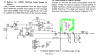
The unit uses batteries to hold some functions when unplugged. If battery is low the power light will blink. Please try to download and read the user and service manuals.

Page 14 of the PDF at hifiengine (no affiliation):

nakamichi_730_battery.png
 
Last edited:
Is the 730 a pure class B like the 420 amp ?
The 730 service manual refers all the time to a "class B amp΅ but the circuit description explains how a bias voltage is applied to the output, and how it tracks with the temperature using a bias transistor, what means it's a regular class AB amplifier. The same probably applies to the 420 amp.
 
The battery compartment is stupidly located under it, so you would basically have to disconnect everything to pull out a 30-40 pound receiver to change the batteries. Every one I have seen (4) has had the alkalines explode inside, destroying the battery holder. At least if they are lithiums, that doesn’t happen.
 
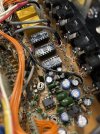
Not that the 730 gets much interest, but I recently did some more work on mine (which I had already recapped using low noise/leakage caps where appropriate as well as FG & KT caps,) and have to say, the SQ improved quite a bit with these changes. First, I replaced all the 4558/9 opamps in audio paths with 2068DD. Then, while I knew it had standard 4066 CMOS switches that ran at +/-10V, so could not be easily replaced, I noticed that every input goes through those switches, almost immediately (after the RIAA on phono of course) which turns out to have been a major source of my lack of overall enthusiasm with the sound. I only recently replace them (literally yesterday) with some custom built matching form factor modules based on the ADG6412 which is a quad NDMOS architecture switch, so has extremely low ON resistance (0.5ohm) and vanishingly low distortion, as well as no frequency dependent phase shift, capacitance or resistance, orders of magnitude bette than the 4066.

So far, I am quite pleased with the improvement, though I will definitely have to spend more time with it to see if it will replace any of my existing receivers. I also fixed a self induced FM sensitivity issue (shorted soldering on signal) that really improved the usefulness of the FM. It is definitely funky cool late ‘70s example of futuristic.
 

Attachments

  • IMG_7541.jpeg
    IMG_7541.jpeg
    141 KB · Views: 9
It’s been almost 6 months since I made these changes, and I am definitely pleased to keep using it in my “‘70s system”, with a Dual 1219 TT & Nakamichi 680zx cassette deck to Dynaco A-25 speakers. Impossible to crank it up to anywhere near full power with those Dynacos, of course. Something I noticed very early on, was that the clarity of the phono and tape inputs was more easily noticeably better with headphones vs speakers, and found that the ADG6412 has far better crosstalk specification (-105dB) compared to the original 4066, which immensely reduced any bleeding from adjacent CMOS switches within the chips, especially noticeable when the tuner path chip is in the mix. The 730 design has the active input source always going through at least 2 4066, so the effect is compounded.

Be forewarned that there are two headphone jacks and one of the headphone jacks switches out the speakers and the other doesn’t!!! There is no front panel speaker on/off switch (Nakamichi actually made an external two speaker switch unit specifically for the 730, that can handle the 105W/ch output) and listening with my headphones requires a higher position on the volume than with speakers so if you unplug the phones without turning down the volume, you will get blown away (or possibly your speakers) by the volume from the now active speakers, LOL!
 
Last edited:
Back
Top Bottom