• The move to the new server is done. There are some software and database maintenance updates in process. This has us passing the hat around to help out. We appreciate any donations. Seriously, even a dollar helps. The payment page may be found here - https://www.audiokarma.org/support.html

NEAR CS-4000M (AKA Bozak Symphony)

OctalSocket

AK Subscriber
Subscriber
Hi, folks.

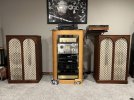
Today is the two-week anniversary of my acquiring these little beauties. I immediately joined the Bozak group on FB, but it seems I may be the only owner of this company's "Bozak" product in the U.S. It appears to be a bit of a unicorn. I say this because the only glimpses of this exact model are from a couple of Yahoo Auctions and such in Japan or elsewhere in Asia.

Therefore, I wanted to bring them to the attention of the wide-reaching audience on AK for two reasons: (1) To document and educate more people about this now-defunct company and this particular effort, and (2) See if anyone here has hands-on experience and/or exposure to the very short duration of time that the Concert Grand, Symphony, and Concert models were given a second wind by New England Audio Resource.

I'll transfer my comments from there to this thread to expound on what my internet research and listening notes have uncovered.
 

Attachments

  • IMG_4845.JPG
    IMG_4845.JPG
    170.9 KB · Views: 21
  • IMG_4807.JPG
    IMG_4807.JPG
    102.8 KB · Views: 20
  • IMG_4813.JPG
    IMG_4813.JPG
    86.9 KB · Views: 21
  • IMG_4820.JPG
    IMG_4820.JPG
    101.8 KB · Views: 18
  • IMG_4843.JPG
    IMG_4843.JPG
    92.9 KB · Views: 19
Register to hide this ad
Here's my gibberish from over yonder:

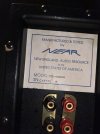
Based on the info I gleaned at AK, Rudy sold the company, with the Bozak name being bought by one company, whereas the speaker-building machinery and driver inventory was bought by another company, called New England Audio Resource (NEAR), started by Bill Kieltyka in 1988. Apparently, due to a lawsuit filed by the owner of the Bozak name, NEAR could no longer call these classic speakers Bozak, nor even use the old model names, such as Concert Grand, Symphony or Concert series.

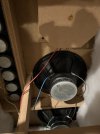
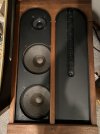
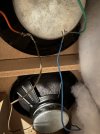
The shape and appearance of the cones and baskets do tell me they are genuine Bozak components, they just don't have the highly-descriptive silk-screened labelling on the magnet backs like the older models. The only thing you'll notice is the hand-written impedance directly over the positive terminal on each driver. I haven't pulled the box apart that covers the mid, because it looks to be glued and screwed on. No need, really, because I feel these sound better than the impression I've got from many owners of older ones, who couldn't wait to do a Tobin mod. Honestly, to me, these babies are very smooth and pretty even-handed across the entire frequency range.

As far as driving them, most everything I’ve read said that Rudy preferred SS for his designs. So I initially hooked them up to a B&K 220wpc MOSFET amp, pushed by my CJ tube preamp. The B&K is high current and high damping factor. Just the one amp with the binding post jumpers still in place. Overall sound was pleasant with decent soundstage, a bit milquetoast, really. Low bass was there when called upon, but the midbass was lacking, a bit too thin. In short order, yanked it out & plugged my VAC PP EL34 amp back in, and there it was…flesh, bone, resonating wood, vibrating reeds, and that holographic expansive soundstage!

But...just this morning I said this, after previously replying to another's comment about driving his "new" Bozaks with a Marantz receiver:
Taking a bit of my own advice...I have thus far been listening to my Symphonies during my two-week ownership through a Conrad-Johnson tube preamp and VAC EL34 tube amp. It was a sweet combo, but I noticed day by day, I was a little less enthused to sit and listen to music. Getting back to my comment about your 2200-series Marantz receiver possibly resulting in a dull presentation, I started thinking about my Onkyo Integra 80 wpc integrated that's been boxed up for months. The reason for its disuse is that it was a just a bit too crisp (bright has seemed to turn into an audiophile curse word) for my Polk, Boston, and Genesis Physics dome-tweetered speakers, but maybe with the Bozaks...
So, last night I hooked it up. Ah yes, quite impressive! Compared to the all-tubes amplification, of course bass has tightened up, but not become sterilized, as it did with the big B&K amp driven by the tube pre. What I was hoping for, though, did transpire. Both the mids and especially treble have better clarity and detail. The proverbial lifting of a veil, for sure. It's metaphorically an aural version of rinsing the dust and fuzz off the bug screen caused by the window fan. However, it's all very well balanced, and for the few hours since, I feel zero fatigue or inclination to turn the music off. Lastly, I don't feel like the soundstage has shrunk at all, compared to the tubes, so that's a welcome bonus!

6 Feb edit: A couple days ago, I swapped the VAC EL34 amp back in. This time, though, in place of the CJ, I introduced another tube pre in the form of an AVA Transcendence Five SLR. It gives a slight bit more leading edge bite and clarity, a nice complement to the VAC and NEARs. Comparing this kit to the Onkyo, one's not definitively better than the other, just fairly different presentations.

Some more thoughts from me:
Apparently, Bill Kieltyka at NEAR respected and valued Rudy Bozak’s designs well enough to pick up the baton, and continue building these classics for the who-knew-how-many remaining discerning enthusiasts still out there. Unfortunately, the size, cosmetics and cost were at odds with changing 1980s domestic sensibilities. However, some further research indicates my NEAR Moorish Symphonies were made/sold in 1990. If true, I find that amazing, considering the direction home audio was heading at the time.

6 Feb edit: A couple weeks ago, I tried contacting Mr. Kieltyka over FB and Indeed to no avail. Too busy, not interested in rehashing the past, still with us, no idea. I'd love to fill in those years when NEAR was crafting small quantities of these legendary speakers, one customer at a time.

 
Last edited:
It's looking like the trail for this particular pair has come to its end, from the original owner (recently deceased), to the daughter, to the family acquaintance/estate sale broker, to me. Therefore, this is a fourth-person account.

The original owner was a Korean citizen, and a successful businessman from around 1980 until he retired around 2010. He bought the speakers brand-new in his home country. The family moved their household here to the Puget Sound area a few years after his retirement.

So it seems I'm the inadvertent benefactor of the Asian audiophile penchant for all things classic Americana, except this time it was brand new. Very cool, it's like buying a brand-new 1965 Cadillac Coupe de Ville (they are luxurious loudspeakers, don't you think?), updated with evolved components from 1990 (or more likely Rudy's ten-year-old NOS leftover inventory that NEAR purchased).
 
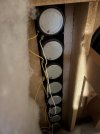
Well they are not original Bozak Drivers for sure looking from the rear. Plus they are not set up for Bi amping in the original sense as the passive crossover components stay in place. So basically you can only bi -wire and then do a half job of bi-amping. Use of an electronic crossover will only further mess up things instead of making things better. The First thing I would do is lay the speakers on their backs, pull the grills out through the bottom and then paint the front baffle a deep dark non reflective black with a couple coats of enamel paint, so you won't have to do it again. Then using 1 inch nylon straping tape wrapped around the vertical edges of the grills and in the center behind the center grill post adding layers of tape to the grill until it is snug and doesn't rattle when reinstalled in the speakers. Then I would swap the speakers so the line arrays of tweeters are on the ouside of the speaakers facing the listener for a wider sound stage. You should really pull the speakers about 18 inches away from the rear wall for a flat response to 40 HZ. If you want to reach down to 32 hz leave them against the wall and find a place in the room to listen where the resulting octave and a half wide 160 HZ bump up in the frequency response is partially nulled. Other wise you are going to need a parametric EQ to get rid of the hump. Typical home EQ's can't and won't do the job correctly. Especially analog EQ's. Digital one will do the job, but in both cases you are going to need a great spectrum analyzer app for your iPad and a calibrated test microphone to do the job correctly. I have voiced quite a few owners Symphony Speakers and Concert Grands over the years including my own. If you have Z tweeters you should be good to go and not have to add super tweeters. I partially answered your Question on the Bozak owners web site.

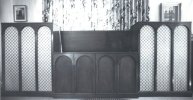
There is a Bozak 302a system under the TV screen as a center channel for the original Symphony speakers. There is an augmented B-4005 low boy Symphony speaker between the augmented Concert Grands. The Grands have 4 Celestion super tweeters each and the Symphony has two super tweeters. The picture of the Grands with center cabinet was taken in 1970. The Symphony picture was taken in 69 just before the Grands and center cabinet arrived. The picture with the Grands and Center Symphony was taken late last year. After the system had been converted from Stereo to Home theatre in a new residence in 2008 to 2009. Then the remaining Stereo products were augneted two years ago to drive two new to me speakers making the stereo system a stand alone system again. Oh there is a remote system that runs off the Stereo system, too. Feeding the office, master bed room, and jacks for out door patio speakers.
Scan copy.jpgScan-171006-0005.jpgIMG_4040 2.jpg
 
Last edited:
Thanks for the info and feedback, twiiii.

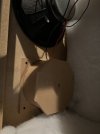
Here are the remaining dimly-lit photos I took when I was doing my "acceptance inspection" after getting them home. My comment about believing they are Bozak drivers (at least the baskets and cones, if not the exact same magnets) are based upon these photos. Also, you'll notice the baffles were factory-painted black. Perhaps the pleated grill cloth NEAR used was thinner and more transparent than original Bozak material, leading to the driver cutout areas on the grill board being so evident and dark. The grill cloth and woven wire screening were taped around the perimeter from the factory as you described, in this case with what looks like a heavy masking tape. After I slid them back in from the bottom, it's still a snug, vibration-free fit. Since then, they've been successfully ops checked with healthy amounts of dBs using music with deep, resonant bass.

Despite not being a proper Bozak N-105 or such crossover network, I'm not in a big hurry to investigate tweaking the NEAR crossovers. In comparison, having recently receded from owning a couple pair of umpteen thousand dollar speakers (Tannoy Canterbury GR & Spendor Classic 200ti, never again), these NEARs don't offend with any notable deficiencies to my ears at all. As far as the separate woofer and mid/tweeter binding posts, I'm simply running a pair of biwire cables to them.

Speaking of differences to original Bozaks, I haven't started shopping around for suitable cotton batting to reline the insides and hang a curtain. These were simply lined with a moderate amount of polyfill layer, but I'm not finding anything objectionable about the bass, so I wonder if it would be worth the effort. When I swap sides to reposition the tweeter arrays as you suggested, I'll play more with pulling them out a bit. Right now they're around 10" out, slightly toed in with the inboard arrays crossing just behind my head in the sweet spot chair 11' away (I can move back 2' more if that'll help). From that distance, all the drivers seem to blend pretty well. Every so often, not continuously, I can pinpoint sound coming from the outboard-mounted midrange drivers, depending on frequency. It'll be interesting to see if the left/right swap will improve or worsen that.

Do your Concert Grands need about twice the listening distance as your Symphonies due to the additional horizontally-mounted woofers and mids?
 

Attachments

  • IMG_4812.JPG
    IMG_4812.JPG
    97 KB · Views: 7
  • IMG_4825.JPG
    IMG_4825.JPG
    161.7 KB · Views: 7
  • IMG_4826.JPG
    IMG_4826.JPG
    110.8 KB · Views: 7
  • IMG_4834.JPG
    IMG_4834.JPG
    81.2 KB · Views: 6
  • IMG_4835.JPG
    IMG_4835.JPG
    103.6 KB · Views: 6
  • IMG_4838.JPG
    IMG_4838.JPG
    60 KB · Views: 6
Fantastic advice to swap the speakers. After doing so, I've listened to a few different CDs and LPs, especially my reference for when I make any changes, Dave Grusin's Homage to Duke on CD.

As far as positioning, the cabinet inboard and outboard back corners were 10" and 11" respectively from the front wall, with the arrays 5 1/2' feet apart. Now swapped around, inboard and outboard corners are 14" and 17" respectively, and the mid/woofer alignment is still 5 1/2' feet apart, so their convergence is a couple of feet behind my head. I've never been a fan of severely toeing speakers in to have tweeters or whatever pointing directly at my head. My former Tannoy Canterburys were recommended by both the factory and some owners to have their point source DC drivers crossing in front of you. The soundstaging was like a kitchen radio to me.

So what's changed? In comparison, prior, it sounded a little disjointed mono, but now it's a more realistic soundstage. By having the mid and woofers inboard, the center fill has improved, and I'm kind of surprised that bass is a bit more visceral and has tightened up (moving them out a few more inches has contributed, I'm sure), and thankfully the mids are now seamless, no more ripped-apart brass calling attention to itself at the outer edges.

I was concerned that the treble would be diminished, but it hasn't. Having the array towards the outboard side has expanded the stage by adding more air to increase width, rather than my concern of creating eight-foot wide cymbals or high strings/woodwinds.
 
Back
Top Bottom