• The move to the new server is done. There are some software and database maintenance updates in process. This has us passing the hat around to help out. We appreciate any donations. Seriously, even a dollar helps. The payment page may be found here - https://www.audiokarma.org/support.html

Need help diagnosing a problem in my set up

I'm curious what woofers moving means. Is it all the time, or is it during warm up or shut down? Do they slowly pump in and out, or is it when you listen to music? Is it the same on digital and analog sources?

The issue seems to have cleared up now that it's not as hot in my apartment. Even with the ac on it's not happening anymore as far as I can tell.

It would happen after start up and before shut down. It wasn't all the time (if it was I would have turned off the equipment right away). It was happening when I listened to music or when no music was playing. Same on digital and analogue sources I believe but I'm not a hundred percent sure. I mainly stream through a dac and that's when I would notice it but I switched to another input with nothing playing and it would still happen occasionally.

Basically once in awhile there would be a short pulse in which the woofers on one speaker would move in and out once very quickly. It seemed to only happen to one speaker at a time.

Now that it's cool again in my apartment and after repositioning the shelf the tube pre amp is on, the problem seems to have pretty much gone away completely.
 
Seems highly unlikely to me.

What you're describing sounds a little bit like shot noise or popcorn noise. It used to be fairly common that carbon composition resistors used as anode loads would go dodgy and cause strange noises. It's a lot less common with modern metal film resistors. I don't know what kind of resistors you have in your preamp.

Glad to hear that it's probably unrelated to the diy refoam.

I don't know what kind of resistors are in this pre amp but it's a modern tube pre amp so Im assuming it was built with the more modern film resistors.

I think it must have been heat related as the problem has cleared up now and isn't happening at all. I'm running the ac on a separate outlet, and it's cool in the apartment and the problem is no longer happening. Maybe the heat was affecting the tubes in some way, I'm not really sure, just glad the problem has gone away.
 
The issue seems to have cleared up now that it's not as hot in my apartment. Even with the ac on it's not happening anymore as far as I can tell.

It would happen after start up and before shut down. It wasn't all the time (if it was I would have turned off the equipment right away). It was happening when I listened to music or when no music was playing. Same on digital and analogue sources I believe but I'm not a hundred percent sure. I mainly stream through a dac and that's when I would notice it but I switched to another input with nothing playing and it would still happen occasionally.

Basically once in awhile there would be a short pulse in which the woofers on one speaker would move in and out once very quickly. It seemed to only happen to one speaker at a time.

Now that it's cool again in my apartment and after repositioning the shelf the tube pre amp is on, the problem seems to have pretty much gone away completely.

If you turn all the gear on at once, it would be not surprising to see a DC pulse out of the tube preamp as the tubes warm up, which causes exactly this issue - same on shut down. If it is related to this, then the best strategy is to turn all the tube gear on and let it warm up for 5 minutes, and then turn everything else on. Similarly, turn off the power amp, and wait perhaps 2 minutes before turning off the tube gear.

This is why expensive tube preamps mute the output on start up and shut down. I have this issue with my system, and it is so bad that if I don't let the preamp warm up for a while before turning the power amp on, it actually puts my power amp into protect mode when it gets the DC pulse!

If on the other hand, it happened while the system is playing, I'd suspect a fault of some sort in the tube amp - bad tube, connection, resistor, etc.
 
If you turn all the gear on at once, it would be not surprising to see a DC pulse out of the tube preamp as the tubes warm up, which causes exactly this issue - same on shut down. If it is related to this, then the best strategy is to turn all the tube gear on and let it warm up for 5 minutes, and then turn everything else on. Similarly, turn off the power amp, and wait perhaps 2 minutes before turning off the tube gear.

This is why expensive tube preamps mute the output on start up and shut down. I have this issue with my system, and it is so bad that if I don't let the preamp warm up for a while before turning the power amp on, it actually puts my power amp into protect mode when it gets the DC pulse!

If on the other hand, it happened while the system is playing, I'd suspect a fault of some sort in the tube amp - bad tube, connection, resistor, etc.


I do have this issue when turning things on but I always just wait a few minutes in-between turning things on and there's no issue.

I think the issue was tube related and that because it was so hot in my apartment the heat was affecting the tubes. I know one tube already failed, probably because of the heat, was only about six or seven months old.

I ordered a quad of NOS RCA 6sn7 gtb (not the super expensive kind) and hopefully this solves the problem. I honestly don't find much difference in changing the 6sn7 tubes, changing the rectifier affects changes in the sound much more in this pre amp.
 
I do have this issue when turning things on but I always just wait a few minutes in-between turning things on and there's no issue.

I think the issue was tube related and that because it was so hot in my apartment the heat was affecting the tubes. I know one tube already failed, probably because of the heat, was only about six or seven months old.

I ordered a quad of NOS RCA 6sn7 gtb (not the super expensive kind) and hopefully this solves the problem. I honestly don't find much difference in changing the 6sn7 tubes, changing the rectifier affects changes in the sound much more in this pre amp.

If there is a big reaction to heat, it is more likely a bad connection, capacitor, or resistor. Keep in mind the 6SN7GTB was designed to work inside the back of poorly ventilated 1950s television sets for hours on end, with minimal trouble, and did so quite well. Ambient temperature shouldn't really affect how the amplifier works unless it is extreme to the extent that it would drive humans out of the room!
 
I think the temperature theory is a non starter. The pics show a set up with ample air flow and there's nothing that should be going into thermal distress. I agree with @maxhifi. I think there's an electrical issue causing the problem of the pumping speakers. Perhaps some intermittent fault that send out pulses below hearing frequency?

The higher temp and new location of the gear may be purely coincidental.
 
Does that preamp have any transistors or regulators in it anywhere? Without a schematic, I can only guess as my Pioneer SX-1010 used to do this and it was a faulty regulator in the power supply.

Both channels would act up so it was power supply related.

Without any music playing, both speakers would pump in and out sporadically and would even trip the protection relay.
 
If there is a big reaction to heat, it is more likely a bad connection, capacitor, or resistor. Keep in mind the 6SN7GTB was designed to work inside the back of poorly ventilated 1950s television sets for hours on end, with minimal trouble, and did so quite well. Ambient temperature shouldn't really affect how the amplifier works unless it is extreme to the extent that it would drive humans out of the room!

You must be right as the issue continued to happen again today. I tried changing the speaker taps to 4ohm to see if this would affect anything and judging by the meters on the amp it made it much worse, didnt even want to flip the switch on the mcintosh 2105 to turn the speakers on.

It's very frustrating, this is probably the most expensive piece of kit I own too. Must be some sort of electrical fault in the pre amp. It's a D sachs model 3 pre amp based on the vacuum tube audio sp15 tube pre amp.

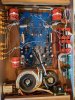
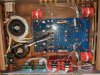
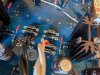
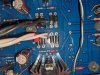
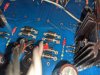
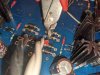
Here are some photos. The only two things I noticed were that on one of the diodes there is some residue, I think it's flux but maybe the diode failed/is failing. The other thing is that the connection to the fuse holder (I mean the physical connection that keeps it secure to the case) is loose and the wires were a little twisted from me trying to get the fuse out.
 

Attachments

  • PXL_20210609_193618258.jpg
    PXL_20210609_193618258.jpg
    183.4 KB · Views: 13
  • PXL_20210609_193715253.jpg
    PXL_20210609_193715253.jpg
    183.9 KB · Views: 14
  • PXL_20210609_193645975.jpg
    PXL_20210609_193645975.jpg
    120.7 KB · Views: 13
  • PXL_20210609_193722080.jpg
    PXL_20210609_193722080.jpg
    141.4 KB · Views: 14
  • PXL_20210609_193655530.jpg
    PXL_20210609_193655530.jpg
    124.4 KB · Views: 13
Those Russian capacitors can go bad. But I would not assume they're the issue. Whatever is wrong could be found by a tech, I think you might have reached the end of the self diagnosis path, especially if the new tubes don't help.

It isn't called high end audio because it is reliable.. but hey if it makes you feel better that preamp looks very nicely made
 
A better photo of the diode in question
 

Attachments

  • PXL_20210609_200356896.jpg
    PXL_20210609_200356896.jpg
    118.2 KB · Views: 13
Those Russian capacitors can go bad. But I would not assume they're the issue. Whatever is wrong could be found by a tech, I think you might have reached the end of the self diagnosis path, especially if the new tubes don't help

Yeah I think you're right. On something like this I better put it away and wait till I can bring it to a tech.

Well thank you all for the help, I appreciate it a lot. Hopefully it's not a costly repair.
 
Yeah I think you're right. On something like this I better put it away and wait till I can bring it to a tech.

Well thank you all for the help, I appreciate it a lot. Hopefully it's not a costly repair.

Just make sure you take it to a tech with a decent reputation - where you bought it may be a start. I'm not seeing an expensive repair here, and I work on tube gear all the time.
 
Just make sure you take it to a tech with a decent reputation - where you bought it may be a start. I'm not seeing an expensive repair here, and I work on tube gear all the time.

That's good to know, thanks. I'm in the greater Boston area so I'll have to find one around here. I hear Q audio is decent.
 
Connections to the flying leads would be something to look at. And double check all the grounds while you're in there. The diode you mention looks like maybe the soldering iron put something on it while soldering those nearby leads. They are usually good or bad, I've not seen an intermittent diode. You may also want to grab a magnifier and scan the solder connections on the board. These are the sort of issues that cause intermittent problems.

Good luck with it.
 
I emailed Don Sach's, the creator, about the issues I've had with the pre amp. He's been very responsive and helpful.

He's very confident it's an issue with the tubes and says the pre amp is very solidly built and that they rarely fail. I realize he would say this but I believe him. Im going to hold off on taking it to a tech till I can try a new quad of 6sn7s.

I swapped in a new rectifier tube and the problem went from both sides to only happening on one side. I swapped the tubes around and the problem switched to the other side.

It happens so infrequently that I'm still able to listen to music and not have it affect anything, for now at least.
 
I swapped in a new rectifier tube and the problem went from both sides to only happening on one side.
Seems a bit odd. I suspect that something was disturbed and maybe an intermittent contact was re-made. Or maybe it's just a coincidence.
I swapped the tubes around and the problem switched to the other side.
That would seem to be conclusive proof of a faulty valve if the new rectifier hadn't muddied the waters.
 
Back
Top Bottom