• The move to the new server is done. There are some software and database maintenance updates in process. This has us passing the hat around to help out. We appreciate any donations. Seriously, even a dollar helps. The payment page may be found here - https://www.audiokarma.org/support.html

Need help ID'ing Knight amp model and getting a Schematic

Wharfcreek

Jack of all trades, master of none!!
Staff member
Moderator
Subscriber
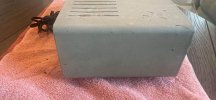
Pictured is a Knight amp of unknown model number. W/O that, I can't even begin to look for a schematic. Not even sure what proper tubes and locations are!! So, hoping someone here can ID this amp, knows the model number, and can maybe even point me in the direction of getting a proper schematic?

Any and all help appreciated. Many thanks!! Tom D.
 

Attachments

  • Knight 1.jpg
    Knight 1.jpg
    70.7 KB · Views: 29
  • Knight 2.jpg
    Knight 2.jpg
    57.9 KB · Views: 28
  • Knight 3.jpg
    Knight 3.jpg
    79.1 KB · Views: 27
Register to hide this ad
There is usually something printed on the chassis when you take it apart.

Looks like a Knight 83 YX 797

Buck
 
Last edited:
Buck, looked EVERYWHERE on the chassis! Nuthin'!! Found an old Allied catalog with what appeared to be this amp. But, no details and no model number. Price for kit: $49! Just listed in '60 catalog as 18 Watt amp kit! Oh well.... its really the schematic I'm after!!
 
What are the tubes? Without seeing the numbers, I can usually tell by 7 pin or 9 pin.
Preamp tubes from here look to be be 9 pin and are most likely 12AU7 / 12AX7.

Been doing this for far too long but it looks like the 2 far right are in push pull output configuration. Both tubes will have their plates connected to each plate connection on the output transformer. From here, these look like 9 pin output tubes so probably 6BM8 / 6GW8, or EL84/6BQ5.

If all these tubes were in their sockets and not moved when you acquired it, then you can usually trust that they are all in their proper spots. It is pretty simple to tell by the way they are connected to each other underneath in the circuit to see if this is so.

One preamp tube will be connected to the other preamp tube, and the other preamp tube will be connected to the output tubes in a RF AMP / Phase Inverter configuration.

The tube closest to the power transformer is usually the rectifier tube. There are a few exceptions but I am good at what I do.
 
Not even sure what proper tubes and locations are!!

What are the tubes?

For others following along here's info on the tube compliment and as @Buck Rogers mentioned it does look to be a Knight "83 YX 797"

Schematic here,


Screen Shot 2024-06-12 at 6.02.17 AM.png
 
Last edited:
Clearer schematic here

Model # in thread title looks to be a typo

 
Well....... that appears to have nailed it!! Much appreciation! Looks like the tubes that are in actually ARE the correct ones for the amp, or at least close. The unit I have has 6CZ5s in the outputs, and I guess that's a legit sub for a 6973, as the schematic lists both tubes. It looks like someone penciled in '6267' in place of the EF86, so I'll have to check on that tube as well. But, overall, I think that schematic DOES apply to these amps. So, again, thanks!! Now on to the task of getting one (or both) to work. Then the REALLY hard task of finding a cage cover for the second amp. (Like that'll ever happen.........lol) Thanks again!! Tom D.
 
I have about three of them including the assembly manual scanned if you are interested. It's too large (even when optimized) to attach. Send me a PM if you want it.
 
EF86 is a 6267. And, you can substitute a 6CZ7 for the 6973. I have scans of two versions of this amplifier. The early version used a 12AX7 in place of the EF86.
 
Those are nice looking little amps. Spray on some crinkle paint on those covers and they'll look super. I hope your able to find a second cover in the future. Good luck with the restore. :thumbsup:
 
Clearer schematic here

Model # in thread title looks to be a typo

Ahh, 6CZ5.

One tube I have never used. :biggrin:
 
Those are nice looking little amps. Spray on some crinkle paint on those covers and they'll look super. I hope your able to find a second cover in the future. Good luck with the restore. :thumbsup:
They actually have a slight crinkle finish. I think at the time they called it "French Gray" whatever that is. Often, if the paint is looking tired, you can spray them with a very light coat of gray primer and they look nice.

Toward the end, Allied Radio changed the colour to a brown. "Cosmetic Upgrade"...
 
Back
Top Bottom