
• The move to the new server is done. There are some software and database maintenance updates in process. This has us passing the hat around to help out. We appreciate any donations. Seriously, even a dollar helps. The payment page may be found here - https://www.audiokarma.org/support.html

Need help with non functional vintage GE P776g compact stereo

scottie4

New Member
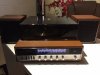
I have a beloved GE P776g am/fm stereo with a ceramic turntable. Not high tech, but I love playing my 60-70's vinyl on it. My first stereo actually. It will no longer turn on. I do not have a repair shop I can go to. I do have a small amount of repair experience, so I opened it and discovered the power supply transformer has an open primary. There are no details on it, so I can only guess outputs, so I can replace it. The secondary outputs have 5 wires = 2 blue wires that are 6V, they powered the dial lamps, 2 red, 1 yellow center tap that powered the amp board. How can the outputs voltage be determined? I don't have a high-quality multimeter or scope to test. I have looked online for schematics or a knowledge source to no avail. I think I could have another transformer rewound, but that would be a costly approach, especially if something I have missed shorts the new one. Anyone with some ideas that can help, would be greatly appreciated, thanks in advance!IMG_1175.JPG IMG_1178.JPG
 
Register to hide this ad
I understand that you're attached to it but it really would be so much more worthwhile to invest in something better. A nice vintage receiver and turntable will not only sound better but they'll be way more reliable.
I think once you get something better you'll forget all about the GE.
 
Most of those lower power stereo systems ran on something like 35 volts or less. I have had many of those power transformers come through my fingers over the years. I don't know the mA rating of you power transformer but I do have several with 36 volts center tapped. The schematic for the higher voltage taps would say 18 - 0 - 18 where the 18 volts are measured between the yellow and either red wires. 36 volts would be both red wires. 0 is the yellow wire or center tap.

I know what you mean about your first stereo. It's a nostalgia thing! I still have my first stereo I got when I was 10. I am now in my 50's.

So just to be certain, with your meter set on ohms, do you get absolutely no continuity between the two black primary wires?

PM me and I'll see if I can dig something up that might work for you.

EDIT: Forgot to mention if you checked to see if it has any fuses.
 
Last edited:
What are the numbers on that transformer? You never know, it might show up in a catalog somewhere.

I will refrain from advising you to replace the stereo because I know what it's like to be attached to things. :thumbsup: Besides it's a good troubleshooting and repair exercise.
 
If it's only the primary that's open, and it's known that the blue-wire secondary is 6V, what I would do is feed 6V AC into the blue secondary and measure the voltage produced on the other secondary. (I don't suppose everyone has a source of 6V AC ready at hand, but the OP seems pretty resourceful.)

I don't have a particularly bright idea for estimating the current capability of the secondaries, but if you can find a replacement transformer that's similar in physical size (or larger, if there's room to spare), it'll probably be just fine.

HTH,

chazix
 
I understand that you're attached to it but it really would be so much more worthwhile to invest in something better. A nice vintage receiver and turntable will not only sound better but they'll be way more reliable.
I think once you get something better you'll forget all about the GE.
Thanks, common sense would be to do that, and I really have been struggling with whether I should just give up. I have Yamaha components for the main system, but when I put Sgt. Pepper, or Jefferson Airplane on the GE, it's a time machine. If it is just the transformer that is broken, it would be a shame to not give it a try. This P776g has been trouble free 45 years.
 
Most of those lower power stereo systems ran on something like 35 volts or less. I have had many of those power transformers come through my fingers over the years. I don't know the mA rating of you power transformer but I do have several with 36 volts center tapped. The schematic for the higher voltage taps would say 18 - 0 - 18 where the 18 volts are measured between the yellow and either red wires. 36 volts would be both red wires. 0 is the yellow wire or center tap.

I know what you mean about your first stereo. It's a nostalgia thing! I still have my first stereo I got when I was 10. I am now in my 50's.

So just to be certain, with your meter set on ohms, do you get absolutely no continuity between the two black primary wires?

PM me and I'll see if I can dig something up that might work for you.

EDIT: Forgot to mention if you checked to see if it has any fuses.

Thanks so much for responding! There are no fuses, and no continuity between primary leads. None of caps are leaking, no burned evidence either. The biggest caps were 35V on the amp board. I got some schematics off ebay but they were for other models, and had no output voltages listed. Is 18-0-18 common? I put the soda can by the transformer for size reference, 2,3, or 4A? It is 2 1/2"H x 2"W x 2 1/2"D. 118G069A on top, had a sticker it was made by GE.
 
What are the numbers on that transformer? You never know, it might show up in a catalog somewhere.

I will refrain from advising you to replace the stereo because I know what it's like to be attached to things. :thumbsup: Besides it's a good troubleshooting and repair exercise.

It has 118G069A inked on top, no other data. It had a sticker that said manufactured by GE on it. Yes, sentimentality is a big driver here. My car is 26 y.o. I just can't part with it LOL.
 
If it's only the primary that's open, and it's known that the blue-wire secondary is 6V, what I would do is feed 6V AC into the blue secondary and measure the voltage produced on the other secondary. (I don't suppose everyone has a source of 6V AC ready at hand, but the OP seems pretty resourceful.)

I don't have a particularly bright idea for estimating the current capability of the secondaries, but if you can find a replacement transformer that's similar in physical size (or larger, if there's room to spare), it'll probably be just fine.

HTH,

chazix

Thanks for the suggestion, maybe I could rustle up a cheap 6v supply on ebay or amazon, to do the test.
 
Not sure I understand what's open; open primary would elicit 0 voltage on secondary(S).

No continuity between the black primary leads. The secondaries are continuous, between the 2 blue, and red-yellow-red. Something either drew more total amps than primary could provide, old age, power surge, or a combination thereof.
 
maybe I could rustle up a cheap 6v supply

I didn't want to get too fancy with the concept at first, but a couple of elaborations:
  • Doesn't need to be exactly 6V fed to the 6V winding. All you really need to know is the ratio between the 6V winding and the other one. You could feed lower voltages to the 6V winding without any worries. I wouldn't go a whole lot higher, but if you happened to have a higher-voltage source, you could reverse the experiment: feed, let's say, up to 40V to the other winding (the two red wires, in particular) and measure what comes out of the 6V winding. Again, once you know the ratio, you can just "do the math".
  • If you have some means to generate a 60Hz sine wave at low level (like a computer with a sound card and I-dunno-what software?), and you have another audio amplifier lying around, you could put those together to produce any voltage you want at the amplifier's speaker outputs. (Well, any voltage within reason - just about any amplifier could output 6V.)
 
Any old power plug-in power supply that puts out AC (most of them are DC, like phone chargers, but some are AC) will work. Who doesn't have a box of old wall-warts in the basement? Or is it just me. :D

Somewhere there might be an old catalog or list of GE transformers online, but it's a crap shoot.
 
Back
Top Bottom