

DiGiTaL4164
New Member
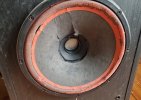
Hello--I am in the process of getting a couple of 12 woofers reconed. The woofers are the original speakers from a set of Cerwin Vega RE-30 speakers that I purchased in 1996. I recently picked up a new Crown XLI1500 power amp. The speakers were used on that amp without issue for about 3 months. They were driven moderately hard--problem is they both had somewhat worn out foam surrounds. I eventually bought a new set of surrounds, but did not get them installed before one of the Vegas blew i,e, torn cone down by the dust cap, and scratchy sounding voice coil. I have not done a recone before, and did not want to spend $200. CAD 0n recone kits, just to bugger it up, and have to start over. I have very low vision, and decided it might be a bit daunting for me. So, I opted to send them out for a pro repair. I sent them to Jon at 'Brew City Audio' who comes across as a genuinely nice guy, and is a long time Cerwin Vega enthusiast. I am thinking some people on here just might be familiar with 'Brew City Audio'.
There is one aspect of the job I am a bit uncertain re parts selection. The recone kit he sells uses 'pressed' cones (paper) and is described as follows: "These cones are pressed rather than pulp, so they are thinner but more dense, and retain the same mass..." Basically, I would like to retain the same sound as the original woofer configuration, although of course any improvements would be welcome. So, I googled ;pressed woofer cones, and found this "
"Pressed woofer cones can produce more distortion at high volumes, while unpressed cones are stiffer and more sensitive: " It also said that pressed cones are more prone to 'breakup". I asked Jon about this, and he felt that the pressed cones were a good choice, but said that he could use regular 'non-pressed' cones if I want. So, I am wondering would going with the pressed cones be a bad choice? Because the repair shop has been repairing Cerwin Vegas for many years, and offers the pressed cones by default, I thought there might be a good reason, but am not sure which way to go for best results. I do like to listen at loud volumes, and am concerned about the statements seen on Google about pressed cones producing more distortion at loud listening levels. The Crown amp is a powerful beast, and I am concerned of any higher likelihood of causing distortion with pressed cones. A little bit re specs:
Cerwin Vega RE30 3 way speakers:
Power handling--250W RMS Peak unknown
Resistance--4 ohms
Sesitivity 97dB
Crown XLI 1500 2 channel pro power amp:
power: 450W/channel into 4/ohms--330W/channel into 8 ohms
I am using a Soundcraft 12FX mixer as a pre-amp--sounds good to my ears. I like the CV RE30s quite a lot, and have had hundreds if not thousands of hours of enjoyable listening since purchased in 1996. Spending the money on a pro repair, I would like to retain the sound I am familiar with, if not improve. With all new parts I am thinking the sound should improve if I make the right call re the parts kit.. Only one speaker was blown, but I am getting both reconed to keep everything compatible, and the second one was looking pretty tired anyways. I did call one other Cerwin Vega repair centre who recommended the non pressed paper cones. Is there anything I am missing here? Which would be the better choice in this case? I am assuming there are different levels of quality re paper cones, and am not sure what the repair shop will be using. I would assume something decent, as the owner is a big CV enthusiast, and seems to take a real passion in the work he does. In the pics it is obvious which speaker is blown--the other has a bad surround, and the cone has a few abrasions. But I figured I might as well get them both done while I'm at it, and will be good to go for many years to come. Thanks for any help in sorting this out.
There is one aspect of the job I am a bit uncertain re parts selection. The recone kit he sells uses 'pressed' cones (paper) and is described as follows: "These cones are pressed rather than pulp, so they are thinner but more dense, and retain the same mass..." Basically, I would like to retain the same sound as the original woofer configuration, although of course any improvements would be welcome. So, I googled ;pressed woofer cones, and found this "
"Pressed woofer cones can produce more distortion at high volumes, while unpressed cones are stiffer and more sensitive: " It also said that pressed cones are more prone to 'breakup". I asked Jon about this, and he felt that the pressed cones were a good choice, but said that he could use regular 'non-pressed' cones if I want. So, I am wondering would going with the pressed cones be a bad choice? Because the repair shop has been repairing Cerwin Vegas for many years, and offers the pressed cones by default, I thought there might be a good reason, but am not sure which way to go for best results. I do like to listen at loud volumes, and am concerned about the statements seen on Google about pressed cones producing more distortion at loud listening levels. The Crown amp is a powerful beast, and I am concerned of any higher likelihood of causing distortion with pressed cones. A little bit re specs:
Cerwin Vega RE30 3 way speakers:
Power handling--250W RMS Peak unknown
Resistance--4 ohms
Sesitivity 97dB
Crown XLI 1500 2 channel pro power amp:
power: 450W/channel into 4/ohms--330W/channel into 8 ohms
I am using a Soundcraft 12FX mixer as a pre-amp--sounds good to my ears. I like the CV RE30s quite a lot, and have had hundreds if not thousands of hours of enjoyable listening since purchased in 1996. Spending the money on a pro repair, I would like to retain the sound I am familiar with, if not improve. With all new parts I am thinking the sound should improve if I make the right call re the parts kit.. Only one speaker was blown, but I am getting both reconed to keep everything compatible, and the second one was looking pretty tired anyways. I did call one other Cerwin Vega repair centre who recommended the non pressed paper cones. Is there anything I am missing here? Which would be the better choice in this case? I am assuming there are different levels of quality re paper cones, and am not sure what the repair shop will be using. I would assume something decent, as the owner is a big CV enthusiast, and seems to take a real passion in the work he does. In the pics it is obvious which speaker is blown--the other has a bad surround, and the cone has a few abrasions. But I figured I might as well get them both done while I'm at it, and will be good to go for many years to come. Thanks for any help in sorting this out.
Attachments

Last edited:

