• The move to the new server is done. There are some software and database maintenance updates in process. This has us passing the hat around to help out. We appreciate any donations. Seriously, even a dollar helps. The payment page may be found here - https://www.audiokarma.org/support.html

Need isolation from a nearby speaker...

drjohnnyfeva

Well-Known Member
I know others must have run into this problem. Seeking some potential solutions from the collective wisdom of AK.

I recently moved a speaker to create a wider field in my office. I usually listen to music from the PC, so the new configuration is better for most of my listening. However, the speaker is now on the same counter where my TT has always lived. They are separated by about 3 feet. I can't move the TT and I don't want to move the speaker back, but, when playing records, the receiver picks up a hum that grows into total distortion playing the TT at even low volume.

I need to isolate both the speaker and the TT. I have the old pitched foam pads under the speaker and the TT has the original feet with just a couple pieces of neoprene mouse pad cut to sit under them. Evidently, this is not enough given the new speaker placement. Somehow these two pieces need to live in harmony.

I don't want to spend a fortune. $150 seems steep for a isolation platform compared to $30 for some other alternative like rubber and cork or other isolation feet. Just wondering if there has been success out there that would save me the time of trial and error and returning Amazon stuff.

Thanks in advance.
 
Register to hide this ad
While playing a record and hearing the hum, try moving just the cables around. Start with the connectors from your turntable and make sure they are not running alongside any power cables (which can definitely result in a hum, like a 60Hz from the mains). If they must intersect with power cables, running them to cross perpendicular to each other is better than parallel in close proximity. Do the same for all the rest of your signal/power cables.

Something changed when you moved the speaker onto that shelf/counter and your solution to the hum/distortion will likely be found in what? Also, when you say "picks up a hum," that is usually more related to the cartridge/turntable signal cabling picking up an electromagnetic field in proximity to it. This does not, however, usually reveal itself in distortion in my experience but rather an annoying hum instead. The distortion you are talking about might indeed be caused by vibration from the speaker causing excitation of the stylus. The best way to solve that problem in your situation might be to build a wall shelf just above your counter for the turntable to sit on, thereby effectively decoupling it from the counter which should/can solve such problems. It's easy to do and most consider it a great solution to such issues.....Let us know how it goes, amigo.....
 
If the speaker and the turntable are on the same piece of furniture, you're almost guaranteed to be creating a feedback loop. If these two things must exist on the same surface, then yes, you'll need ridiculous isolation measures. It's more than an uphill battle. You're gonna have a bad time. If it's a closed (wall mounted) kitchen cabinet, the open space inside is acting like a drum as well, and will transfer into the wall as well so even a shelf may not solve it.

Can you maybe install a shelf for it directly above where the table is now? Or for the speaker?
 
Yeah, it's interesting you both @loudnoises and @Fishead suggest the shelf. I thought of that myself because the counter is, indeed, a kitchen cabinet and largely empty space but for a little storage of records and record cleaning stuff. I have limited space to do a shelf as there are also kitchen uppers above. The dust cover would likely be able to open enough to change records, tho, so this might be the best choice. I imagine a heavy, butcher block type shelf attached to the wall might be best along with something simple like the cork and rubber isolation feet for a little extra protection.

I could feel the vibration from the speaker along the whole counter even with the foam under it. None of the wires behind the TT were moved, but, of course, the speaker wire was then on top of them after the speaker's relocation. I initially considered a speaker shelf, but the speaker is just a little too tall to be placed above the backsplash part of the counter, so that it would be disengaged fro the counter.

I think it will probably be better with a shelf, but the shelf supports will be in contact with the backsplash so it may still carry some vibration. Perhaps some thicker rubber washers where the shelf meets the bracket would diminish it even more.

Any other ideas while I consider the shelf, more to the idea of some kind of isolation on the counter top itself, would be appreciated.
 
I recently moved a speaker .. now on the same counter where my TT has always lived. They are separated by about 3 feet. ... when playing records, the receiver picks up a hum that grows into total distortion playing the TT at even low volume. I need to isolate ....
(see @Fishead post above - 'a hum that grows' has me thinking electro/magnetic interference as well, and not vibration)

If you have vibration concerns, I would continue with your existing efforts (isolation feet, platforms, etc). Not all are expensive, some DIY advice on 'net.
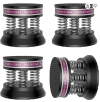
Others here have benefited from $25 spring feet (again, @Fishead ?)
1789913589880.png

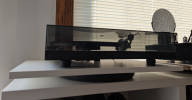
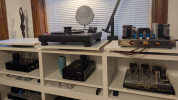
I use bicycle inner tubes under my TTs (see below). Some have made DIY sand pits.
Shelf for the speakers/mount speakers on wall should help. Not the best for hifi, but might work for the office.

1789913492516.png
 

Attachments

  • 1789913555675.png
    1789913555675.png
    418.4 KB · Views: 6
That inner tube is a great solution, just requires another shelf for the turntable though and the degree of inflation is also very important. Too much and you get more transfer of vibration, too little and it touches whatever it's sitting on. @drjohnnyfeva, the wall shelf can literally be just millimeters above the counter, just enough so that it does not touch it, so you should be able to pull that off as well. Those vibration dampers that @mrwood200 shows in his post are the REAL DEAL!!! I use those under my subs and it has done wonders to cut the vibration from the low frequencies down so I don't get the "woofer pumping" that is so often associated with this kind of problem. In fact, I'm wondering if you don't have a bit of both going on because of your description of the problem. Increasing the volume will DEFINITELY increase distortion if your speaker driver is flopping in and out like it has whirling disease!!! Pull the speaker grills and observe what your bass/mid driver is doing when the distortion first appears and what happens when you increase the volume.....if the cone starts to get "nervous" and rapidly moving in and out then you are most likely experiencing what I'm talking about.....you'll get there, just need to do a little more experimenting with things to identify the problem(s) more accurately in order to solve them.
 
Hey! Now that's some engineering I like to see, @mrwood200 !! I have a few of those sitting around, so that is a go with the spring isolators to start. I had those and the cork/rubber feet in the cart and I definitely have some shelf material laying around too.

@Fishead , that's exactly what the cone does. It gets going and then out of control vibration. It does not recover by turning the volume down, it just holds the same hum and seems out of control. I don't know the vocab on it, but it escalates once it starts and then I have to take the needle off and cut the volume completely.
 
Yup, that would be the issue then.....this can be cured if you have a subsonic filter on your preamp/receiver by just engaging it (turn it on) and that should stop it. And, yes, once it starts it can be very persistent although cutting the volume way down usually tames it. It has to do with resonant frequency and there is usually a mismatch between the effective mass of the tone arm and the compliance of your cartridge causing it, but the degree to which the output of the speaker's low frequencies affect this can be minimized by isolating the turntable from the structures (floor, shelf etc.) that the speaker has an interface with. This is why many choose to mount the tt on a wall shelf which typically does an excellent job! In the end, however, you're still left with a compromise unless you can deal with the resonant frequency problem, and that means choosing a cartridge whose compliance will be a good match for the effective mass of your tone arm. There are lots of threads on here that deal with this....just do a search on "woofer flutter" and they should come up. This will provide you with some direction......it's all about the issues peculiar to record playback on a turntable and often things can get complicated.
 
What kind of speakers and what kind of turntable? Does the TT have a dust cover on when you are playing a record?
 
AMIP-2.webp

 
Thanks for that info, @Fishead . The TT is all original, head shell and all. I've only replaced the stylus. I had it opened once when the return wasn't working and may have over tightened the springs on the table, so I'll check that too. It was super "bouncy" within the plinth, so maybe I created the problem myself. That was years ago before moving the speaker. It's Pioneer PL-115D. Not the best, but very worthy for midline tables. I'm going to look up "woofer flutter."

@dankik the TT is the Pioneer listed above and the speakers are Polks. They're about 20 years old. I don't know the model off hand.
 
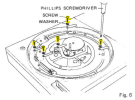
The Pioneer had foam cones inside the springs to help with damping. I will bet yours turned to powder years ago. You can replace with pieces of a foam sponge cut to fit. Also make sure the transport screws are loose, you will have no suspension if that is not the case. Best of luck.
 
Just double checking... you did fully remove these clamping screws?
If the cartridge is the original, check to make sure that the stylus is still there and in good shape. What tracking force are you using?
1789998412283.png
 
Take one or two bath towels folded into about a foot square area to fluff them good then place them under the turntable.
 
Yeah, it's interesting you both @loudnoises and @Fishead suggest the shelf. I thought of that myself because the counter is, indeed, a kitchen cabinet and largely empty space but for a little storage of records and record cleaning stuff. I have limited space to do a shelf as there are also kitchen uppers above. The dust cover would likely be able to open enough to change records, tho, so this might be the best choice. I imagine a heavy, butcher block type shelf attached to the wall might be best along with something simple like the cork and rubber isolation feet for a little extra protection.

I could feel the vibration from the speaker along the whole counter even with the foam under it. None of the wires behind the TT were moved, but, of course, the speaker wire was then on top of them after the speaker's relocation. I initially considered a speaker shelf, but the speaker is just a little too tall to be placed above the backsplash part of the counter, so that it would be disengaged fro the counter.

I think it will probably be better with a shelf, but the shelf supports will be in contact with the backsplash so it may still carry some vibration. Perhaps some thicker rubber washers where the shelf meets the bracket would diminish it even more.

Any other ideas while I consider the shelf, more to the idea of some kind of isolation on the counter top itself, would be appreciated.

I often defer to a shelf because it's really the best solution in almost all cases. Isolating the table from the vibration source is far more productive than trying to eliminate the vibration transfer.

To eliminate the transfer of the vibration energy you need to lean heavily on the physics. You need mass AND you need damping, proportional to the vibration. In the case of a turntable, you've got a device designed to pick up a wide spectrum of vibration.

Years and years ago I got to help build a "table" for making holograms. Vehicles driving past the building were causing too much vibration for the laser. The solution was multiple yards of concrete, sitting on dozens of inner tubes. Tens of thousands of pounds. Worked great, but took up the entire basement.
 
I often defer to a shelf because it's really the best solution in almost all cases.
Yep, we agree and I've seen it work extremely well in, as you say, almost all cases! It's uncanny how a wall, attached to the floor which is the vibration source, can effectively reduce that vibration by so much especially given that, in most cases, that same wall is attached to the floor with either 2X4 or 2X6 wooden studs! But it does work and is often the only thing that you need to do.

I was commenting earlier on tone arm effective mass and the cartridge compliance perhaps being a mismatch but I may have misspoken because, as I reminded myself above, the system was displaying no issues before the movement of the speaker to the same shelf the turntable is on. Still a good thing to keep in mind @drjohnnyfeva for future reference.....as in should you ever decide to try another cartridge with that turntable. If you stick with a cartridge that is of the same compliance or very close as the original one that was on the table from the manufacturer, you should be safe. Compliance is one of the specifications that is given for most cartridges you might wish to consider.

Isn't this fun??? All the mysteries and unknowns about vinyl playback and sometimes you just have to experiment until you arrive in the land of vinyl nirvana! Anyhow, if possible, shoot us a picture of the shelving arrangement you have and we might be able to give you some ideas of how to arrive at a good shelf system if you haven't already thought it out.....have fun, amigo!
 
@mrwood200, that is a seriously attractive arrangement you have there! Very simple, clean and no doubt highly effective! I first heard about the use of the inner tube from a gentleman, Barry Diament, known for his work in speaker isolation amongst other things audio in nature. His ideas of using cups and ball bearings were unique and interesting as well but I have not yet explored that realm, having solved my resonance issues with wall shelves and the spring isolators you pointed to above.

@drjohnnyfeva, you said you had some innertubes lying around, correct? Those might be a good place to start to see if they might not solve the problem without going to much other trouble. It's worth a shot and don't forget to vary the inflation.....you want it to be about as soft as you can get it without it bottoming out, at least that is what Herr Diament recommended to me when I was trying that method. Is that your experience as well, @mrwood200?
 
Yup, that would be the issue then.....
Well Done! Good Troubleshooting!

Is that your experience as well?
I got started using inner tubes for isolation when I lived in an apartment with lively floors.
Not required for me today, and not 100% recommended, but effective & cheap.

1790018041732.png
There are a couple of good threads out there that can offer better insights -
I use 12.5" tubes, adjust pressure for weight (& appearance) to provide desired cushion w/minimal bounce.
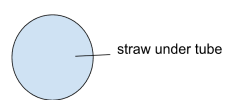
Internet said to put a straw on the bottom to allow any trapped air to escape, so I have straws.
1790019127701.png

It is a bit of a challenge to get your equipment level on a tube, at the right pressure/height, with the top platform in the right position, with the equipment in the right position. The center of gravity of your equipment will help decide placement (e.g., see sl1200 above, offset on platform)
 
Back
Top Bottom