• The move to the new server is done. There are some software and database maintenance updates in process. This has us passing the hat around to help out. We appreciate any donations. Seriously, even a dollar helps. The payment page may be found here - https://www.audiokarma.org/support.html

New Old Stock ferro fluid cooled tweeters

thrillbird

Member
I have a set of d26tg-05-06 out of a pair of Dahlquist M-905 whose ferro fluid is completely gunked up. I recently replaced the tweets with a model that is close (d26tg-35-06). I am continuing to look into exact model replacement. I found a set on an auction site listed as NOS. They appear to be in near mint physical condition.

My question is: Might there be any way to tell the state of the ferro fluid other than the seller's representation?


All guidance is gladly welcomed. I reckon at very least I can look into Regnar for a rebuild?

More background: I replaced the d26tg-05-06 with a set of d26tg-35-06. The originals were totally gunked so although the replacement sound better since they at least work, I want to get as close to original as I can. Below is a comparison of the only spec differences between the two.

d26tg-05-06
Operating power [W] 3.2
Sensitivity [dB] 92
Frequency range [kHz] 3-30
Free air resonance [Hz] 1500

d26tg-35-06
Operating power [W] 4
Sensitivity [dB] 91
Frequency range [kHz] 1.5-30
Free air resonance [Hz] 940

Thank you in advance for your time and efforts..
 
Register to hide this ad
If anything, just clean the stuff out and use them without it. Ferrofluid was added by many manufacturers to help with heat dissipation and returns....kind of like circuit breakers (that go bad), fuses (that blow), etc. I have a set of Speakerlab SK's I'm rebuilding where they came with FF in the Atlas PD5VH and EV T35 tweeters. The current company said to remove it and don't put it back in. They sounded better without. Just my $.02.
 
If you opened up the original tweeters to determine the condition of the ferrofluid you’re half way there to cleaning them up and replacing the ferrofluid. Ferrofluid is cheap and readily available in pre measured amounts. YouTube is your friend, Ebay is your source.
“I want to get as close to original as I can”
Easy enough!
 
Thank you Dobieguy!
Shortly after getting the Dalqs, awesome members here helped me with replacing a broken voice coil. Time for the next step. I appreciate your guidance!

Out of curiosity, I noticed in the specs the original has a range from 3-30 kHz and the xover is spec-ed at 2.5 kHz. Does that indicate that there is a 500 kHz gap?
 
Lessons learned: Ask before spending.

The original tweeters are back in place making tweets..

Thanks Dobieguy and avguytx!

I'm still curious about the xover vs bottom range of the tweeter spec disparity, but my ears are pleased.
I do not know if .8 W operating power, and sensitivity difference of 1 db is audible, but the top highs do seem more apparent. Quite possibly bias confirmation..
 
If anything, just clean the stuff out and use them without it. Ferrofluid was added by many manufacturers to help with heat dissipation and returns....kind of like circuit breakers (that go bad), fuses (that blow), etc. I have a set of Speakerlab SK's I'm rebuilding where they came with FF in the Atlas PD5VH and EV T35 tweeters. The current company said to remove it and don't put it back in. They sounded better without. Just my $.02.
I'm just considering cleaning the ferrofluid from my Speakerlab SK's with EV T350's. I have two pair. Both have T350's. One set has old fluid (1977?) and the other pair has none. The ones with the old fluid sound better but seem muted compared to the ones without fluid. I have both connected to the same preamp but powered with separate power amps so I can balance them or listen to them individually. All the drivers are the same and I was expecting them to sound the same but I was wrong. I did replace the old crossover caps in the ones without fluid (factory built) but not the others (that I built from plans in 1977). The ones I did replace were 50 years old and still measured in spec. Probably didn't make a difference. If the fluid is what makes the one sound so much better than the other, it's worth cleaning out and replacing.

P.S. The company calling themselves "Speakerlab" in Seattle at this time, has nothing to do with the original Speakerlab. Paul, from "The Loudspeaker Store" in Kent owns the patents to all of speakerlabs products and services. He hasn't sued because it wouldn't be worth the cost of litigation.
 

Attachments

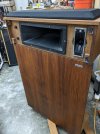
  • PXL_20230630_151523189.jpg
    PXL_20230630_151523189.jpg
    130.8 KB · Views: 5
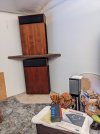
  • PXL_20231123_223634900.jpg
    PXL_20231123_223634900.jpg
    93.7 KB · Views: 5
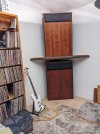
  • PXL_20231123_223623403.jpg
    PXL_20231123_223623403.jpg
    117.5 KB · Views: 5
Last edited:
Lessons learned: Ask before spending.

The original tweeters are back in place making tweets..

Thanks Dobieguy and avguytx!

I'm still curious about the xover vs bottom range of the tweeter spec disparity, but my ears are pleased.
I do not know if .8 W operating power, and sensitivity difference of 1 db is audible, but the top highs do seem more apparent. Quite possibly bias confirmation..
Those frequency ranges are marketing numbers, good question but no need to worry at all.
A simple dome tweeter is a closed box direct radiator and, if well designed like these, will have a
roughly flat passband response with a second order rolloff below the free air resonance.
Someone should figure out how to raise the 940Hz resonance of the newer tweeter to the 1.5K
value of the older tweeter probably by reducing the rear chamber volume.
 
Back
Top Bottom