• The move to the new server is done. There are some software and database maintenance updates in process. This has us passing the hat around to help out. We appreciate any donations. Seriously, even a dollar helps. The payment page may be found here - https://www.audiokarma.org/support.html

New thread on DC offset protection and B&K 200.7

handyguy

Member
Hi,
There are many (inexpensive) aftermarket DC protection boards you can buy to cover you if your amp does not happen to have protection. Youtuber xraytonyb has several videos on them. However, you would need 4 of these boards in this case. There are many different designs for these boards; anyone weigh in on what's the best 'audiophile' design?
Does the 200.7 not have any protection designed into it at all? There is a cheap one near me that I am considering, but the whole blow up my irreplaceable vintage speaker drivers is cautioning my reptile brain from sudden purchases!
 
Last edited:
Register to hide this ad
does your unit not have speaker fuses for each speaker on the rear panel? above the binding posts?
 
Yes, but the factory fuses are 6 amp slow blow, probably not gonna protect from a sudden DC offset when an output transistor blows and goes short.

yeah, you would have to be pushing a good amount of power for a 6a slo blow to blow if dc was presented.

i've been running a b&k 6ch amp with no dc protection for 20 years and even had a mosfet going bad and never damaged any speakers with it, but i doubt that will make you feel any better.:)

i have used those relays that xraytonyb made a video on, they work.
 
yeah, you would have to be pushing a good amount of power for a 6a slo blow to blow if dc was presented.

i've been running a b&k 6ch amp with no dc protection for 20 years and even had a mosfet going bad and never damaged any speakers with it, but i doubt that will make you feel any better.:)

i have used those relays that xraytonyb made a video on, they work.

How/what did you replace the mosfet with? Just replaced the one?
 
How/what did you replace the mosfet with? Just replaced the one?
i bought 6 nos 2sj162 and 6 2sk1058. i only replaced the one 1058 and made sure the problem went away. listened to it for a while then put it away until i can get back around to it.

the pcbs have very delicate traces. double sided with plated thru holes that are very hard to clear. i did not have a desoldering gun at the time. i do now but i have zero time to get to it. it's too low a priority .
 
There are a few different technologies for DC offset protection: Triacs, capacitors, relays (SSD/mechanical). Some say that mechanical relays are subject to total destruction due to arcing upon a DC event.
 
if you scroll down on that link I posted earlier, it shows a melted relay from something, and includes a discussion on using MOSFETs to sub for the mechanical relay.
 
i bought 6 nos 2sj162 and 6 2sk1058. i only replaced the one 1058 and made sure the problem went away. listened to it for a while then put it away until i can get back around to it.

the pcbs have very delicate traces. double sided with plated thru holes that are very hard to clear. i did not have a desoldering gun at the time. i do now but i have zero time to get to it. it's too low a priority .
Thanks for the warning! Any tips on setting the bias and dc offset? I have the so-called service manual, which is just a few incomplete schematics (not even this model named in it), but no text.
 
Thanks for the warning! Any tips on setting the bias and dc offset? I have the so-called service manual, which is just a few incomplete schematics (not even this model named in it), but no text.
dc offset goes as close to 0vdc as possible.

i have never seen a service manual for my amp and the sheet i have for adjusting bias is only for 2 channel amps.

i just measured across emitter resistors as is the norm for setting idle current, i set it for 10mv and watched the scope for crossover distortion at low input and low output at various frequencies and made sure the amp didn't run hot.

that's all i could do. anyone that i talked to that works on b&k amps will only work on 2ch amps, not multi channel amps.
 
Thanks for the tips. Yes, not sure about purchasing. There is one (an s2) going for a $1000 near me in like new shape, but, like you said, they are dodgy amplifiers to get involved with.
 
Thanks for the tips. Yes, not sure about purchasing. There is one (an s2) going for a $1000 near me in like new shape, but, like you said, they are dodgy amplifiers to get involved with.
servicing them is sketchy. i wouldn't call them dodgy. mine has always been reliable and i beat the hell out of it for 15 years before i got a noisy mosfet. i left it on for months at a time, ran it 80% power for 7 hours after work every night. 16 hours a day on the weekends.

i fully abused that amp and it never let me down. i was going to buy a pair of matching monoblocks a few months ago but i got outbid at $1100 and let them go. i should have stayed on them. kinda regret not buying them. i regret selling my 2 ch b&k amp too.

they are good amps and well worth the money but you are gonna wanna service them or learn to service them yourself. there are only a couple places in the usa that will work on them and like i said, they won't work on multi channel amps.

minimal service info out there makes it tough too.

mine is going nowhere. i've recapped it and it can sit on a shelf until it's turn in rotation comes back around.

rated 6x60@8 ohm..measured 115wpc @8 ohm 2 channels driven.

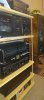
some fisher amps and b& k and merinos 036.jpg
 
The onlu problems we had with B&K were with their 5 an 7 channel AVR's. They really need plenty of air circulation to keep them running properly. The stereo pre-amps and amps never gave any problems. The 200.5 and 200.7 need external cooling though we never had issues with them. But remember I retired in 03 and by 05 I was definitely out of touch when it came to B&K.

When we bi-amped Altec, EV and JBL professional stuff we always installed caps to prevent LF from getting to the drivers if the amp or electronic crossovers croaked. I guess you could install some series caps that are tuned to 25 HZ that would protect the speakers from DC and and yet allow your speakers to reach the lowest frequencies.
 
Last edited:
the only down side to adding a cap to the mix, and exactly how much it matters would also be the topic of endless debate, is the damping factor will reduce as frequency goes down and cap impedance increases. There also is no mechanism to correct for the cap itself. Cap coupled amplifiers usually took their feedback after the output coupling cap.

I guess if you're really up for some amp hacking you could modify the amp to be cap-coupled with feedback taken after the cap. That would prevent DC, and it wouldn't compromise the response of the amp any. Would still have some effect on damping but it would be a lot smaller.
 
Back
Top Bottom