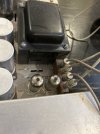
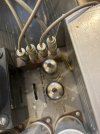
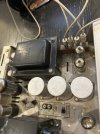
I’ve been reading a lot and researching this group on this amp. Plan on doing most of the upgrades I’ve found people doing. But the amp I got has something different on it that no other has. I’m stilll a beginner in audio but what’s this rca bridge type thing running into the power block? I’ll post a pic,


You are using an out of date browser. It may not display this or other websites correctly.
You should upgrade or use an alternative browser.
You should upgrade or use an alternative browser.
New to me help with H.H Scott LK-72 B
- Thread starter Tronlee
- Start date
-
- Tags
- scott lk 72 tube amp
Register to hide this ad
trainbuffton
Active Member
A breakout box for some purpose.
Without an underside shot of how it's wired we are left to guess.
I'll go first.
I think someone added a pre out/power in jumper like you'd find on a Marantz or similar solid state amplifier
Without an underside shot of how it's wired we are left to guess.
I'll go first.
I think someone added a pre out/power in jumper like you'd find on a Marantz or similar solid state amplifier
trainbuffton
Active Member
I would also add that "upgrades" as reported by members of Audiokarma are often not upgrades.
Get it working as close to as designed as possible, have a listen and then consider weather it needs "upgrades"
My conclusion was that it does not.
It does need electrolytic capacitors...
Get it working as close to as designed as possible, have a listen and then consider weather it needs "upgrades"
My conclusion was that it does not.
It does need electrolytic capacitors...
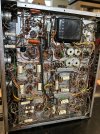
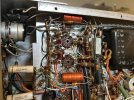
Just opened the underside for the first time still have the ceracaps let me know what else you guys notice thanks, those two larger orange ones seem to stand out that I didn’t notice on others. The add on seems to be on topside?
Attachments
trainbuffton
Active Member
And circumvent the learning process?Also if anyone can post links to what I need to buy that be amazing thanks
Nah...
Clean Can capacitor rebuild. (Scott Owners)
I have been playing with tube gear for a few years, I have been on here stumped more than once. Kind and generous folks have always helped me whenever I had a question. I figured it was time I gave something back. I am going to try and write up a tutorial on how to re-stuff an electrolytic...
audiokarma.org
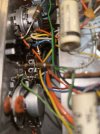
So the wires run from the loudness/volume (power) to the rcas then the yellow/grey run to what looks like between the treble bass pots ?? I’m a noob sorry they seem to connect the bass and treble pots then white blue wire to tie into the 12AX7 tube V-102
Attachments

Last edited:

kvflyer
Super Member
I have worked on many of the HH Scott 222, LK-48, 299 and LK-72 amplifiers. I have found that early models had problems with film or paper capacitors. The American Radionic Ceracaps could be Mylar because by the time the LK-72B and 299D came out, many were still good. But... I have found some which had problems, Dissipation if I remember correctly. Testing them on the capacitor checker (Cornell Dubilier DB-60) showed an eye shadow which was not open nearly as much as a new film capacitor should show. Also, the edges of the eye shadow was fuzzy, not sharp and crisp. They may also show no leakage at the same time.
I have a 345 on the bench right now and the .25µFD Ceracaps are still perfect and have no leakage. It's a judgement call.
Also, I have found those orange electrolytic capacitors to usually still be good, on value with no leakage. Electrolytic filter capacitors may reform and may not reform. Again, it's a crap shoot.
But as for those RCA jacks, who knows what that is all about. All of the Scott tube amplifiers that I have worked on have been restored to stock condition as they came from Maynard, Massachusetts.
I have a 345 on the bench right now and the .25µFD Ceracaps are still perfect and have no leakage. It's a judgement call.
Also, I have found those orange electrolytic capacitors to usually still be good, on value with no leakage. Electrolytic filter capacitors may reform and may not reform. Again, it's a crap shoot.
But as for those RCA jacks, who knows what that is all about. All of the Scott tube amplifiers that I have worked on have been restored to stock condition as they came from Maynard, Massachusetts.

Like kvflyer, I have restored many of the Scott amplifiers and tuners (own a few of those as well). I have replaced many of the Ceracaps, but have never found a bad one (as tested on my Sprague TO-5). They are Mylar (polyester) caps, not paper. If I find any of the molded plastic paper caps (eg. Pyramid), I always replace those. They always test leaky. I have read about a case or two where a Ceracap lead came loose, leaving the cap open, but this is evidently rare. I have not seen that failure mechanism.
The 25 uF 25V sections on one of the cans (cathode bypass cap sections) always test bad and I don't trust the old cans at all. On an early 299B restoration, it seemed to be working fine and the cans checked OK for ESR, but one day I heard cracking and popping and one of the cans was very hot and on the verge of exploding. Since then, I don't trust any of the 50-60-year old cans and replace all of them, either with properly valued CE new caps, F&T or JJ HV caps, or Hayseed Hamfest. For the can in the bias/12V heater circuit, I usually disconnect these and use 100uF/100V axial or radial modern caps installed underneath, leaving the disconnected can in place.
Another must replacement is the selenium rectifier bridge which powers the output tube bias circuit and the four phono and line stage 12AX7 heaters. These go bad gradually and began produce lower and lower voltage and should always be replaced with a new silicon bridge rectifier. These produce a bit higher voltage than the original selenium bridge, and you need to increase the value of the first dropping resistor after the bridge to around 30 ohms (3-5W).
Check also the 18 ohm 1W resistors in the heater/bias circuit string. These often rise in value and need to be replaced.
To me these are the minimum things requiring attention when acquiring a vintage Scott amplifier and it's worth the expense and work--they are excellent amplifiers.
Dave
The 25 uF 25V sections on one of the cans (cathode bypass cap sections) always test bad and I don't trust the old cans at all. On an early 299B restoration, it seemed to be working fine and the cans checked OK for ESR, but one day I heard cracking and popping and one of the cans was very hot and on the verge of exploding. Since then, I don't trust any of the 50-60-year old cans and replace all of them, either with properly valued CE new caps, F&T or JJ HV caps, or Hayseed Hamfest. For the can in the bias/12V heater circuit, I usually disconnect these and use 100uF/100V axial or radial modern caps installed underneath, leaving the disconnected can in place.
Another must replacement is the selenium rectifier bridge which powers the output tube bias circuit and the four phono and line stage 12AX7 heaters. These go bad gradually and began produce lower and lower voltage and should always be replaced with a new silicon bridge rectifier. These produce a bit higher voltage than the original selenium bridge, and you need to increase the value of the first dropping resistor after the bridge to around 30 ohms (3-5W).
Check also the 18 ohm 1W resistors in the heater/bias circuit string. These often rise in value and need to be replaced.
To me these are the minimum things requiring attention when acquiring a vintage Scott amplifier and it's worth the expense and work--they are excellent amplifiers.
Dave

buffstereo
Member
Having had a Scott LK-72B for many years, I found it to be the best 7591 amp that I ever pushed music through. In fact I believe it to be one of the best amps ever!  However in my case, I became too confident because I "know what I am doing!" The amp was upside down and hot when I dropped a screw. Scratch 1 output. Just saying, don't be a dolt like me, and that amp won't let you down!
However in my case, I became too confident because I "know what I am doing!" The amp was upside down and hot when I dropped a screw. Scratch 1 output. Just saying, don't be a dolt like me, and that amp won't let you down!