That gunk on the choke and transformer is because of heat. I would not worry too much about it though just give it plenty of ventilation from now on. I would buy one of those 6GH8A boards for $100 one day in the future if it were mine. Probably be a good idea to check the resistance on the resistors too because of the heat. Take the tubes out when doing so. Heat is the enemy of parts in a amplifier.


You are using an out of date browser. It may not display this or other websites correctly.
You should upgrade or use an alternative browser.
You should upgrade or use an alternative browser.
New to the Dynaco ST70 Community
- Thread starter RDW
- Start date

RDW
Well-Known Member
Thanks for bringing up the preamp. I have been looking into what to do in this regard. I ordered a Fosi P4 just to get it running initially but haven’t opened the package. I also found a newish Marantz ST 4320 amp that has pre out/main in for cheap that is probably a better choice especially for durability (but I did see a YouTube video of someone running lab tests on the Fosi and the performance looked very clean). I can always upgrade in the future. Whatever I do I plan on running line out from my main system so I can use it to select sources so any preamp only needs one line level input.I'll jump in here with a few cents worth. I too found some Dynaco stuff in the 80's and 90's. I hadn't used my 70 in years, many years, and brought it up slowly. Works great! I did the same with my Pas3. Works perfect, sounds super. I even recently found a PAS 3 on the auction site, and it too works good. I've tried a PAT, they are ok, but not a Pas either. I also tried a Douk. NOT impressed. Mine is a small black box with bass, treble, volume and a couple small tubes sticking out of the top. I'd say don't waste your money. I'd used mine on a couple amps I built, and felt they were a little lame., but when I connected my Pas3, they came to life! I think you'll like that st70. yea, some quirks, but mine (both) are factory original, and to me, sound great. I'd check it with the 7199s. May be fine. Looks like you may have the German EL34s. good ones. I'd use 'em. So, just my 2 cents.

Lavane
Lunatic Member
I'm run my ST-70 without a preamp at the moment. Unless you need tone controls it really isn't needed. Most line level sources will drive the amp just fine. I added a volume control to my ST-70 when I built it. I omitted the stereo/mono switch and installed a volume control in its place. An input selector/volume control box will work just fine until you find a tube preamp, unless you need a phono preamp.
You should be able to find an input selector box with a volume control fairly cheap.
You should be able to find an input selector box with a volume control fairly cheap.

My ST-70 is a new build by getdynaco.com that uses the 6U8A tubes versus the original 7199's. I love this amp. Have tried new issue Mullard EL34 and EH6CA7 fat bottles with excellent results. It is currently paired with an Erhard Audio Aretha MKII preamp with the 6SL7 tubes. Love this combination. 
Lavane
Lunatic Member
I really lkke the EH 6CA7's in my VTA ST-70. I'm using Erhard's Ella preamp.My ST-70 is a new build by getdynaco.com that uses the 6U8A tubes versus the original 7199's. I love this amp. Have tried new issue Mullard EL34 and EH6CA7 fat bottles with excellent results. It is currently paired with an Erhard Audio Aretha MKII preamp with the 6SL7 tubes. Love this combination.
I've been using that preqmp for 8 years now.

albusark
Dynaco Fan
A note about PAS 2-3 preamps, you really need to fully clean and test the pots in them. They may seem to be working properly but after working on a lot of them, I've learned that the pots and switches can really limit the audio fidelity. If you notice eq inbalance between channels you might focus on the potentiometers in the eq section, when in reality it's the volume pot having inconsistent continuity. If the loudness or filter switches aren't clean, you might be running with either or both of them on without knowing and it sounds bad. I think a Pas 3 in working order is a fantastic preamp and I really enjoy the shape of the eq network. Shout out to Peter for sending me an ALPS volume pot pcb.

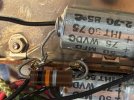

yeah looks like a goof, though practically speaking it probably never showed up as an actual issue. One handy thing about bias supply noise is that it goes in common mode and cancels. Ideally you don't want ripple at the grids, but practically speaking you aren't going to hear it.
date codes on those caps are 1970 I think?
date codes on those caps are 1970 I think?
RDW
Well-Known Member
Ok thanks that’s probably why nobody ever noticed it. I will correct it when I install the new caps.yeah looks like a goof, though practically speaking it probably never showed up as an actual issue. One handy thing about bias supply noise is that it goes in common mode and cancels. Ideally you don't want ripple at the grids, but practically speaking you aren't going to hear it.
date codes on those caps are 1970 I think?
RDW
Well-Known Member
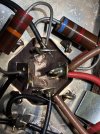 I’m trying to replace the can cap but I don’t want to undo all of the wires at once. The guide am going by said that he clipped the lugs on the cap but what can I use to do that? The only big diagonal cutters that I have are too dull and the newer small cutters can’t do it either. Can you just twist them off of the can? What do people here do?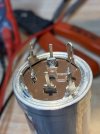


I disconnects all wires and components one at a time as they are pretty well documented in the manual. ReconnectionView attachment 3820639I’m trying to replace the can cap but I don’t want to undo all of the wires at once. The guide am going by said that he clipped the lugs on the cap but what can I use to do that? The only big diagonal cutters that I have are too dull and the newer small cutters can’t do it either. Can you just twist them off of the can? What do people here do?
on the new cap will be according to the manual.
Your cap however has board-style connectors. Here i could use a small ring made of solid wire to hold the connctions
in place before soldering.
Lavane
Lunatic Member
I have a big Weller high watt soldering gun for chassis soldering.
You can solder some ring connectors to those cap leads if its too difficult for you to wrap the wiring and resistor leads to those cap leads. Ive done this in the past when replacing filter caps in SS amps when snap in caps were the only thing I could find to replace the original caps that has multiple wires connecting to them.
I usually remove the plastic sleeve on the ring connectors before soldering to the cap leads. I put a little flux on the lead before slipping the ring connector over the lead and soldering it.
You can solder some ring connectors to those cap leads if its too difficult for you to wrap the wiring and resistor leads to those cap leads. Ive done this in the past when replacing filter caps in SS amps when snap in caps were the only thing I could find to replace the original caps that has multiple wires connecting to them.
I usually remove the plastic sleeve on the ring connectors before soldering to the cap leads. I put a little flux on the lead before slipping the ring connector over the lead and soldering it.
Attachments

if you're trying to cut the old lugs off to solder them to the new can in order to avoid pulling each component, the only way to do that is a good pair of diagonal cutters.
The cleaner way is to remove each component and attach to the new can. Check the resistors for value or just replace them if you don't feel like fighting with it quite so much.
The cleaner way is to remove each component and attach to the new can. Check the resistors for value or just replace them if you don't feel like fighting with it quite so much.
RDW
Well-Known Member
I’ve only done the can cap and bias caps so far (no input board changes yet) but I have it hooked into my main system and it sounds good with the old tubes. I hooked record out of the Marantz into a Fosi P4 preamp for volume control.
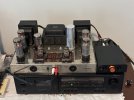
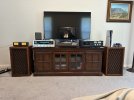
Rocking out to some Steely Dan!
Rocking out to some Steely Dan!
Last edited:

Quadaptor!
Active Member
Cool. If that's a FIIO Warmer iId suggest taking it out of the signal chain as I see no need for a tube buffer on a tube amp. But that's just my opinion. Glad it's coming together!
RDW
Well-Known Member
The black box next to the amp is the preamp. Probably a passive preamp would be ok but that’s what I had and a YouTube lab analysis showed it to be almost completely invisible.Cool. If that's a FIIO Warmer iId suggest taking it out of the signal chain as I see no need for a tube buffer on a tube amp. But that's just my opinion. Glad it's coming together!
Quadaptor!
Active Member
Cool again. Do your research into active preamps and find out what you like. I've been a little critical of the PAS series but I'm not against them. As a matter of fact a well performing PAS 2, 3 or 3X will give you a good representation of what an advanced hifi enthusiast was listening too "back in the day." And it still aint bad. But I still think a more modern design would allow the ST 70 a better opportunity to spread it's wings. Regardless, have fun and please continue to post your experiences!The black box next to the amp is the preamp. Probably a passive preamp would be ok but that’s what I had and a YouTube lab analysis showed it to be almost completely invisible.
RDW
Well-Known Member
So far I have tried the Fosi P4 active preamp and a simple passive preamp (volume control). So far I am liking the P4 mainly because of the multiple inputs and the tone controls (gain is not needed however and is set to minimum). As long as I use my Marantz receiver as the input controller I will never need a full preamp as in a PAS. Sounding great though I will recap the input board at some point (I have the parts waiting) and I also installed a matched quad (it had 3 German tubes and some no name 4th tube). I might also install a 3-prong power cord that I have.