
• The move to the new server is done. There are some software and database maintenance updates in process. This has us passing the hat around to help out. We appreciate any donations. Seriously, even a dollar helps. The payment page may be found here - https://www.audiokarma.org/support.html

Newbie Cleaning Question - Anything I should NOT touch inside?

Vintage74

New Member
I'm about to clean the pots and switches following the AK "Idiot's guide to DeOxit" but before I start is there anything in there i should definitely NOT touch?

Either do to risk of electrical shock or just because it could cause some damage or it's not worth the trouble?

I did a search on AK and did find some posts on discharging the caps:

"Make sure that caps are discharged. If you don't know how to discharge the main filter caps, I would suggest leaving the unit unplugged for a couple days before working inside it. Most units would discharge quicker than that, but some may not."

So if I just unplug it for a couple days all should be ok?

I'm assuming the larger black ones (see attached) are the power supply capacitors and could have a risk of shock?

Will those also discharge if unplugged a few days?

I just want to make sure I don't mess anything up or shock myself!

Mark
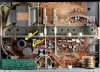
ca-610-inside.jpg
 
Register to hide this ad
yes, yes and yes are the answers to your questions about the caps. Each of those 2 you have highlighted in your pic have 2 contacts on the other side of the circuit board which could stay charged for some time after switching/unplugging the unit.

Please read up on electrical safety tips also before attempting any repair.
 
I'm assuming the larger black ones (see attached) are the power supply capacitors and could have a risk of shock?

Will those also discharge if unplugged a few days?

I just want to make sure I don't mess anything up or shock myself!
If you have a multimeter. You can measure the DC voltage across each of the main capacitors to verify they have bled down the stored charge.
 
Hi,

It's a Yamaha Ca-610 II. My first ever vintage amp and first time ever opening up a piece of stereo electronics.

I just picked up a multimeter to test DC output to the speakers so I'll check caps with that too.

So for spaying DeOxit and dusting things off on the top of the circuit board would I be pretty safe without discharging caps?

Just don't touch anything under the board?

Any links to "safety" threads on AK? I did a search but didn't see anything specific to cleaning and repair?

Mark
 
Last edited:
There are these two slide switches that usually really need to be removed,disassembled and cleaned then reassembled and re-installed. They always are pretty badly tarnished.ca-610-inside.jpg
They will look just as bad as this one.
index.php


After proper cleaning

index.php


https://audiokarma.org/forums/index.php?threads/real-dirty-pictures.244784/
 
Last edited:
So for spaying DeOxit and dusting things off on the top of the circuit board would I be pretty safe with discharging caps?
The easiest place to measure the the capacitors charge is the metal cases of the 4 output transistors. Mounted on the backside of that aluminum heatsink thats dividing the front half and rear half of the unit.

So to answer your question. The capacitors charge potential is present on the top side as well as the bottom side.
 
Usually after it is turned off and unplugged, the capacitors will usually drain down quite quickly but if you are unsure, do what avionic recommends with a meter. If you are worried about a little shock, then yeah, use a little common sense and if there is any charge left, it certainly won't kill you. What are those like 50, 60, 70 volt capacitors? It will say on the sides but will be no where near the full voltage rating when unplugged.
 
Ahh... I think I'd be ok with a "little shock" but I'll do my best to avoid that... I was thinking it would be more of a "Holy crap" sort of shock!

Avionic - Wow... 49,000 posts!

Looks like you are a Yamaha guy so I'd certainly like to hear anything you have to say on cleaning up the amp. I'd love to get it as close to factory fresh if I could just to say "I did it!"

I know I've got a lot to learn.

The REC OUT switch is currently causing static / crackle in the left channel only with even a slight touch of the switch. Don't even need to turn it to get the crackle.

I checked your link and while it looks to be quite a task I'm up for the challenge!

Question on the output transistors:

When you say "measure the capacitors charge in the metal cases of the 4 output transistors" do you mean touch both the multimeter probes to the outside of one of the cases?

Not the contacts on the front side of the heatsink but the cases on the backside of the heatsink?

Mark
 
And it's not only the risk for shock that is a personal danger, but shorting the stored energy to parts of the circuit can cause component damage. Unplug the unit, turn on the switch, and way several hours. Then measure the DC voltage as described above.
 
Usually after it is turned off and unplugged, the capacitors will usually drain down quite quickly but if you are unsure, do what avionic recommends with a meter. If you are worried about a little shock, then yeah, use a little common sense and if there is any charge left, it certainly won't kill you. What are those like 50, 60, 70 volt capacitors? It will say on the sides but will be no where near the full voltage rating when unplugged.
10,000µf /50 volt caps with actual voltage around 42-43 vdc.
 
When you say "measure the capacitors charge in the metal cases of the 4 output transistors" do you mean touch both the multimeter probes to the outside of one of the cases?
Fasten your black test lead to the metal chassis ( ground reference). With the red probe, touch the output transistors metal case(collector).One at a time. Fully charged should be in the +/- 42.5vdc ballpark.
 
Last edited:
Back
Top Bottom