• The move to the new server is done. There are some software and database maintenance updates in process. This has us passing the hat around to help out. We appreciate any donations. Seriously, even a dollar helps. The payment page may be found here - https://www.audiokarma.org/support.html

No more subwoofer flutter! KAB RF1. This device really works.

Some points...
1. I have nothing against subsonic filters. However...
2. Turntable rumble has components that are well above 20 Hz.
3. You still need to be careful about cartridge-arm resonances for physical reasons - dancing tonearms lower tracking ability, and your phono preamp could be overloaded even before its output is filtered.
4. There are good reasons for letting L & R speakers run full range, even with a sub. There are also good reasons not to, of course.
5. Concerns about overloading a power amplifier are valid, but only at higher volumes.
 
Hey sqlsavior and fellow-New Mexican!
1. I don't either which is why I'm going to get one and am trying to find out if the simple high pass unit offered by HL is sufficient.
2. Yes, I believe that is correct as well but it's the really low, below 20hz frequencies that play most badly in my system and are somehow being generated in a way other than turntable rumble. I believe the lows find their way back to my cartridge in a kind of feedback loop, suggesting floors or other construction related issues that I have tamed about as well as I can, using a wall shelf helped a great deal but when the water cooler comes on this summer there will still be a certain amount of that really low frequency stuff that the cooler somehow generates and sends out through the framework of the house. I will be working on the cooler itself to attempt a remedy, going to try to de-couple it as much as possible from the framing but not sure how this will be best done. Before the wall shelf, even footfalls were causing the woofers to pump pretty dramatically.
3. Point well-taken, which is why I have held off ordering the AT ART 9 due to apparent mismatch with my arm. I need something with a compliance of right at 10.
4. I do, and have tried both ways and my L&R really add tremendously to the soundstage when run full range.
5. Yes, and I usually listen at an average of about 80-83dB which is pretty loud but not damaging my ears......not that I can tell although if you ask my wife, she may have a different opinion......I tell her it is selective-listening, which gets me into even more trouble but I enjoy humor......so does she, luckily!

Thanks for the comments. If you ever get up here to Farmington, give me a shout (PM, that is).
 
With all due respect Thomas, that isn´t how it works. If You state that all records have bass summed, it needs some proof.

If you read carefully, I did not state that.

Here is <100 Hz of Fletwood Macs Monday morning:

Sk%C3%A4rmavbild%202019-03-02%20kl.%2016.01.17.png
Sk%C3%A4rmavbild%202019-03-11%20kl.%2019.38.31.png
 
Very interesting conversation. Really appreciate the info. When I said, "I don't get the impression that KAB is that kind of company..." regarding marketing hype, I was referring partially to their ancient web design which appears to have been done in the mid 90's using raw html and perhaps a 7th grader.

There were a few things that drew me toward the KAB subsonic filter. The WIMA caps, gold teflon RCA's, all steel construction, and being made in USA are very attractive features to me. I have lots of U.S. made components in my recording studio like Coleman Audio switchers, Switchcraft junction boxes, Pro-Co cables (Neutrik), Furman Power Conditioners and various mic preamps. They just work and I never have to think about them. Like the KAB, they utilize solid steel boxes, WIMA caps, Switchcraft switches, CTS pots etc. That's the stuff I've learned to trust, and they are the kind of components that I look for in an electronic product.

Those little in-line RCA plugs with built in filters didn't inspire confidence,

When I first set up my new Sutherland phono pre, my REL subwoofer and my main LR speakers were flapping like crazy even on the run-in and run-out grooves where there is very little audible sound.

My first instinct was to redo my turntable setup from scratch since it was a month old and things had probably shifted during the break-in cycle. Once I had the tonearm adjusted, things settled down considerably, but I still felt I was playing with fire, especially with the REL sub.

RELs are extremely fast, taut, efficient, and above all musical, especially the version that I have which is geared towards audio rather than home theater. I certainly didn't want to blow out the voice coil; nor did I want the sub to have to work harder than it needed to by feeding it a massive amount of energy that was not part of the music.

Everything I read related to the KAB RF1 indicated that it was a well-built product that did exactly what it claimed. In my world, $179 is a small price to pay for that.


By the way, an aside, if you will. I laughed out loud when I read this review of Harrison Audio 30 Hz rumble/subsonic filter:

2.0 out of 5 stars didnt work for me
June 5, 2018
Verified Purchase
honestly, i dont hear any difference with or without these
 
Last edited:
Everything I read related to the KAB RF1 indicated that it was a well-built product that did exactly what it claimed. In my world, $179 is a small price to pay for that.

I don't doubt that the KAB unit is a quality product, and well-worth the $179. I've never really had any major subsonic issues (with the exception of a couple badly warped records and some feedback issues at really high volumes), so I never really investigated into filters before. I stumbled across the HL filters while helping a buddy set up a car system, and figured for $40, what the hell, I'll give one of these a shot at home--what can it hurt, and it's only $40--I spend more than that on a mediocre bottle of bourbon anyways.

I was actually surprised at how well it worked, and how effectively it addressed "issues" that I wasn't really even aware of. So I bought two more for my other two TT rigs.

Maybe, one of these days, I'll spring for one of the KAB units and give it a shot, as well. On my main TT rig, I've got over $1K invested in the cart and the same for the phono pre, so $170 is nothing in comparison.

BTW--at the time of my initial posting, I had no idea what the price of the KAB unit even was, so it wasn't a matter of me just "cheaping out" and going with the HL filter. If I hadn't stumbled upon the HL first, and had found the KAB instead, I'd have probably just bought it and never thought twice about it.
 
There is another way to get a "filter" which I use. I have a HT amp and feed the LF part via the HT amps two sub outputs to stereo amp and then to the two subwoofers (playing < 80 Hz). Since both outputs are in mono the out of phase signal is cancelled. So neither the sub amp nor the subs get any signals caused by record warps.
 
I I stumbled across the HL filters while helping a buddy set up a car system, and figured for $40, what the hell, I'll give one of these a shot at home--what can it hurt, and it's only $40--I spend more than that on a mediocre bottle of bourbon anyways.

I was actually surprised at how well it worked, and how effectively it addressed "issues" that I wasn't really even aware of. So I bought two more for my other two TT rigs.

Maybe, one of these days, I'll spring for one of the KAB units and give it a shot, as well. On my main TT rig, I've got over $1K invested in the cart and the same for the phono pre, so $170 is nothing in comparison.

No need if those little plug filters work for you. HL does have an excellent reputation as far as I can tell from the car audio folks. I think that what you did was extremely sensible.

What I observed in my REL in terms of flutter was pretty extreme. I figured that I had better no cheap out on the filter, but I probably would have done exactly the same thing you did if it was an intermittent, less severe situation.
 
There is another way to get a "filter" which I use. I have a HT amp and feed the LF part via the HT amps two sub outputs to stereo amp and then to the two subwoofers (playing < 80 Hz). Since both outputs are in mono the out of phase signal is cancelled. So neither the sub amp nor the subs get any signals caused by record warps.
I had to draw a mental diagram to be able to picture what you described. That's pretty creative!
 
Never heard of what KAB is doing with the cancellation and such, seems a bit over complicated for the small task, but I could be wrong on this and it's a great thing that I just haven't experienced.

As far as I know, most of us are using simple HP filters built into phono stages with or without an activation, or with similar filters within our preamps. These simple filters works, don't really know if the additional processing that KAB is doing is really beneficial or detrimental, but either way that must be the reason they are high priced for such a simple filter.

Warped records alone can produce the large speaker movements alone, assuming your pre/amp/speakers are all capable of passing this along.

Now HP filters set higher than 20 hz are another matter, and are typically used to prevent speaker bottoming out in systems where this is a risk. Most pro amps have HP filters built in that you can use, specifically for this purpose. I have this situation today, and use the filter in my active crossover, set at 25 Hz (non-adjustable). It helps prevent driver bottoming out when things get a bit out of hand, but also doubles as a TT rumble filter. I'd like to go back to using the 15Hz HP filter in my Yamaha preamp someday, but this will require additional drives to offset the chance of this occurring, or I will have to mature more!
 
3. Point well-taken, which is why I have held off ordering the AT ART 9 due to apparent mismatch with my arm. I need something with a compliance of right at 10.

Good call. I have the Art 9, and with a somewhat heavy arm (Victor 7045) it sounded somewhat blase. With a lighter tonearm (Grace 707), I'm enamored with it.
 
Just a note - if you spend some time talking to Kevin at KAB you'll quickly learn to appreciate that he is quite gifted at elegantly and simply solving sonic issues in a way that is both cost effective and, more importantly, non-intrusive.

His website has not been overhauled since I started dealing with him well over a decade ago, I can see where he'd see that as a waste of resources. He's a no-BS kind of guy who has actively talked me OUT of buying things from him in favor of a simpler and less expensive solution. Of all the people in the industry I have interacted with over the last several decades, Kevin is the one I honestly trust the most.

I've used the RF-1, although it's not necessary in my current system, and it is the most transparent sub-sonic/rumble filter I have ever used. I have always been able to hear the impacts of simple HP filters...
 
Never heard of what KAB is doing with the cancellation and such, seems a bit over complicated for the small task...
I've heard of it being done this way before. In fact, it has a long history as far as I'm aware, but has somehow got lost since vinyl became "obsolete" and then miraculously rediscovered.
The graphics on this page might help to explain what's going on:
https://www.vinylrecorder.com/stereo.html

The wanted signals are recorded at 45 degrees to the record surface and the relative phase of the two channels is such that purely vertical motion of the stylus will produce L/R signals which will cancel when summed.
 
Just a note - if you spend some time talking to Kevin at KAB you'll quickly learn to appreciate that he is quite gifted at elegantly and simply solving sonic issues in a way that is both cost effective and, more importantly, non-intrusive.

His website has not been overhauled since I started dealing with him well over a decade ago, I can see where he'd see that as a waste of resources. He's a no-BS kind of guy who has actively talked me OUT of buying things from him in favor of a simpler and less expensive solution. Of all the people in the industry I have interacted with over the last several decades, Kevin is the one I honestly trust the most....

My experience, as well. He's honest to his own detriment (financially). He's said things like, "You might be able to hear an improvement," when inquiring about one of his products. Who else would sell a tonearm end cap for $4.95? I'm sure the simple device costs him even less, but many merchants would call it a poly-something-or-other and charge 5 times that.
 
Just a note - if you spend some time talking to Kevin at KAB you'll quickly learn to appreciate that he is quite gifted at elegantly and simply solving sonic issues in a way that is both cost effective and, more importantly, non-intrusive.

His website has not been overhauled since I started dealing with him well over a decade ago, I can see where he'd see that as a waste of resources. He's a no-BS kind of guy who has actively talked me OUT of buying things from him in favor of a simpler and less expensive solution. Of all the people in the industry I have interacted with over the last several decades, Kevin is the one I honestly trust the most.

I've used the RF-1, although it's not necessary in my current system, and it is the most transparent sub-sonic/rumble filter I have ever used. I have always been able to hear the impacts of simple HP filters...

I've heard of it being done this way before. In fact, it has a long history as far as I'm aware, but has somehow got lost since vinyl became "obsolete" and then miraculously rediscovered.
The graphics on this page might help to explain what's going on:
https://www.vinylrecorder.com/stereo.html

The wanted signals are recorded at 45 degrees to the record surface and the relative phase of the two channels is such that purely vertical motion of the stylus will produce L/R signals which will cancel when summed.

Thanks for the information. Like I already stated a couple of times, the device works and it's incredibly well built.

As far as sound quality is concerned, I was not able to safely run my vinyl system with the new Sutherland preamp in place at at any volume for fear of bottoming out not only my sub, but the mid/bass drivers on my BW 705 S2.


Even though my speakers can't reproduce audible sound at 9Hz, they are still being fed the signal, and it packs a lot of energy. Is it enough to damage a modern speaker? From what I witnessed the answer is yes. But even if it's not enough to damage the speakers, it's still robbing the subwoofer of its power, and low frequency power is something that I can't afford to compromise if I want clean sounding vinyl.
 
Last edited:
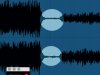
This screen cap really tells the story. Before I installed the KAB, I captured some albums using my home studio gear (Universal Audio Apollo x8--->Pro Tools 2018). You can clearly see the subsonic information between Side 1 and Side 2 in the waveform (highlighted). I edited the two sides together to make a continuous waveform. If you played this clip back, you would hear just a few little pops, but for the most part, this signal is below the threshold that my gear and my ears are able to hear. But my subwoofer would be trying really hard to reproduce this signal well below it's range. That cannot be good for either the amp or the drivers.

wave.jpg

Interesting side note--sharp eyed viewers will immediately notice that there is a potential problem somewhere in my signal chain. There is clearly a gain mismatch between the left and right channels. Is it the recording or something in my setup? Well, it's easy to determine with a decent vinyl setup record that has stereo signals at various frequencies and stereo frequency sweeps. Just capture them on your computer and examine the difference in amplitude between the left and right speakers.

In my case, there was, indeed, a mismatch and the culprit was azimuth. A fiddly procedure on my VPI (I'm getting the hang of it though), adjusting the azimuth on my tonearm/cartridge evened out the waveforms of the test signals.

Careful though. Your digital audio interface may not be very precisely calibrated. In my case, I can send test signals at various frequencies from an Ampex Tape Recorder (ATR 102) plugin in Pro Tools and loop the test signal back into Pro Tools making very precise adjustments between the left and right channels. Once adjusted, I know that the signal entering my computer is perfectly matched, left and right.

I've highlighted the controls on this amazing Universal Audio active plugin that allow me to calibrate my system for capturing audio (among many other uses for this plugin!):

ampex.jpg

Once set up, I can use visual waveform information from a vinyl setup record to check my azimuth. It's scientifically untested, but I think my logic works as well as a Fozgometer.
 
The KAB is an active filter. The HL is passive and will be affected by the impedance of the input. This can be 100k in a tube amp and is not standardized in solid state equipment. So results may vary. Also, sealed subs (woofers) do not suffer problems with subsonic signals. The air in the enclosure limits the excursion of the cone, raising the impedance, which limits the power the amp can deliver. So no wasted power unless it's a current source amplifier. If so, nevermind (most amps are voltage amplifiers.)
 
The KAB is an active filter. The HL is passive and will be affected by the impedance of the input. This can be 100k in a tube amp and is not standardized in solid state equipment. So results may vary. Also, sealed subs (woofers) do not suffer problems with subsonic signals. The air in the enclosure limits the excursion of the cone, raising the impedance, which limits the power the amp can deliver. So no wasted power unless it's a current source amplifier. If so, nevermind (most amps are voltage amplifiers.)

My REL T7/i is sealed with a downward firing passive radiator and a side firing active driver. It was very animated with subsonic signals from my record player before I installed the KAB, so I'm a bit confused by your comments.

It looked like a trampoline when I played a record. I would think that all of that unnecessary movement would interfere with the audible portion of the audio signal. My REL is normally very fast and controlled in its movements with very little, if any, bloat. The attack and decay are exceptionally lifelike and punchy rather than slow and boomy like other subs I've owned. I really don't want subsonic info smearing the sound of Getty Lee's bass lines.
 
Last edited:
The most important button on my long departed Technics SU-7700 amp was the 32hz subsonic filter that only worked on the phono inputs.
 
My REL T7/i is sealed with a downward firing passive radiator and a side firing active driver. It was very animated with subsonic signals from my record player before I installed the KAB, so I'm a bit confused by your comments.
In a ported speaker the driver is well damped at resonance but below resonance the box acts as if it was just open, so the air in the box does nothing to damp cone movement. In a sealed box the internal air damps cone movement all the way down to DC, so there's usually less of a problem with the cone flapping about. However, dependant on all the other parameters, you can still get a lot of cone movement from subsonic frequencies even in a sealed box - it's just less likely.
 
Last edited:
In a ported speaker the driver is well damped at resonance but below resonance the box acts as it was just open, so the air in the box does nothing to damp cone movement. In a sealed box the internal air damps cone movement all the way down to DC, so there's usually less of a problem with the cone flapping about. However, dependant on all the other parameters, you can still get a lot of cone movement from subsonic frequencies even in a sealed box - it's just less likely.

Thanks. I appreciate the info and I seriously considered a Rothwell preamp, but it seems like I had trouble finding one that had enough gain along with a 47Kohm setting for my low output Grado Statement 2. Maybe I missed something...I do that a lot.
 
Back
Top Bottom