• The move to the new server is done. There are some software and database maintenance updates in process. This has us passing the hat around to help out. We appreciate any donations. Seriously, even a dollar helps. The payment page may be found here - https://www.audiokarma.org/support.html

Nobsound Tube Preamp

FWIW I had this preamp on order, but after watching this video, I canceled the order.
You could order it from Amazon and have a listen. You can always return it. Make sure to replace the 12au7s with good tubes. The stock 12au7s seems to be the culprit in making this preamp sound crappy. Right now, I have nos 12au7s with stock 12ax7s and it's sounding more detailed and opened than my NADs.
 
I'm hunting right now for some good but affordable 5751s. Any recommendations? Btw, is this transformer ok to turn down the voltage to 110v? Thanks again.
Yinleader 500W Voltage Transformer Power Converter(220V to 110V, 110V to 220V) Step Up/Down Converter 110/120 Volt - 220/240 Volt https://www.amazon.com/dp/B07PS3NKWS/ref=cm_sw_r_apan_i_9TJAYNNY9RRJHYF80G1X
No, that unit would be used for running devices made for standard American voltages in countries where the nominal wall voltage is 220v and vice versa.

There are various devices that reduce the wall voltage but not all of them actually regulate it to a stable voltage, even if they're sold as "voltage regulators". Some, when set to their "110v" setting can actually put out voltages that are over 110v. This might still result in heater voltages that are on the high side.

The cheapest way to get the heater voltages in line is to add some low value resistors. You would need to measure the heater voltages with the unit plugged into your wall first, and also measure the actual wall voltage. The wall voltage will vary a bit but if you measure it several times a day for a few days you can get an idea of how high it can go. Then figure out the value of the resistors you need from there.

When I build things I set my variac so that I have 122v coming into the unit and I use whatever resistor values are needed to get the heater voltages right with that input voltage, which is typically what I have coming from the wall.

I've never heard a 5751 that I didn't like but they've all been old production American tubes. I believe there are some new production 5751s but I have no idea how good they are. And, given the current tube supply situation, who knows how affordable they are even if you can find them.
Make sure to replace the 12au7s with good tubes. The stock 12au7s seems to be the culprit in making this preamp sound crappy. Right now, I have nos 12au7s with stock 12ax7s and it's sounding more detailed and opened than my NADs.
The 12AU7s, as used in that preamp, are cathode followers and I would think that they have much less effect on the sound than the 12AX7s. However, based on the results of that shootout, this preamp doesn't really have any "tube sound" worth mentioning. So, to me, it doesn't make much sense to spend money on tube rolling in a preamp that doesn't exhibit any "tube sound". It may be an improvement over your SS preamps but that's not saying much.

I think @CraigVMN did the smart thing by cancelling his order. If you want to try a Chinese tube preamp, why not try the one that won Stephe's shootout? Not only does it sound better, it's a fraction of the price of the Nobsound.

 
At first, I was also thinking that it's the 12ax7s that are really the culprit to the harsh highs but after much tube shuffling, it was actually the 12au7s that needs replacing.

The most concerning thing for me about the winner of the preamp shootout, the 6sn7, is the hum and the high THD it has. Those two things should have made it the loser preamp. Also that amp only has one set of RCA inputs unlike the Nobsound which has 4 inputs.
 
At first, I was also thinking that it's the 12ax7s that are really the culprit to the harsh highs but after much tube shuffling, it was actually the 12au7s that needs replacing.

The most concerning thing for me about the winner of the preamp shootout, the 6sn7, is the hum and the high THD it has. Those two things should have made it the loser preamp. Also that amp only has one set of RCA inputs unlike the Nobsound which has 4 inputs.
Well, I haven't heard any of the units she reviewed and I doubt I ever will since I'm into DIY and built my own.

https://www.audiokarma.org/forums/index.php?threads/1626-preamp-build.931276/

Perhaps @StepheK will weigh in on your concerns about the unit that she declared the winner. But I can't imagine that she would have been so enthusiastic about it if the hum or THD were serious issues.

I know some people pay a lot of attention to specs like THD but I recall reading a study where they did a blind test to see how high the distortion needed to be before it became audible. I don't recall the exact numbers but it had to be quite high, much higher than the level found in most equipment. So, while the differences between two units are certainly measurable, you likely won't notice it in normal use.

As I recall, she thought the hum might be easily solved by using twisted wires for the heaters or something similar.

As for the number of inputs, there are ways around that. I have several little switch boxes that I've found at thrift stores for $5 or less that work fine. I'm sure there are new ones available too.

I would tend to agree with Stephe that most people who buy tube preamps, especially for use with SS and Class D amps, are hoping to add some "tube sound" and, according to her, this unit was lacking in that regard. Everyone has their own priorities, though, so if you're finding that the Nobsound meets your needs, great.

Still, it has issues which need to be addressed. Almost all the inexpensive Chinese gear uses power transformers that are designed to be run from a wall voltage of 110v so they all have heater voltage problems as a result.
 
Yup, the main issue left now for the Nobsound preamp are the high voltage on the heaters. Almost all Chinese gear are running on 110v. Crazy! I'll need a buck transformer I guess.

Btw, I read on the 12ax7 and 12au7 spec sheets that this tubes can handle up to 12.6v on the heaters. Wouldn't 7.1v be no problem for these tubes? Thanks again for your input.
 
IF it's wired for 12v. The 12AX7 can be wired either for 6.3v, or 12v. Depending on if you jump two pins or not. If the socket is wired for 6v, you don't want anything more than 6.9v at the most.
 
Hello I own one of these. Are these safety or tube life issues you’re talking about?
I guess it would depend on just how high the voltages are but, generally, it's more of a tube life issue.

When you run a tube's heaters more than 5% over spec their life expectancy drops very quickly. For a 6.3v heater, that means you should stay under 6.6v. Yeah, the data sheets will tell you that the absolute limit is 10% but you will go through tubes very quickly at that voltage. Best to run them as close to 6.3v as possible or just slightly under, especially since there seems to be at least some shortage of tubes and some dealers are asking crazy prices. I saw a new production JJ 12AX7, which are not even produced in Russia, listed for $150 on eBay. That is totally insane. Even half that it nuts.

Of course, all the other voltages will be high too which may or may not cause an issue. Where I've seen it cause problems it's not that the tube is being run too hot but that these inexpensive Chinese products sometimes use resistors whose wattage ratings are too low.

I recall seeing an amp that had a resistor burn up as a result. It was a 1w resistor and, when run with the wall voltage of 110v, it was dissipating something around .8w. When run on a wall voltage of 120+ volts, it burned up. Good engineering practice is to de-rate resistors by a factor of 3x, so a resistor that is dissipating .8w should be rated for 3w, maybe 2w as a bare minimum. When I build things I prefer to de-rate them by 5x when possible.
 
O
I guess it would depend on just how high the voltages are but, generally, it's more of a tube life issue.

When you run a tube's heaters more than 5% over spec their life expectancy drops very quickly. For a 6.3v heater, that means you should stay under 6.6v. Yeah, the data sheets will tell you that the absolute limit is 10% but you will go through tubes very quickly at that voltage. Best to run them as close to 6.3v as possible or just slightly under, especially since there seems to be at least some shortage of tubes and some dealers are asking crazy prices. I saw a new production JJ 12AX7, which are not even produced in Russia, listed for $150 on eBay. That is totally insane. Even half that it nuts.

Of course, all the other voltages will be high too which may or may not cause an issue. Where I've seen it cause problems it's not that the tube is being run too hot but that these inexpensive Chinese products sometimes use resistors whose wattage ratings are too low.

I recall seeing an amp that had a resistor burn up as a result. It was a 1w resistor and, when run with the wall voltage of 110v, it was dissipating something around .8w. When run on a wall voltage of 120+ volts, it burned up. Good engineering practice is to de-rate resistors by a factor of 3x, so a resistor that is dissipating .8w should be rated for 3w, maybe 2w as a bare minimum. When I build things I prefer to de-rate them by 5x when possible.
Ok thanks. But considering how long preamp tubes usually last is this an issue that’s something to be concerned about in the short term? I’ve been using the preamp for almost two years and everything seems fine.
 
O

Ok thanks. But considering how long preamp tubes usually last is this an issue that’s something to be concerned about in the short term? I’ve been using the preamp for almost two years and everything seems fine.
Well, they're not going to simply go "poof" and blow up. But I would suggest that you at least measure the heater voltage so you know what it is. There are various ways to deal with it if it's too high.

When heaters are run too hot the emission of electrons from the cathode drops faster than normal. A basic tube tester measures emissions and, over time, the tube will test weaker and weaker. The higher the heater voltage is, the faster the emissions fall off.
 
Yup, the main issue left now for the Nobsound preamp are the high voltage on the heaters. Almost all Chinese gear are running on 110v. Crazy! I'll need a buck transformer I guess.

Btw, I read on the 12ax7 and 12au7 spec sheets that this tubes can handle up to 12.6v on the heaters. Wouldn't 7.1v be no problem for these tubes? Thanks again for your input.

Prolly those heaters are wired in parallel. So the each heater of the duo-triode is seeing 7.1VAC times 2 = 14.2VAC. You need to fix this. Maybe, a 120 to 110 voltage step-down converter?

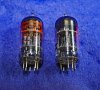
As for 5751. I do not like the new issues. Nothing beats NOS 5751. But, they are $$$. Triple-mica, mil spec GE, RCA, and Sylvania are very good. My all time favorite is the Raytheon 5751 windmill getter. Under the correct electrical conditions, good testing 5751 tubes last forever.


Raytheon 5751 windmil (small).jpg
 
I read on the 12ax7 and 12au7 spec sheets that this tubes can handle up to 12.6v on the heaters. Wouldn't 7.1v be no problem for these tubes? Thanks again for your input.
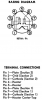
Just to clarify, if you're not familiar with how the heaters are wired . . . The tubes used in this (12AX7, 12AU7 and others in the 12A*7 series, including the 5751) have heaters that can be wired in either parallel or series.

Here's a pin diagram. As with all pin diagrams, this is the view from the bottom of the socket.

12A*7 Diagram.png

In almost all cases they're wired in parallel, which is run off of a 6.3v transformer winding. In parallel, pins 4 and 5 are connected and one of the heater wires connects to them, the other heater wire connects to Pin 9, which is the center tap of the heater. So each half of the heater sees 6.3v.

To measure this, connect one probe of your meter to pins 4/5 and the other to pin 9. Ideally, you should see 6.3v.

If they're wired in series, there will be nothing connected to Pin 9. To measure this, connect one probe of your meter to pin 4 and the other to pin 5. Ideally, you should see 12.6v. But, again, series connection is pretty rare.
 
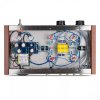
Here's a photo of the preamp's insides. I see a wire connected to pin 9. My actual preamp is wired the same. Is there a fix to lower the heater voltage? I really like this preamp. I've never heard music sound so alive.
 

Attachments

  • 1965074235-1845543669.jpg
    1965074235-1845543669.jpg
    116.6 KB · Views: 22
Here's a photo of the preamp's insides. I see a wire connected to pin 9. My actual preamp is wired the same. Is there a fix to lower the heater voltage? I really like this preamp. I've never heard music sound so alive.
First step is to measure the heater voltages so you know how much you need to drop. Then calculate the values of the resistors needed using Ohm's Law.

You need to measure both the signal tube (12AX7s & 12AU7s) and the rectifier tube heaters and deal with them separately since they are run off different transformer windings.

This will lower the heater voltages, which are generally more critical, but not any of the other voltages.
 
As for 5751. I do not like the new issues. Nothing beats NOS 5751. But, they are $$$. Triple-mica, mil spec GE, RCA, and Sylvania are very good. My all time favorite is the Raytheon 5751 windmill getter. Under the correct electrical conditions, good testing 5751 tubes last forever.

+1for @Mr Boochie comments, completely agree..... Really, really tough to beat a NOS 5751. Similar with a NOS 5814A triple mica black plate from RCA or GE, tough to top those as well.
 
Back
Top Bottom