• The move to the new server is done. There are some software and database maintenance updates in process. This has us passing the hat around to help out. We appreciate any donations. Seriously, even a dollar helps. The payment page may be found here - https://www.audiokarma.org/support.html

Now just how do I use this new Oscilliscope to find a problem?

tusntuk2

Active Member
Got a "new" (old used) scope to help diagnose a voltage/oscillation problem in a KR-5600 receiver, and I'm learning how the scope functions. How, exactly, do I use the scope inside the amp? I'm trying to diagnose a vexing problem with apparent oscillation or voltage runaway as the volume control is increased, so what do I test?

Amp board recently recapped, so I might be looking for a bad or reversed cap. How to apply the scope? I have reviewed the work 10 times, it seems to be OK. Getting the scope to help diagnose the component was suggested here.

Many thanks for your help!
 
Register to hide this ad
Basically, a scope is just a very fast volt meter, think of it as a volt meter with a time component.
Like a MM there are adjusters for voltage scale. There is also an adjuster for the time scale. There
will be supporting buttons for positioning, channel selection, AC or DC or GND,,,

Connect the probe with the GND connection to channel 1. The GND connection should be connected
to the amp chassis/GND connection. Feed the amp a 1KHz sine wave via AUX RCA, mobile phones
or PC SW can generate audio signals/sine /square waves. I would start at the speaker posts so you
know what the problem looks like. Next at the pre out/main in. Then at the base of transistors in the
affected stage (pre/power)

The scope service manual will say that the probe GND connection should be connected to system
under test GND. Do not remove the CRO's GND pin from power cord/protective earth. It is there to
protect you.
 
An o-scope will show noise on power source lines, indicating poor bypass caps allowing cross-contaminating sections.
 
Have you read the owners / operators manual ?

I 2nd this.

Download or find the OM for the scope. Read it stem to stern- twice.

Get your probes and calibrate them on the 'cal' terminal on your scope. Learn about the x10/x1/gnd switch on the probes. Learn about ground/gnd/earth on the scope and how that relates to common ground- you don't want to start vaporizing probes or blowing up your amp.

Get some battery powered device (radio cassette or portable CD boombox) from a thrift and start poking around in that, learning how to read and interpret what your scope displays.

Seriously. A scope is an instrument that took everyone who first used one, years to become familiar with. My DSO 'scope is still a nightmare to me sometimes, as compared to my 30 year old CRO that I can operate in my sleep.
 
I 2nd this.

Download or find the OM for the scope. Read it stem to stern- twice.

Get your probes and calibrate them on the 'cal' terminal on your scope. Learn about the x10/x1/gnd switch on the probes. Learn about ground/gnd/earth on the scope and how that relates to common ground- you don't want to start vaporizing probes or blowing up your amp.

Get some battery powered device (radio cassette or portable CD boombox) from a thrift and start poking around in that, learning how to read and interpret what your scope displays.

Seriously. A scope is an instrument that took everyone who first used one, years to become familiar with. My DSO 'scope is still a nightmare to me sometimes, as compared to my 30 year old CRO that I can operate in my sleep.
That's me. I was edumacated on scoped in the 80's. Have a new DSO and dang, I can have trouble getting it to display the way I want. I also don't care for the way it displays noise that I don't care to see. My old tube scope had much smoother lines and was easier to operate. But then again, now I can get screenshots in like 5 seconds to post up here, whereas the old scope, I'd be taking pictures of the waveform.
 

Attachments

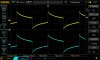
  • RIGOL Print Screen11-29-2017 3_06_57 PM.359.jpeg
    RIGOL Print Screen11-29-2017 3_06_57 PM.359.jpeg
    77.3 KB · Views: 31
That's me. I was edumacated on scoped in the 80's. Have a new DSO and dang, I can have trouble getting it to display the way I want. I also don't care for the way it displays noise that I don't care to see. My old tube scope had much smoother lines and was easier to operate. But then again, now I can get screenshots in like 5 seconds to post up here, whereas the old scope, I'd be taking pictures of the waveform.

I bought a 1054Z too just for fun, honestly it's a brilliant piece of kit, but not intuitive at all. The screen shots are great but I cannot get it to work on my LAN to my puter directly- have you done that?
 
Do you mean LAN or USB?
Mine is attached via USB and you have to install some other piece of software first to make it work. "Ultra-Sigma- something".
It's just stupid the Rigol software doesn't do that automatically. I can get more info if you wish - it's set up on another PC, down on the bench. But once installed, easy to get screenshots.
 
PM Answered. Let me know if I can help further. Sorry for hi-jack of thread.
 
Wow, didn't know I'd stir the hornet's nest - what fun! I get busy and can't stay to chat, sorry. What scope? Tektronix 2213, 60mhz but no bells or whistles. I have been playing with it for a couple of weeks, have learned what a waveform is and how to move it around with controls. Don't know about all the math yet, but I think I need to use the scope more to just find the problem rather than measure it. I need to understand how to pre-set things like voltages so I can find what I'm looking for, then where to probe in the circuit.

Yes, have the SM. Audio board was recapped, then problem was noted. Oscillation kicks in after warm up and increases speed (freq) with increase in volume control. Haven't touched the amp with a probe yet.

Many thanks to all who chime in! I will maintain better progress reports. Better go view more of those pages. Thanks, y'all! More later.
 
Yes, read the OM and followed the manufacturer's instructions to help learn the controls and comp. the probe. I have been playing with sine waves et al from a website called onlinetonegenerator, using a Kindle Fire headphone output for the source. Very cool, and very interesting. Probably not the cleanest waveforms, but sufficient for learning.

Thanks again for the educational web sites. I've tried to watch some you tube videos and the more I go over the same thing the more it seeps in. Not easy for an old man! (67) Makes me brave enough to try the amp.

General precautions? 1. Good ground. My workbench includes a direct #14 wire to an old fashioned stake in the ground outside of the window. (my wife thought I was crazy drilling through her brick wall!) Grounds the power strip, and has exposed screw terms outside of the frame.
2. Extra ground wires applied to the amp ground screws and said terminal on the power strip. Checked with DMM.
3. Talking with you guys! At this age I've learned I can no longer pretend to know what I'm doing sticking my hands into electricity. Like Mark Farner once said (Grand Funk RR) " It's a helluva rush, but I can't take too many!"
 
At this exact point in time, I'm going down the rabbit hole. Seriously thinking of finding a real electronics course with focus in audio, if there's one locally (not likely). I've already done a couple of years for a Electronics AA focused on VCR's and Cathode TV's - yea, that was in the middle 80's.
These are links open on my browser right now.

http://sound.whsites.net/articles/squarewave.htm

http://www.kennethkuhn.com/students/ee351/square_wave_testing.pdf

http://lcweb2.loc.gov/master/mbrs/r...ektronix Cookbook of Standard Audio Tests.pdf

http://audiokarma.org/forums/index....response-test-questions.770557/#post-10544096
 
I don't know exactly where to direct you, but understand that scope controls are laid out a certain way and there's a logic to the whole way of triggering and using a scope. I'm always amazed when I see engineers with years of experience that don't really understand the fundamentals. They fiddle until they see something they like on the screen, but without any in-depth knowledge of what the various triggering options do and what the pitfalls of a given measurement might be.

You might start here- http://w140.com/tekwiki/wiki/2213
Read the operators manual, then the other stuff.
 
Back
Top Bottom