• The move to the new server is done. There are some software and database maintenance updates in process. This has us passing the hat around to help out. We appreciate any donations. Seriously, even a dollar helps. The payment page may be found here - https://www.audiokarma.org/support.html

OHM OHM OHM - QUESTION

SmileyFaceEQ

Super Member
ok,

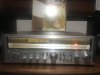
I have a Sanyo JVX2600 K vintage amp. It is rated at 85 W RMS. 4 - 16 Ohms

Question is:
--------------------------------------------------
Can i drive speakers on channel 1 and 2 at the same time if:
- one set is rated at 4 ohms (Yamaha NS-625) Channel 1
- second set consists of two pairs of speakers rated at 8 ohms and wired together Channel 2 (Pioneer CS-T6000 and Klipsch Energy B2 bookshelf)

Total of 6 speakers: {1 X 4 ohm pair} and {1 x 8 ohm pair + 1 X 8 ohm pair} (effectively 4 ohms)
and drive them all at the same time.
 
Last edited:
Register to hide this ad
Only if you like smoke. You're creating a 2 ohm load. Sanyo never made anything that would drive a 2 ohm load unless they had some sort of "Skunk works" division that has remained top secret.

Don't do it.

If you absolutely MUST (for some reason) use all of your speakers at the same time, wire the 4 ohm speaker in series (NOT Parallel!!!) with an 8 ohm speaker for each channel and put the 2nd 8Ω pair on the speaker 2 outputs.
 
Only if you like smoke. You're creating a 2 ohm load. Sanyo never made anything that would drive a 2 ohm load unless they had some sort of "Skunk works" division that has remained top secret.

Don't do it.

If you absolutely MUST (for some reason) use all of your speakers at the same time, wire the 4 ohm speaker in series (NOT Parallel!!!) with an 8 ohm speaker for each channel and put the 2nd 8Ω pair on the speaker 2 outputs.


speaker set 1 : 4ohm
speaker set 2 : 8 ohm parallel with 8 ohm results in halfed resistance 4 ohm

why can't the receiver drive 4 ohms on speaker 1 and 4 ohms on speaker 2? Aren't the speaker sets independent? or does the 4 ohm load on each speaker set create a 2 ohm load combined effect?
 
Well, maybe, maybe not. It depends.

If the amp runs the two speaker circuits in series, you may be effectively increasing the ohms.

Here's an easy test to figure out if A+B is in series or not.
Unplug any speakers from output B then switch to A+B. If you don't get sound, they are in series, and it probably wont be a problem.

I couldn't find your model over at hifiengine.com to check your manual about how A+B functions, but here's the excerpt from my Sony manual explaining the same thing.

upload_2018-5-2_2-51-40.png

Keep in mind without consulting YOUR manual, I can't guarantee this info applies to your stereo. So proceed with caution.
 
My math is: speaker set 1 : 4ohm
speaker set 2 :(8+8) / 2 = 4 ohm

why can't the receiver drive 4 ohms on speaker 1 and 4 ohms on speaker 2? Aren't the speaker sets independent? or does the 4 ohm load on each speaker set create a 2 ohm load combined effect?

Typically speaker outs they are run in parallel. 4 Ω and 4 Ω in parallel = 2Ω. No bueno for most vintage consumer stereo stuff.
Takes more wire to run them in series inside a receiver.
Bean counters notice. If it was a Qudraphonic receiver it would have separate output sections. In stereo amps, it's a bit of a cheat. Kind of like the phono 2 input. Usually there isn't a separate phono amp unless it denotes "Ceramic" or "MC" on one set of inputs.
 
Well, maybe, maybe not. It depends.

If the amp runs the two speaker circuits in series, you may be effectively increasing the ohms.

Here's an easy test to figure out if A+B is in series or not.
Unplug any speakers from output B then switch to A+B. If you don't get sound, they are in series, and it probably wont be a problem.

I couldn't find your model over at hifiengine.com to check your manual about how A+B functions, but here's the excerpt from my Sony manual explaining the same thing.

View attachment 1177396

Keep in mind without consulting YOUR manual, I can't guarantee this info applies to your stereo. So proceed with caution.

Smart move by Sony in this case. Probably saved them thousands of dollars in magic smoke.
 
Smart move by Sony in this case. Probably saved them thousands of dollars in magic smoke.

Yeah, it confused me at first since I was used to my Yamaha CR1020 being able to switch between A+B and A+C and still play normally even if I had nothing connected to B or C - it is all parallel.

If we could verify the model number of the Sanyo and find the manual, I'm sure we could get the answer to this question pretty easily.
 
Ive found a JCX-2600K over there that is 85WPC - possibly this is it?

In the manual, it says nothing like what my Sony manual says though.

Here's the detail from the schematic: I think they look parallel.

upload_2018-5-2_3-22-6.png
 
Yes. Very, very quietly. Otherwise, probably puff the magic dragon time.

More speakers usually sounds worse. But I guess stacking is a thing. Not for me though. What are you trying to achieve?
 
wow thanks - parallel it is.

you are correct JCX 2600 K. Sounds great. Lot of power. I guess i'll have to run a separate amp (old yamaha AVR) as a separate power amp off the main out. Then I can power the extra speakers off the Sanyo preamp. I'm also going to feed an powered sub off the second amp as well. Cool workaround I guess.

I'm thinking of getting a small dayton mini to use as an external power amp.

Goal:
The 10 " powered Sub
pioneers have dual woofers, mids, tweeters with diffusers, and ribbon tweeters
Klispch have horns that work well with the setup.
Yamaha NS - are the speakers I want to add. Just picked them up for next to nothing and are in great shape. Grills on the tweeters are mint.
 
wow thanks - parallel it is.

you are correct JCX 2600 K. Sounds great. Lot of power. I guess i'll have to run a separate amp (old yamaha AVR) as a separate power amp off the main out. Then I can power the extra speakers off the Sanyo preamp. I'm also going to feed an powered sub off the second amp as well. Cool workaround I guess.

I'm thinking of getting a small dayton mini to use as an external power amp.

Goal:
The 10 " powered Sub
pioneers have dual woofers, mids, tweeters with diffusers, and ribbon tweeters
Klispch have horns that work well with the setup.
Yamaha NS - are the speakers I want to add. Just picked them up for next to nothing and are in great shape. Grills on the tweeters are mint.

I really enjoy the process of setting up different configurations to suit my ear. Plus I am addicted to searching for and buying speakers, using them and selling them and upgrading.....the process continues.

I was big into AVR but now have trended to vintage.
 
Your other solution, as good or bad as it may end up sounding, is to ‘daisy chain’ all the speakers out of just A output.

(A)Right+ to S1+, S1- to S2+, S2- to S3+, S3- to (A)Right-

Then

(A)Left+ to S1+, S1- to S2+, S2- to S3+, S3- to (A)Left-

That would add up the ohms, though you’d have no choice but to have all running at the same time. Probably wouldn’t sound all that great, but who knows?

That would mimic a series connection inside.
 
If that "second speaker" you're referring to is a powered sub, you should be fine. The speaker level input impedance of a powered sub is seen by the driving amp as extremely high and is essentially invisible to the driving amp.

It's only when talking about passive speakers that this impedance thing becomes an issue. In which case, putting anything in parallel with four ohm speakers is risky.
 
You could simply use a speaker selector switch with impedance protection, then the outputs will only ever see a minimum of 4 ohms load. Adcom GFS-6 should do it.
 
If that "second speaker" you're referring to is a powered sub, you should be fine. The speaker level input impedance of a powered sub is seen by the driving amp as extremely high and is essentially invisible to the driving amp.

It's only when talking about passive speakers that this impedance thing becomes an issue. In which case, putting anything in parallel with four ohm speakers is risky.

This is true UNTIL you connect a speaker to the subs SPEAKER OUTPUT, that will be reflected BACK to the amplifier (at some point if it has a high pass filter to the speaker output, some don't).

Mark T.:music:
 
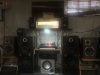
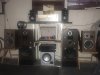
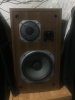
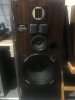
I6C46209C-9544-4DCA-B36D-C519453AD0CF.jpeg 6D4853E4-F3E8-46CC-817B-A202AA307757.jpeg CA5DD561-F987-40BD-8261-C6C8CA8F5291.jpeg 089952B9-3255-4DB1-82A5-4E9ACEF4DBE9.jpeg 9E2FC34A-7491-4224-A881-CA3C258C3CB9.jpeg ABFF643B-AA2F-4B38-84EB-4E1E1AA77729.jpeg Thought I’d upload a few pics of my set up after the warnings and help I received from the group. Need to upgrade to some more substantial klipsch speakers. These one get over powered and distorted at 1/2 volume. So I’ll flip these up a size or two. Thanks a lot everyone. Going to build some custom stands on the weekend and work on cable management.
 
Last edited:
Are you sure its the speakers that are distorting and not the receiver?

Driving three pairs of speakers simultaneously is a large load for your receiver.

Do you get the same distortion when running only one pair of speakers?
 
Are you sure its the speakers that are distorting and not the receiver?

Driving three pairs of speakers simultaneously is a large load for your receiver.

Do you get the same distortion when running only one pair of speakers?
I have the preout input to an old Yamaha that’s driving 4 of the speakers. So the volume knob on the sanyo controls all speaker volume. The Yamaha only acts as a power amp. Beauty is there are Speaker on/off switches for each set of speakers. So I can play with the sound. Sub runs off the Yamaha as well. The Yamaha has old school bass treble and balance controls as well.
 
Back
Top Bottom