• The move to the new server is done. There are some software and database maintenance updates in process. This has us passing the hat around to help out. We appreciate any donations. Seriously, even a dollar helps. The payment page may be found here - https://www.audiokarma.org/support.html

Old MC75 Mono Blocks?

Seamaster

Active Member
I just sold my 2015 MC75 and bought MC30 instead, never regret that decision. I really appreciated the old Mac sound when they pair up with modern speakers, a match in haven! Now I wonder how old MC75 sound? How do they compare to other amps like MC30, MC40, MC240, etc. in that era?
 
Register to hide this ad
All I can offer is that SS rectification of the MC30 & MC60 provided the genesis of the MC40 & MC75 respectively. Since the MC30/60 are the only McIntosh amplifiers that are tube rectified (in the chrome & black chassis series), they are accorded special recognition in tube circles - both collectors and audiophiles.

Beyond that I cannot comment other than to say low noise and low distortion never goes out of style.
 
I can tell you MC30 sound tuby but at the same time, they are quick, detailed, transparent, and powerful, those qualities usually never come in one package in modern amps unless you are ready to spend 10 grand for it
 
Afaik, putting a couple of ca 200 ohm power resistors in series with the hv leads of the power transformer to the solid state doubler should dupe the tube rectifier sound of the older amps, tho it may drop optimum operating voltages some. Otherwise, the series resistance current limiting effect of the tube rectifier is the only effective difference between the older and newer Mac tube amp power.
 
I own vintage MC75, restored MC60, series II MC275G and have heard MC30 but not spent time with a pair. I would say the tube rectified MC60 and MC30 are superior to all of the solid state rectified Mac's. As you have already noted, the tube rectified amps give an extra serving of tube goodness.
 
Afaik, putting a couple of ca 200 ohm power resistors in series with the hv leads of the power transformer to the solid state doubler should dupe the tube rectifier sound of the older amps, tho it may drop optimum operating voltages some. Otherwise, the series resistance current limiting effect of the tube rectifier is the only effective difference between the older and newer Mac tube amp power.

Not to be too picky here but there is another significant difference betw the (vintage) 60 & 75: the 75 employes a trifilar primary winding such that the the bootstrap to the CF driver and 12BH7 pre-driver can be supplied with B+ approx 1/2 that on the finals. Since the ratio is the same as the final's anode and cathode winding, signal applied to the bootstrapped stages is same as if tapped off primary as on 60 but at a more "conservative" B+. Depending on how one chooses to look at it, this third "primary" winding might actually be considered a secondary winding since it doesn't contribute any appreciable power to output.

Not sure what effect this arrangement has on sound but improved durability of 12AZ7 & 12BH7 might be expected.
 
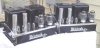
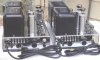
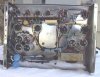
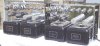
I once owned not one but two pair of MC60s that were hot rodded by some mad scientist. He had . . . get this . . . upped the HV to 575 VDC, swapped the 5U4s for 5AR4s, scrapped much of McIntosh's original circuitry internally and wired things point to point with leads going everywhere. The caps in the unit were clearly marked 450VDC on them but when I measured 575VDC across them, I was like holy ****. He claimed 130W from a pair of Chinese 6550s per amplifier. I never did verify that. I did spend a few days inside each amplifier cleaning up all of the haphazard workmanship just so that I would know the amps wouldn't burn down the house when I used them. There were parts scattered all over the internals, some mounted and some not.

To date, I've never heard a vintage tube amplifier sound as good as those amps did. I had a quartet of Genelex KT88s that I used in 'em. I did not leave the room with them powered up though for fear the caps would explode like sticks of dynamite. I probably put 50 hours on the one pair and man did they sound good. Hard times forced the sale of both pair.

As luck would have it, I have a picture of the internals of one pair. This is after I repainted the bottoms, mounted all of the components correctly, and installed new power cords and terminal blocks. They sure were pretty.

MC60-both.jpg MC60-ends.jpg MC60-innards.jpg MC60-tops.jpg
 
Not to be too picky here but there is another significant difference betw the (vintage) 60 & 75: the 75 employes a trifilar primary winding such that the the bootstrap to the CF driver and 12BH7 pre-driver can be supplied with B+ approx 1/2 that on the finals. Since the ratio is the same as the final's anode and cathode winding, signal applied to the bootstrapped stages is same as if tapped off primary as on 60 but at a more "conservative" B+. Depending on how one chooses to look at it, this third "primary" winding might actually be considered a secondary winding since it doesn't contribute any appreciable power to output.

Not sure what effect this arrangement has on sound but improved durability of 12AZ7 & 12BH7 might be expected.
Noted, thank you.
 
I owned all MC mono blocks (mc/30's/40's/60's/75's). I am an electronic design engineer and spent my evenings "Blueprinting" each set to exact factory specifications. Meaning i corrected them to the designers ideal. Or I should say as close as i could, ex; better than 1%match of resisters, capacitors, Etc. Compared to 20% resistors, capacitors, etc used in manufacturing back in 1950's & 1960's.

I can state the following-

1.) I believe there is no person living today (or very few) who have actually heard how wonderful these amps sound. That is because; a.) any 60-70 year old amp the capacitors have all deteriorated, b.) If you do not have quality and correct balanced NOS tubes they will not sound right (i have a collection of thousands of tubes). The new Russian and China tubes are inferior in construction and metals.
Generally all my before and after listening comparison between the amps- They sounded like MUD before restoration! Simple "tech expert" checking voltages & changing a couple failing components will not bring them back to the glory they had back when they were made. Not possible.

2.) The MC engineers were true genius. Their output transformers are pure magic. Hands down the best. The mathematics involved in designing them back in the day of slide rules (and only computer was one between your ears) is amazing. I have studied them for years, and it is still hard for me to wrap my head around.

MC's transformer design make them very easy on tubes. I see amps for sale with original "macintosh" tubes. Amazing on amps over 50 years old! With the cost of NOS 6550's over $ 300 each and KT 88 GEC over $ 500. This is a very big positive. Other standard push-pull Amps with 50-60ma+ idle current are just burning up the tubes!! I have several "classic" push- pull amps, the tubes in them get HOT!!! I only run my cheap russian & china re-pop tubes those. The tubes only last a year or two, they get weaker by the day.

The one exception (that i am aware of). Is the new Bob Carver tube amps. He is another true genius. Tube life 5-50years! I did the mathematics on his published design. Those big KT120's are running at only ~ 8-10ma of idle current, couple watts at idle. The tubes are very cool to touch. I have not heard how they sound. But would love to..... :)

General listening comparison (fyi; i love them all)-

a.) MC30's- very warm non fatiguing sound. Can listen to them all day.
Downside- they were designed back in 1949, recordings had little low frequency energy. If you listen to modern recordings with a lot of low end energy the IM distortion is high (low frequencies "smear" the mids and highs). If you have efficient speakers and primary listen to vocal or string/piano type music for long periods. The MC30's maybe your ideal amp.

b.) MC40's- Very clear and balanced sound. Little weak on the bass (compared to MC-60 & MC-75's). I spoke to a person who knew one of the 1960 engineers. That engineer believed it was McIntosh's best amp (of course maybe he had a hand in design? so a bit biased? unknown). The bandwidth on this amp is amazing 10hz to 100khz.

c.) Mc60's- Warm tube sound with more power than the MC-30's. Designed in 1955, same IM issue as MC30's, but to lesser degree because of more power. Nice dramatic sound. Bass little "flabby". Not as "musical" as MC30, bit more fatiguing in long listening. I like NOS Tung Sol 6550's, NOS KT88 GEC's are crisp, but sound like missing lower octave. I guess tube selection would depend on your listening taste, source, speakers, room, etc.

d.) MC75s- Very clear and tight sound, strong bass pulses (more like solid state?). I like T-S 6550's in this amp also. It is a more fatiguing sound (compared to MC-30's). But that fatigue maybe just because of increased dramatic impact. ie; I play them louder than mc30! haha.

Marvin

 
Last edited:
Marvin:

Welcome to AK, a very nice first post. Resurrecting a "zombie thread" is sometimes a bad idea (if you're looking for help/advice, it'll remain buried in an old thread), but in this case I'm glad that you did.

I currently run an MC240, and MC75s.

Although I like the sound from the 240 I have found that it lacks a little detail unless you find the right tubes, in my case NOS RCA 6L6GCs and RCA 12xxx tubes with one telefunken 12AX7 preamp tube seems to be a good formula, none of the new-issue Chinese & Russian manufactured tubes did the job. It is very good at bass on efficient speakers, but I'm not feeling the detail that my modern tube amplifier brings to me. It is restored, all resistors/caps are well within spec now and the main modification being larger doubler caps (I believe 250uF) and a diode rectifier with a series resistor to adjust HF voltage.

My MC75s are unrestored and running an all-GE compliment of tubes (circa 1960s). A few cap replacements and thermistor replacements which surely impacts the ability to compare them, but their current condition they do have IMO better detail than the MC240s, the lack of match between the amps' performance however makes for dismal imaging. I'm looking forward to the completion of their restoration so that I can make a fair comparison.
 
MC 75's have SS rectifiers, MC 30's have tube rectifiers which color the sound. That said I Iiked my MC 60's in the 60's. Not today how ever. My current speakers prefer the woofers to be driven by fast amps with high damping. The MC 60 doesn't apply. If you have efficient speakers such as some models of Tannoy MC 30's are a great choice to calm the Tannoy tweeters with their big Coax models.
 
MC 75's have SS rectifiers, MC 30's have tube rectifiers which color the sound. That said I Iiked my MC 60's in the 60's. Not today how ever. My current speakers prefer the woofers to be driven by fast amps with high damping. The MC 60 doesn't apply. If you have efficient speakers such as some models of Tannoy MC 30's are a great choice to calm the Tannoy tweeters with their big Coax models.

MC60's paired with Yamaha NS-1000M's make for a compelling match. NS-1000M's are transparent speakers and expose poor performing solid state amps. MC60's sound fast and crystal clear but retain the tube flavor and blending. That an old mono amp can sound so good with M's is a testament to the design.
 
SoCal Sam is spot on. The tube rectified MC30 and MC60s sound better than their SS rectified brothers. the SS rectification adds a dryness to the sound. The MC40 and M75 have a bit more power, due to higher B+, but few watts of extra power not enough to give up toobe rectifiers on the 30 and 60. I have at least 2 copies of each of black chrome series tube amps. Of the SS rectified amps, the MC225 is the sweetest. And have tried to get more power by using a second MC225, but much of the magic is lost over a single MC225.

But for sonic bliss have to stay with the MC30 and MC60.

and if you really want to make a jump in SQ with the MC60s, still in a quad set of the new Shuguang Western Electric KT88 plus Red base tubes......now that is a match....

have a number of copies on the MC60. keep in mind some models use half of the first input tube as a voltage regulator, while other versions simply use just one section of the triode.

And speaking of triodes, try a pair of PSVANE T-II 12AX7s as the input tube in any of the MAC MC series.

best
 
SoCal Sam is spot on. The tube rectified MC30 and MC60s sound better than their SS rectified brothers. the SS rectification adds a dryness to the sound.

:idea: "Much" better might be a bit far fetched... Having owned a pair of expertly restored MC30 and an MC240, I was unable to detect any significant audible differences between them. As always, YMMV.
 
Back
Top Bottom