• The move to the new server is done. There are some software and database maintenance updates in process. This has us passing the hat around to help out. We appreciate any donations. Seriously, even a dollar helps. The payment page may be found here - https://www.audiokarma.org/support.html

Old speaker conversions to Bluetooth

G7065

Member
Not sure if this is best in Speakers or DIY but I’m looking to convert an old (low-end) 1970s passive speaker to active Bluetooth. I want to build in a Bluetooth amp board and li-on/lipo battery with charger port.

No desire for any buttons or knobs other than on/off and power input to run off mains or charge the battery.

For me this is about repurposing some old but good looking passive speakers into something that sound fine for general listening (ie better than through a flat panel TV or laptop!). The kind of speakers you got with ‘all in one’ budget music systems (typically 10-20w power).

Where I’m running into (novice) difficulty…

- almost all Bluetooth amp boards are stereo, but I only want one channel for a 2-way speaker. Mono boards tend to be high power for subs.

I found some videos of people doing similar but I have concerns…

This guy seems to bridge his amp board but I’ve read these little amp boards shouldn’t usually be run this way as they’re not designed to be bridged into mono. Anyone have any advice on this?

This person seems to connect his tweeter to one channel, woofer to the other… doesn’t seem right at all without a crossover to split the frequencies.

- also, anyone know if integrated Bluetooth amp boards are any better/worse than individual Bluetooth and amp boards?

- from a little research, I’ll need a battery pack/module and a charger board to prevent overcharging.

- any general recommendations of the right gear for this? Dayton does some stuff but it’s a bit of a limited range and gets pricey once all added up… as ever, this is a fun budget project, emphasis on budget

Cabinet space is not an issue as these are practically empty boxes…

Did I mention being a novice to electronics… I can solder and learn quickly!

Appreciate any advice from those who have experience with this sort of hobbyist/home electronics gear. Thanks!
 
Register to hide this ad
I’d look into a cheap low power mono amp and cheap Bluetooth receiver and have the power cords go into a three way in the box. Just use two into one rca from the receiver into the mono amp
 
I’ve heard people are doing Bluetooth conversions on old am antique tube radios because am is dying out and it gives them some renewed viability. But those have the mono tube amp already in them
 
Why not just run a speaker wire from one cabinet to the other? You could use the original speaker terminals for that.

That's what lot of self-powered speaker pairs do nowadays. The entire electronics package (BT receiver, amp, etc) for both channels is in one cabinet, and the other is a "slave", for the other channel- connected by a speaker wire.

Regards,
Gordon.
 
I've got the same questions, same projects lurking. I have orphaned singles that make a nice mono setup far preferable. I have no pairs available.

Biggles
 
Sorry, I misunderstood the initial post.

Best thing might be to find either a dual-voice-coil woofer driver (admittedly harder now than in previous times, to find one that's not a dedicated subwoofer driver), and then use two tweeters, one on each channel, one mounted right above the other, as close together as possible. Use both channels of the BT amp.

Regards,
Gordon.
 
Thanks for the replies. I think the challenge is there's no obvious 'out of the box' solution for something that seems like it should be very easy (and cheap) to do. Plus there are a lot of products that seem to be pretty close to what you want, but either require more electronics understanding than I have or are just not quite right... plus most of them have very little info or support available.

For example, a higher power mono version of something like this would be great as it's got bluetooth, power source and amp combined... https://www.aliexpress.com/item/32979882239.html

There's a big gap between the little low power mono amp boards (usually around 2-5w output) and then 60w+ mono boards - not much in the middle, probably due to the original end products they are designed for (laptops and subwoofers)

The higher power mono amp boards require a 12V+ power source which is more than I want - I need to be at about 5v to make it easier to add a rechargeable battery source inside.

I'm discounting all the stereo/2-channel boards (of which there are loads and they are cheap) as I can't find any proof they can be bridged to mono and I don't want to add a second driver, etc.

The way it's looking for far, I'll need (individually):
5v mono amp board
Bluetooth receiver board
Charger board / protection circuit
Battery pack

..Or I may have to up my electronics knowledge and build my own!
 
Could you recycle old Bluetooth sound bars, just take the hardware out and re-wire those? Are they mono signals? I have three that just keep piling up

additional thought: many old speakers are pretty efficient and often shouldn’t require 60 watts.
 
I don’t need much power, but I’d like a halfway decent amplifier. I’ve got a single Klipsch KG two way that’d be perfect for this project. I’d like to use it in the backyard for music at a party.

Biggles
 
I've done a bit more research and digging around for products away from the usual stuff on eBay/Amazon/AliExpress... from what I can see, all of the small mono amp boards are, well, really small and low power. Even the ones that claim to be 5-10w RMS are usually rated at 2ohms... once you rate at 8ohms it's more like 1w output, which is too low for what I want. I suspect these boards are made for very small and/or cheap devices that don't need much power at all.

I'd like to be somewhere around 10-30w RMS at 8ohm ideally.

@CJ Payne - I like your thinking and have been keeping an eye on a few on eBay myself. Quite surprised how expensive even faulty portable bluetooth speakers are(!) and many seem to be stereo (which would explain all the cheap stereo amp boards on the market). I'll keep looking in case something useful comes up that I can use for parts.

@drbiggles - I hear you. The most interesting mono amp I've found recently is the Cebek E-14, which is the only one I've seen that has integrated high and low outputs for the tweeter and woofer. This should mean no need to use the original crossover, which could be useful in older speakers where they may be faulty. 20w RMS at 4ohms isn't too bad, but it's back up to 12v DC input.... here's a link if of interest (I'm based in UK, but I'd guess you can get in the US too) https://quasarelectronics.co.uk/Ite...put-mono-audio-power-amplifier-module-20w-rms

Other mono options here: https://quasarelectronics.co.uk/Category/kits-modules-mono-audio-amplifiers
 
G7,

Thank you! For me, the original crossover, or lack of one is a positive thing. I keep extra caps, resistors, and inductors around for such projects. I think a good solid 10 watts would be enough for me.

One of my harebrained schemes is to make some type of modern boombox using a modern vacuum tube amplifier made for your car. Shoot for something tasty. But I rarely have time to do anything more than just watering my apple trees.

Biggles
 
I've done a bit more research and digging around for products away from the usual stuff on eBay/Amazon/AliExpress... from what I can see, all of the small mono amp boards are, well, really small and low power. Even the ones that claim to be 5-10w RMS are usually rated at 2ohms... once you rate at 8ohms it's more like 1w output, which is too low for what I want. I suspect these boards are made for very small and/or cheap devices that don't need much power at all.

I'd like to be somewhere around 10-30w RMS at 8ohm ideally.

@CJ Payne - I like your thinking and have been keeping an eye on a few on eBay myself. Quite surprised how expensive even faulty portable bluetooth speakers are(!) and many seem to be stereo (which would explain all the cheap stereo amp boards on the market). I'll keep looking in case something useful comes up that I can use for parts.

@drbiggles - I hear you. The most interesting mono amp I've found recently is the Cebek E-14, which is the only one I've seen that has integrated high and low outputs for the tweeter and woofer. This should mean no need to use the original crossover, which could be useful in older speakers where they may be faulty. 20w RMS at 4ohms isn't too bad, but it's back up to 12v DC input.... here's a link if of interest (I'm based in UK, but I'd guess you can get in the US too) https://quasarelectronics.co.uk/Ite...put-mono-audio-power-amplifier-module-20w-rms

Other mono options here: https://quasarelectronics.co.uk/Category/kits-modules-mono-audio-amplifiers

Perhaps I just missed it- but is there anything in the description of that Cebek amp board, that states the frequency of the crossover point, and/or how to change it?

That would be pretty important, naturally, in making drivers, with differing parameters, work with it...

Regards,
Gordon.
 
Perhaps I just missed it- but is there anything in the description of that Cebek amp board, that states the frequency of the crossover point, and/or how to change it?

That would be pretty important, naturally, in making drivers, with differing parameters, work with it...

Regards,
Gordon.

Agreed - a few more details here: https://www.esr.co.uk/manuals/e-14.pdf
Frequency output is listed at 22-22.000Hz but no mention of crossover point - does say the High level can be adjusted via on-board potentiometer.

Progress update:
Having figured out the smaller mono amp boards were very low power (at 8ohms), the same logic applies to the larger output boards - although many claim to be 60/100/200w, again that's usually rated at 2ohms. When you rate at 8ohms, they drop very quickly. Power input is also critical of course - my hope of 5v is too low, it really needs to be 12v minimum. Again, many boards are rated at 24v, so the output really drops when 12v. If I was building a mains powered speaker, this wouldn't be too much of an issue... but I want this to be truly wireless and battery powered.

I've gone with this amp board: https://www.ebay.co.uk/itm/203072870900, rated 20w @12v 4A and I'll use the existing crossover.

I like that it has a BT 5.0 module integrated, and although it wasn't my first thought, it has TWS so can be paired to another board for stereo if wanted. This isn't a feature I originally looked for, as this was always meant to be a single (mono) speaker project. However, the opportunity to make two separate BT speakers that can be paired together wirelessly (or used independently) just seems like fun.

Planning on going with a 3 cell lithium 18650 module with built in protection board to protect against over/undercharging, with the option of adding another 3 cells if needed for longer run time.18650 cells are not cheap, though... If I had a decent spare laptop or power tool battery, I would probably repurpose it instead.

Waiting on the components to arrive...
 
Time for another update. Both speakers are now finished, although I plan to add a couple of handles to the rear panels and some protective pads on the bottom of the cases, but otherwise, good to go. Some pics:

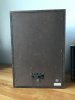
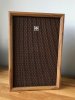
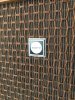
Sanyo SX 2611 speaker, still looking as good as it did in the 70s but now with added BT power:

0F697F04-E2C7-4B26-8F09-FA0559285CAA.JPG


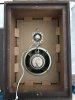
Original internals - super clean and untouched (like new!), tweeter and driver both rated 10w @ 8ohms

IMG_2477.jpg


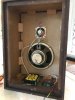
Modern extras going in (not a finished shot) - amp/BT board plus power pack:
IMG_2486.jpg


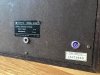
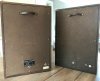
Revised rear panel - added 12v port where the speaker wires used to come out, plus LED power switch:
IMG_2488.jpg

IMG_2489.jpg


Rear of the matching pair - Right speaker has an extra push button to pair it with the Left (signal master), or they can be used individually
IMG_2501.jpg


She's alive!
IMG_2487.jpg


Overall, they sound great, much better than expected, individually and when paired together. The little amp board can really move the speakers and they are loud enough for a large room. I've run them for a few hours at a high volume and the batteries have held out so far - will be interesting to see how long they run for before needing charging. Great little speaker project and a good way to give new life to some budget 70s speakers that otherwise would have probably been destined for the bin.
 
Last edited:
What about using a midrange(price) Bluetooth speaker, ripping it's guts out and dropping them into your project.

Anker Soundcore 2 is around $30
 
So how is the BT signal from say your cell changed from stereo to mono? Or the BT amp receives a stereo sig and outputs mono? Both speakers are mono I assume?

Both speakers are mono, and I took a good while finding a suitable mono amp. The BT amp converts from stereo to mono, however you can also output in mono from iPhone (settings - accessibility - audio/visual - mono audio).
 
What about using a midrange(price) Bluetooth speaker, ripping it's guts out and dropping them into your project.

Anker Soundcore 2 is around $30

I had a look at this route and it should be possible, but the cheap BT speakers I found were either too low powered or stereo and could not be bridged. Plus, all the good quality ones are still pretty expensive even second-hand on eBay here in the UK.
 
Figured I would post final pics and a run-down of main parts used, for anyone looking to do something similar. All links are UK but should be available worldwide.

PSA: I am a beginner 'enthusiast'. I know the basics and how to Google, but I strongly suggest anyone do their own research - none of the parts below are recommendations, just an overview of what I chose for my project.

- Mono amp with integrated BT module: https://www.ebay.co.uk/itm/203072870900?var=503300710269
I went with 'no call/talk' version, so it uses chimes to notify when you have powered on, paired etc. I read the 'talk' version is in Chinese language and pre-set very loud, but I haven't tried it myself. TWS function allows them to be paired together, which seems to work well.

- Battery module with integrated BMS: https://www.ebay.co.uk/itm/124461683979?var=425335171843
3-cell 18650 lithium battery holder with the integrated battery module to prevent overcharging (it is soldered on the bottom of the board, ready to go), with a simple 12v DC power socket soldered on - I used a pig tail to connect it to the power socket on the rear panel for easy charging.

- lithium batteries (I chose 9800mAh 3.7V rechargeables), 12v 2A DC mains charger (https://www.amazon.co.uk/gp/product/B01D4ZYEWM/), DC female power sockets, latching and momentary switches, spade connectors, wire, etc (typical stuff you might have around for most electronics jobs), felt pads for feet, spare material for handles. I was originally planning on soldering everything up but opted to use spade connectors on the switches so I can fully remove the back panel in future if needed (...repairs/modifications).


IMG_2535.jpg


IMG_2536.jpg


They don't make them like they used to...
IMG_2541.jpg


Next project is to retrofit some modern passive components into a pair of Sony SS-210 cabinets so they can handle much more power... *EDIT* you can see that project here.
 
Last edited:
Back
Top Bottom