• The move to the new server is done. There are some software and database maintenance updates in process. This has us passing the hat around to help out. We appreciate any donations. Seriously, even a dollar helps. The payment page may be found here - https://www.audiokarma.org/support.html

On ultrasonic cleaners: does the speed they spin the records actually matter?

Stack

Active Member
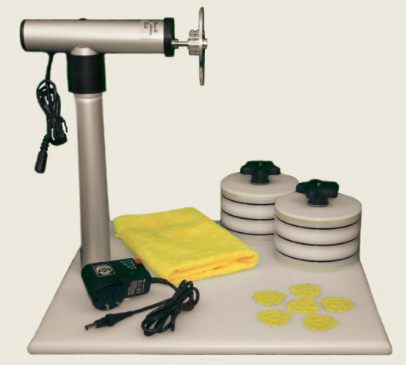
I bought a cheap Vevor ultrasonic record cleaner last week, and have been using it to some success, but one thing that keeps coming up is that people say the Vevor spins the records too fast and you need to slow it down with a lower voltage power supply.

This has me wondering: outside of extreme outliers, why does the speed that the record spins matter?

Like obviously if it's going 1000RPM then that's going to cause problems, but in normal circumstances, if the record is roughly 1/3rd submerged in solution at all times, doesn't that mean that it's going to spend the same amount of total time in the cleaner whether it's spinning at 2RPM or 10RPM? It's just going to be divided up differently, right? 20 10 second dips vs 100 2 second dips are both 3 minutes and 20 seconds dipped total, right?

I guess I'm wondering if anybody experimented with this, if it actually matters, and if so why?
 
Register to hide this ad
There was some test somewhere about it, google will be your friend. From what I remember, slower was better, but not to slow.
Too fast and it doesn't get a chance to get deep in all the grooves, too slow, and record damage can happen (doubt our cheap US are strong enough).
Want to say like 10-15rpm was the goldilocks zone.
 
My stock Vevor US cleaner spins about 3-1/2 rpm. I've seen threads where AKers were reducing speed to far slower than this.
Search Vevor threads here for discussions about it.
I'm a skeptic. Record surface spends same amount of time in cleaner. Irregardless of speed, within reasonable RPM range.
If a surfactant is used. Water stays on record through full rotation.
 
Last edited:
I use an UltraSonic and stock it spins at 5 RPM. Went with a voltage adapter where I can slow it down from stock to almost dead stop. I tried 1-2 RPM and didn't notice any difference in performance. I think it's more mental than anything else.
 
There was some test somewhere about it, google will be your friend. From what I remember, slower was better, but not to slow.
Too fast and it doesn't get a chance to get deep in all the grooves, too slow, and record damage can happen (doubt our cheap US are strong enough).
Want to say like 10-15rpm was the goldilocks zone.
I did find this good thread on it, but it seems inconclusive:

https://audiokarma.org/forums/index...-record-cleaner-rotation-speed.1045618/page-2

I guess it's a hard thing to test. You would need two records of which you know the condition that are soiled exactly the same amount.
 
I'm guessing that a slower (longer) dip will allow the ultrasonic process to progress to provide a deeper clean, than restarting the process over and again, in short bursts, whereby the process might need to start from the beginning again, each time - and never progress to a deep clean.

On this basis, I'd opt for the slowest speed possible - perhaps going to the extreme of only one full rotation in the given cleaning period.

Just my 10-cents worth... :biggrin:
 
Hey @Stack, lots of opinions about this and you might as well just follow your own preferences on this one. However, in that other thread that you linked to, I rather relate more to this idea:
Would you wash your dishes by quickly dunking them in and out of the water or is soaking them for that amount of time better?
That's close to my logic, and I too remember reading a study about this suggesting that the longer continuous exposure of any given spot on the record tended to remove more of the dirt in the grooves. Personally, mine is set to 1 complete rotation every 3 minutes, and given that my session is 15 minutes long that gives 5 rotations total. I like it, but I really haven't played around with this to know much more than that. Ruston Paul, who wrote a very informative article about ultrasonic record cleaning suggested a speed of 3 rotations in 10 minutes, which is 4.5 rotations in 15 minutes.

The bottom line is that when you get things set up properly, you are very likely to be extremely happy with the outcome! There is a lot of good information about getting great results in this forum so keep doing searches and read what you find.....many of us have been doing this for a few years now and have contributed some great ideas and procedures. Have some fun and enjoy the ride amigo......carry on
 
The only real issues I can think of is that, for a faster speed, the probability of water sheeting down and getting on to the label increases which is an issue you have if you do not have a label protector. If you were to run so slow that you didn't repeatedly expose the record surface you may not benefit from any "loosening up" of crud.

The length of time that you leave the records in the solution is independent of the speed of rotation. That is, if you spin at 1 rpm or 5 rpm for 5 minutes then the amount of time any portion of the record is submerged will be the same between the cases.

What is interesting is that the amount of time in the solution, as a percentage of the total cleaning time, is dependent of on how far from the spindle hole the "groove of interest" is (yea, there's only one groove per side unless you are Monty Python but bear with me for arguments sake).

For example, if you solution comes right up to the runout/matrix portion then there will be a point (static) or ring (dynamic) that barely gets exposure at all while the lead in groove will have the most (as a percentage of cleaning time) of any.

The math is far simpler if you consider submerging the record up to the spindle hole. In that case half the record would be submerged at any time and, for any point on the record surface, the submerged cleaning time would be 50% of the total time. Of course, points at the perimeter of the record would travel through the solution faster but the dwell time would be the same regardless of how far from the spindle hole they are.

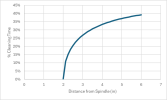
Spare you the horrible geometry. For a 12" diameter record submerged just to the edge of its 4" diameter label the cleaning time, as a percentage of total running time, is given as arccosine (2" / point distance from spindle) / pi

1745654840826.png

Surface points right at the label edge (2" from spindle) are getting nearly zero cleaning.
Surface points right at the edge of the record are getting just about 40% cleaning time (2 min of a 5 minute total cleaning cycle).

What fun! Or I could be wrong, this is the disinformation superhighway.
 
If the speed is too fast, the still water in the tank brushes the expanding bubbles off the record before they implode. In other words, fluid turbulence prevents cavitation from happening on the record and instead happens only in the water. Ideal speed is somewhere around 1/2 rpm.

If Neil Antin (@pacvr) drops by he can explain it in better terms.
 
Last edited:
What fun! Or I could be wrong, this is the disinformation superhighway.
Time submerged is the same regardless of the location on the record. What changes is the linear speed of movement. Like playing a record, outer speed moves faster than inner but they both take 1.8 seconds per rotation.
 
Time submerged is the same regardless of the location on the record. What changes is the linear speed of movement. Like playing a record, outer speed moves faster than inner but they both take 1.8 seconds per rotation.
That is an incorrect statement unless either the record is completely submerged or is submerged up to the spindle hole the amount of time exposed to the fluid will be dependent on the distance from the spindle hole to the surface of the fluid.

As for the time per rotation - the actual stylus speed is relative to its distance from the spindle hole, faster at the edge and slower near the runout.
 
If the speed is too fast, the still water in the tank brushes the expanding bubbles off the record before they implode. In other words, fluid turbulence prevents cavitation from happening on the record and instead happens only in the water. Ideal speed is somewhere around 1/2 rpm.

If Neil Antin (@pacvr) drops by he can explain it in better terms.
I don't believe that's true.

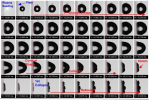
The following image is from a paper on cavitation bubble formation and collapse. Note that it is only 0.351 milliseconds from when the bubble forms (they used plasma seeding so they could control the location of the bubble formation) and the time when the bubble collapses. The bubble growth to instability and collapse occurs over multiple successive pressure waves. At 40 kHz the pressure oscillation at a given point goes from low to high to low one time every 0.025 milliseconds.

Generally, the time scales of bubble formation and collapse (which are why we use US cleaners) is of the order of milliseconds while the rotational speeds we're talking about are in minutes.

1745751394093.png

I guess that there are bubbles that form with gas in them (rather than just water vapor) that don't become unstable as they grow and float to the surface. Another issue with US cleaners - degassing. These are not "cleaning" bubbles since they don't collapse but they are the bubbles you would see.
 
It is true that the length of time the record spends in the ultrasonic bath is independent of the speed of rotation. My experiments have shown the cleaning efficiency in my ultrasonic bath was not statistically different for rotation speeds of about 1 to 5 RPM. As the rotation speed increased, the cleaning efficiency began to decrease. I used a variety of surface analytical techniques to confirm this. One theory for this is based on fluid dynamics. When a solid rotates within a liquid, the fluid near the solid surface tends to rotate at the same angular velocity, creating a "boundary layer" where the surface fluid moves at the same speed relative to the rotating object. At fast enough speeds, this "boundary layer" might prevent the cavitation bubbles and/or the surfactant micelles from effectively contacting the record surface to remove the surface contamination. This is just one theory, however the effect has been observed experimentally.
 
We keep talking about length and speed - what we're concerned with is how much time any particular point at the surface record is submerged in the ultrasonic bath.
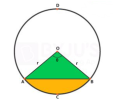
Simply put, at the point that is just submerged it will only be submerged for a small fraction of each rotation while points that are submerged the deepest (record edge/lead-in) it will be a larger fraction of each rotation. This fraction is a function of the distance from the spindle. The base of the triangle OAB moves closer to O as you move towards the surface of the record such that the angle theta decreases and the percentage of each rotation is defined as theta / 360 degrees.

1745763572467.png

Not quite sure what boundary layers have to with anything here. There is some shear across the boundary layer that might affect cavitation bubble stability but I figure that, at such slow speeds, it's a pretty small effect. At some speed you would develop turbulent (rather than laminar) flow but ... not at these speeds.

If slower speeds work that's fine. 1 rpm to 5 rpm are reasonable values although, with 5 rpm, you might get drippage.
 
If slower speeds work that's fine. 1 rpm to 5 rpm are reasonable values although, with 5 rpm, you might get drippage.
That seems very reasonable indeed.

I had to grin while cleaning the car a couple days ago because I was thinking about this question and how to try to provide a simple answer that would also make sense without getting too analytical about it......

Sooooo, I took the floor mats out and laid them on the driveway concrete. They were not particularly soiled and each had about the same amount of dried dirt on them from people getting in and out. I turned on the hose and, focusing on the area most soiled, sprayed one for 30 seconds not moving the stream of water at all, just concentrating on the dirtiest area. I then turned to the other mat and did the same thing, focusing on the area with the most soiling, using the same water volume and pressure (I have one of those nozzles that allows you to just open and close it changing nothing else) and moved the spray quickly back and forth for 30 seconds. The mat where I just focused the spray on the one spot came out much cleaner than did the one where I was moving quickly back and forth over a similar spot.

Not very scientific, eh? However, sometimes a simple, no-brainer exercise like this tends to be pretty convincing IF the analogy seems to fit. Let's not lose sight of having fun with our hobby and it just might be that the old adage "to each their own" would seem to apply if what you are doing is making you happy and increasing your pleasure with your listening experience! Carry on amigos.....
 
That seems very reasonable indeed.

I had to grin while cleaning the car a couple days ago because I was thinking about this question and how to try to provide a simple answer that would also make sense without getting too analytical about it......

Sooooo, I took the floor mats out and laid them on the driveway concrete. They were not particularly soiled and each had about the same amount of dried dirt on them from people getting in and out. I turned on the hose and, focusing on the area most soiled, sprayed one for 30 seconds not moving the stream of water at all, just concentrating on the dirtiest area. I then turned to the other mat and did the same thing, focusing on the area with the most soiling, using the same water volume and pressure (I have one of those nozzles that allows you to just open and close it changing nothing else) and moved the spray quickly back and forth for 30 seconds. The mat where I just focused the spray on the one spot came out much cleaner than did the one where I was moving quickly back and forth over a similar spot.

Not very scientific, eh? However, sometimes a simple, no-brainer exercise like this tends to be pretty convincing IF the analogy seems to fit. Let's not lose sight of having fun with our hobby and it just might be that the old adage "to each their own" would seem to apply if what you are doing is making you happy and increasing your pleasure with your listening experience! Carry on amigos.....
Thought for a sec you were going to put your floor mats in the US cleaner.

It is fun and there is no one right way.
 
Thought for a sec you were going to put your floor mats in the US cleaner.

It is fun and there is no one right way.
:rflmao:Yeah, thought about it but they're too dang big!!! NOT!!! Love your sense of humor!
So true, amigo, and even though I did a lot of research before I started down this path, my methods do not conform in any strict way to those proposed by folks whose work I studied. I simply took what made sense to me and went with that. For instance, Rushton Paul makes a pretty big deal about using a filtration system along with a huge emphasis on two rinse steps and the Type 1 Reagent Grade water used in them.....BUT, reading his article helped me a great deal in getting a better understanding of the proposition at hand. I would very much recommend folks to have a look at it and then decide for yourselves:


Foremost, an interesting read for those with inquisitive minds and it certainly helped me transcend the intimidation of getting set up and going so there's that.....and I'm so very pleased I did!!
 
The only real issues I can think of is that, for a faster speed, the probability of water sheeting down and getting on to the label increases which is an issue you have if you do not have a label protector. If you were to run so slow that you didn't repeatedly expose the record surface you may not benefit from any "loosening up" of crud.

The length of time that you leave the records in the solution is independent of the speed of rotation. That is, if you spin at 1 rpm or 5 rpm for 5 minutes then the amount of time any portion of the record is submerged will be the same between the cases.

What is interesting is that the amount of time in the solution, as a percentage of the total cleaning time, is dependent of on how far from the spindle hole the "groove of interest" is (yea, there's only one groove per side unless you are Monty Python but bear with me for arguments sake).

For example, if you solution comes right up to the runout/matrix portion then there will be a point (static) or ring (dynamic) that barely gets exposure at all while the lead in groove will have the most (as a percentage of cleaning time) of any.

The math is far simpler if you consider submerging the record up to the spindle hole. In that case half the record would be submerged at any time and, for any point on the record surface, the submerged cleaning time would be 50% of the total time. Of course, points at the perimeter of the record would travel through the solution faster but the dwell time would be the same regardless of how far from the spindle hole they are.

Spare you the horrible geometry. For a 12" diameter record submerged just to the edge of its 4" diameter label the cleaning time, as a percentage of total running time, is given as arccosine (2" / point distance from spindle) / pi

View attachment 3490194

Surface points right at the label edge (2" from spindle) are getting nearly zero cleaning.
Surface points right at the edge of the record are getting just about 40% cleaning time (2 min of a 5 minute total cleaning cycle).

What fun! Or I could be wrong, this is the disinformation superhighway.
I hadn't considered this limitation, but it makes perfect sense. If you fill right up to the inner groove it's effectively a tangent point to the water line, which means... not much exposure, so this makes sense. It seems like I should be trying to fill up as close to the label edge as I dare.

I haven't had an issue with the labels getting wet on the Vevor, because it's spinning fast enough to where the water doesn't get a chance to drip down. I'm using 3 drops of tergitol in 6 liters of distilled water (less than recommended, but videos I've watched seem to say that less is more with this stuff, and to use the minimum amount possible to break surface tension), the water seems to stick to the grooves of the record as it comes up out of the solution but not the flat surfaces, so as it spins the water tends to stay on the playing surface only.

If the speed is too fast, the still water in the tank brushes the expanding bubbles off the record before they implode. In other words, fluid turbulence prevents cavitation from happening on the record and instead happens only in the water. Ideal speed is somewhere around 1/2 rpm.

If Neil Antin (@pacvr) drops by he can explain it in better terms.

This is the sort of thing that I was thinking might make a difference, and it seems like there's good arguments for and against how much it matters. I'm not an engineer or anything, so all I can do is go by intuition and experimentation, but this is the sort of thing I want to be sure matters, or does not matter.


Hey @Stack, lots of opinions about this and you might as well just follow your own preferences on this one. However, in that other thread that you linked to, I rather relate more to this idea:

That's close to my logic, and I too remember reading a study about this suggesting that the longer continuous exposure of any given spot on the record tended to remove more of the dirt in the grooves. Personally, mine is set to 1 complete rotation every 3 minutes, and given that my session is 15 minutes long that gives 5 rotations total. I like it, but I really haven't played around with this to know much more than that. Ruston Paul, who wrote a very informative article about ultrasonic record cleaning suggested a speed of 3 rotations in 10 minutes, which is 4.5 rotations in 15 minutes.

The bottom line is that when you get things set up properly, you are very likely to be extremely happy with the outcome! There is a lot of good information about getting great results in this forum so keep doing searches and read what you find.....many of us have been doing this for a few years now and have contributed some great ideas and procedures. Have some fun and enjoy the ride amigo......carry on

I did see that dish washing quote, but that's actually the sort of thing that made me skeptical.

The more you think about it, the more that analogy falls apart; the reason you don't keep dunking your dishes in the sink is not because it doesn't work as well, but because it's easier to just leave them in the sink. It has nothing to do with the performance, it's purely down to effort. Even if it turned out that repeated dunking was marginally more efficient (which it might be with all the agitation in the water) you wouldn't do that because it would turn dishwashing into a labor intensive task; you'd take the minor performance hit to save your arms. On top of that, as somebody farther down pointed out, dishwasher spray arms DO work that way.

None of that is to completely write off the effectiveness of a longer soak, I just want reasoning that's a little more in depth. And, to be fair, I got it... arguing in both directions :D
 
I've been US cleaning for a couple years. This thread is first time the short duration cleaning near label has been pointed out. To my memory, such as it is. Not much to do about it with Vevor style machines.
I pick an arbitrary cleaning cycle duration. 10 to 15 minutes. Records that don't sound as I'd like, get another cycle.
 
When I built my first ultrasonic cleaner for records, I found that longer than a few minutes in the ultrasonic bath had little beneficial effect on the overall cleaning process of records and the possibility of a detrimental effect. My initial experiments to evaluate several ultrasonic bath variables were done on sacrificial records that were cut into ~1 cm squares. These 1 cm square record samples had controlled amounts of various known contaminants (oils, greases, lubricants, fingerprints and minerals from hard water) applied to them. These samples were then heated in an oven to drive off any volatile species and to promote mechanical interlocking and/or diffusion into the record surface, which would make them more difficult to remove. These samples were then analyzed with several different surface analytical techniques before and after various ultrasonic cleaning variables. One variable was time in the bath. For these experiments, the 1 cm square samples were suspended vertically in the ultrasonic bath for various times. So these test samples were static and not rotating on a spindle as in a typical record cleaner. Typically > 95% of all surface contaminants were removed after 1 min of exposure which corresponds to ~3 minutes with a rotating record in an ultrasonic bath.

So even if the exposure time is much less closer to the label, I doubt that it would have little effect on the overall cleaning efficiency because most people are using run times of 10 to 15 minutes which corresponds to 3 to 5 x the time that I found for > 95% removal of contaminants.

Note 1: These experiments were all done using laboratory ultrasonic cleaners (Elma, Cole-Parmer or Emerson). Results may vary with different ultrasonic cleaners.

Note 2: The surface techniques that were used to analyze the test samples include; Optical Microscopy, Scanning Electron Microscopy (SEM), Photoelectron Spectroscopy (PES), Fourier Transform Infrared Spectroscopy (FTIR) and Thermal Desorption Mass Spectrometry (TD-MS)
 
Last edited:
Back
Top Bottom