• The move to the new server is done. There are some software and database maintenance updates in process. This has us passing the hat around to help out. We appreciate any donations. Seriously, even a dollar helps. The payment page may be found here - https://www.audiokarma.org/support.html

ONKYO decks with Nakamchie parts?

RichTassoni

Active Member
So I have a few ONKYO decks 6, two that this tech that worked on them does great cassette deck work, a TA2600 AND is working on my TA2700 now tuning it up said they have Nakamchie heads and mechanisms in them maybe some other parts making them rare to him that he's seen but makes for great recording and playing. Have anyone owning ONKYO decks know of this?
 
Register to hide this ad
No, Onkyo decks do not have Nakamichi parts.

However, it is true that some Onkyo decks (and some decks of other brands like Yahama, TEAC, Kyocera, Kenwood, ...) used the same or near-identical bought-in mechanisms that are also in the Nakamichi decks of the BX, CR, CD, and DR-series. These mechanisms are colloquially called 'Sankyo', although it is not 100% certain that Sankyo provided them: it may have been Alps, with Sankyo motors.

Curiously Nakamachi never used the two most interesting variants of this transport: the single-capstan direct-drive (pioneered in the Onkyo TA-2055 IIRC) and the dual-capstan quartz-lock direct-drive (TEAC V-7010).

Nakamichi never shared their proprietary heads with any other manufacturer. But the heads in the 2-head models of the above series were bought from Canon, and Canon, obviously, sold these also to other brands.
 
I can't remember where I heard this, but (going along with what Werner said), that the only Nak deck with a Nak transport, was the Dragon. All others were Sankyo. Take that with a grain 'o salt.
 
Nope Artie. All Nak BX,CR,DR,CD and the RX202 decks use sankyo. All older nak decks use nak transport. ZX7,ZX9,LX5,LX3,Dragon,480,481,680 series,RX 505,RX 303 etc etc etc.
 
Nope Artie. All Nak BX,CR,DR,CD and the RX202 decks use sankyo. All older nak decks use nak transport. ZX7,ZX9,LX5,LX3,Dragon,480,481,680 series,RX 505,RX 303 etc etc etc.

Cool. Thanks for that clarification. So, my CR-5A is Sankyo?
 
So back in the days when all these decks were being built 80s 90s in Japan hard to believe that these companies weren't mixing parts, or Nakamchie not selling some of their products under the different name? I have a 93 Ford F150 all in mint condition had a little transmission and clutch work done on it few years ago, transmission shop said it's a Nesson 5 speed manual transmission great transmission. We all know that our cars have parts from all over the world.
 
Inferential logic can be somewhat inaccurate, or wildly inaccurate, or even occasionally accurate IF the input to the inferences is comprehensive and true.

In this case, start with the question of whether Joe Blow Transmissions in B^@%^ck IL has any idea what they're talking about when it comes to Ford's 1993 major component pipeline choices, and go on from there... it's not a slippery slope, it's a straight vertical drop.

In this case what zedex stated is fairly common knowledge in the tape community and even if JimBob Solderblob over there in mid-Ohio says he's seen an Onkyo with a proprietary Nak head in it, doesn't make that a broad truth. Sure someone could have put one in there along the way and he might be right from that one example, but we know the factory did not do this.

Post a picture of the head in question and we can remove all doubt. Same for the mechanism.

John
 
Last edited:
All Nak BX,CR,DR,CD and the RX202 decks use sankyo. All older nak decks use nak transport. ZX7,ZX9,LX5,LX3,Dragon,480,481,680 series,RX 505,RX 303 etc etc etc.

There are four transport mechanism families related to Nakamichi.

The first is the original single-motor dual-capstan of the 1000 and 700. Then there is the single-motor single-capstan transport of the 600, 500, 550, etc. and likely the decks Nakamichi OEMd before they started under their own name.

But all these are regarded antique and are seldom the subject of discussion these days.

That leaves two families: the Classic transports (48*, 58*, 68*, 1000ZXL, 700ZX*, ZX7/9, Dragon, RX) and the Sankyos (see above).

The Classic transport was almost certainly designed by Nakamichi, but I am not 100% sure they actually built it. AFAIK there was a major agreement with Sankyo(*) over a long time. Who builds what in Japan is mostly moot anyway, as they have/had a tradition of deeply-nested subcontracting, with small, unknown companies often doing most of the work.

The generic transport known as 'Sankyo' emerged with the Onkyo TA-2055 in 1982 (single-capstan direct-drive). Already in 1981 the TA-2060 had a very very similar mechanism, but actuated by solenoids instead of a cam motor. Later in 1982 Nakamichi for the first time used a Sankyo, in the BX-1 (single-capstan belt-drive). Given that Onkyo seems to have been the first customer of this transport, it is unlikely that the family had been designed with of for Nakamichi, although there must have been some customisation through the years. But that holds for every customer. It is also not certain if Sankyo built these mechanisms. Most likely it got its name during the recent cassette revival, because many of its instances proudly have 'Sankyo' on the reel motor. (Sankyo also was the supplier of the entire direct-drive motor system, right up to the final quartz-locked version used by TEAC). So, who made the Sankyos? Might be Sankyo. Also might be Alps: the large dual-capstan transports of the big Luxmans, Alpines, and Alpages also have a lot in common with the Sankyo drive!

There are some nuggets of information in the Nakamichi book (https://www.cdjapan.co.jp/product/NEOBK-2456125), but (machine) translation is hard and bound to confuse matters even more. I really should find the time to approach one or two people capable of a decent translation ... And even then the book, written only a couple of years ago, may well be wrong in this matter.


Once past the OEM times Nak really never supplied any other manufacturer with their unique crystalloy heads. In doing so they would have given away their single-most important performance advantage. But I do happen to know of a hobbyist who transplanted Nak heads into a Yamaha KX-1200 or whatever. Both decks being Sankyo-based that was not too arduous.


(* Confusing, not?)

 
But I do happen to know of a hobbyist who transplanted Nak heads into a Yamaha KX-1200 or whatever. Both decks being Sankyo-based that was not too arduous.

Velly interesting. I just posted about a Luxman deck with a bad head. I wonder if I could transplant a Nak in there? Better question: could I even find one these days?
 
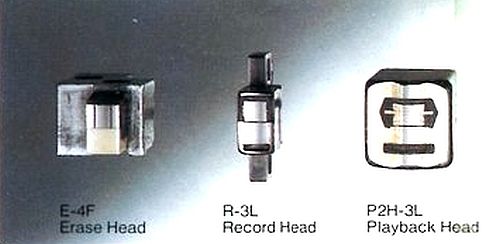
The famed Nak heads are discrete record and play heads. They do not apply at all to a basic 2-head deck like the Lux K-100.

You won't find them anyway. These things are worth their weight in gold these days.

Nakamichi%2BCR-7E%2B%252803%2529.jpg
 
The famed Nak heads are discrete record and play heads. They do not apply at all to a basic 2-head deck like the Lux K-100.

You won't find them anyway. These things are worth their weight in gold these days.

And just as an FYI, many folks think the purpose of a 3-head machine is for the ability for real-time off-the-tape monitoring. That's merely a side benefit. The reason is that a record head, and playback head, need different gaps for highest frequency response. I can't remember which needs the wider gap.

Record head, maybe?
 
Thanks for that additional info, Werner. 100% on the main reason for 3 head being able to optimize the gaps, though I suspect that became more of a focus as various companies tried to pull what was originally a midfi solution (cassette) up closer to hifi performance. The slower speed and narrow tape were obstacles that the engineers didn't have to wrestle with as much on open reel. Also I'd say that 3 head open reel designs predate the drive for "recording as good as the source" results, so pre-cassette I am not sure but what the ability to monitor during record or do other things (like sound on sound etc.) were higher priorities.

BTW there's also a Tandberg 3014 out there somewhere (probably Canada) with a Nak head in it, PB IIRC... professional tech did the work, supposedly it worked ok but who knows. Point being, it's just another aftermarket mod, not evidence of an intercompany alliance :)

John
 
Back
Top Bottom