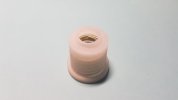
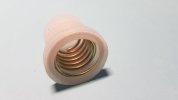
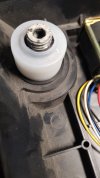
Pioneer PL-L series & Phase Linear 8000 series suspension "Boots".
Hello all,
It's been awhile since I last posted. I've been very busy with turntable repairs.
What you are all referring to is officially known as a "Rubber cushion A" in the Pioneer service manual. The part number is 942-8040.
I have discussed this part already in another AK thread, so I'll try to add information instead of saying the same thing.
The function of the Rubber cushion A "boot" is threefold:
FIRST, (and most importantly), it provides a positively centered, geometrically stable, compliant seat for the spring.
SECOND, it provides a thin rubber sleeve that fits snugly over the spring to help damp spring coil resonances.
THIRD, the sleeve (when new only!) assists the spring by slightly increasing the spring rate. The effect of this is that the lower plinth will reside at a slightly higher position with a new boot as opposed to an old torn boot, and the fundamental suspension frequency will be slightly higher.
Since the amount of spring rate assist a new boot provides is probably quite low (you would have to do an analysis of the design to determine the actual percentage of this), it is probably safe to say we can ignore this factor especially since we can make up for the theoretical increase in downward displacement of the lower plinth with a higher pre-load in the form of a slightly thicker spring seat. The lower suspension frequency due to the lower spring rate of a dried out torn boot will be a welcome outcome anyway.
I hate to say it, but most of the Audio Karma advice I have seen (including the advice posted here in this thread) demonstrates a lack of understanding of this part. Remember, when it comes to these turntables (and the Yamaha PX series, and the Sony PS-X SLT series), I do not proclaim my opinions from the arm-chair, my advice comes from actually working on these repeatedly and carefully studying their idiosyncrasies and special needs.
First let's look at the advice for using an O-ring for the spring seat. Like I have already stated here "most importantly it provides a positively centered compliant seat for the spring". A typical round cross-section O-ring from the hardware store will not provide adequate lateral positive centering. The O-ring will tend to slip between the coils of the suspension spring and now the plinth looses its necessary centering. Of course, there is always the possibility that an O-ring will work in your particular situation (unlike me, you might have been born under a lucky star), but this is not the correct, thorough, and proper way to effect a repair that you can be confident and proud of.
Second is the less important issue of spring coil damping. Energy of all frequencies is doing its level best to ingress into your turntable from the feet and any other surface it can (nature abhors a vacuum). Frequencies higher than the fundamental resonance of the suspension spring/plinth mass combination will try to set the spring coil into a harmonic resonance condition. In addition, the primary fundamental resonance of the suspension will need to be tamed with some damping as well. This is what the sleeve portion of the Rubber cushion A does.
Now, if we take into account the fact that there is a substantial amount of wiring connecting the upper plinth to the suspended lower plastic pan plinth on a PL-L1000, we will understand that adequate fundamental resonance damping is already present. If we now look at the function of the sleeve at higher harmonic frequencies, we will see that a sleeve will indeed provide damping of the spring coils. How important is harmonic damping? This is a good question. If we assume that an attenuation of this harmonic energy will occur across the only path that this energy can take into the critical lower plastic pan plinth (the compliant and hopefully lossy spring seat), we can assume that the sleeve should be mostly unnecessary.
So the bottom line is:
1- Don't use a round or X cross-section spring seat. Use a square cross-section seat of suitable durometer and material.
2- If you must use a sleeve, use a sensible, stable, and compliant material/device that will not impede the free movement of the spring such as a finger from a thin rubber glove or even a condom. Keep in mind that latex is not going to give you eons of stable longevity. Again you can use a spring sleeve, but I don't think it is necessary.
Finally, what I would like to convey here is how important it is for audio forum posters to have their facts straight and to make the effort to thoroughly and properly understand the physics of whatever they are volunteering advice on.
There are countless cases where an innocent reader of a given thread implements forum advice only to break something or compromise the performance of whatever device he or she is involved with. Of course there are also many cases where forum advice was very helpful and my guess is the good advice is more prevalent than the bad. Let's strive to improve this ratio as much as possible.
Best wishes, Professor Bizzt