• The move to the new server is done. There are some software and database maintenance updates in process. This has us passing the hat around to help out. We appreciate any donations. Seriously, even a dollar helps. The payment page may be found here - https://www.audiokarma.org/support.html

Passive or active subwoofer?

wazhead

New Member
Hi there, I have a JBL control sb5 passive sub 40-120hz. They have a crossover of 120hz and the frequencies below this are taken from from attached Monitor Audio Bronze 2s.
They say having a powered sub takes the heavy lifting off the main speakers, but my Audiolab 6000aMk2 only has pre out (no bass management), so the main speakers would receive the low frequencies if I swapped for a powered sub.
What I want to know is, have I got this all right and is there any real point to swapping for a powered sub?

I know this is a weird question, but no-one I have spoken to seems to give me any reasons for their decision.

Any advice here would be greatley appreciated.

Thank you in advance.
 
Register to hide this ad
Hi there, I have a JBL control sb5 passive sub 40-120hz. They have a crossover of 120hz and the frequencies below this are taken from from attached Monitor Audio Bronze 2s.
They say having a powered sub takes the heavy lifting off the main speakers, but my Audiolab 6000aMk2 only has pre out (no bass management), so the main speakers would receive the low frequencies if I swapped for a powered sub.
What I want to know is, have I got this all right and is there any real point to swapping for a powered sub?

I know this is a weird question, but no-one I have spoken to seems to give me any reasons for their decision.

Any advice here would be greatley appreciated.

Thank you in advance.
If I am understanding your situation, I would opt for the powered sub for two reasons. First is it will give you lower bass extension which will make a big difference in overall sound quality by extending to frequencies well below 40hz. Second is that a powered sub will give you much better control over bass volume and the cross over frequency point. Since your speakers can reach down to 42hz you should crossover much lower than 120hz, IMO, and experience. A powered sub will allow you to tailor the crossover frequency and sub volume to work the best in your setup.
 
A powered sub has several advantages over a passive one. Level matching, crossover adjustment, phase adjustments, and the addional amplification dedicated to the sub. Plus, you can run you main left and right speakers through the sub crossoveer and that will relieve them from trying to reproduce low frequencies. An added benefit is cleaner mids from the main speakers.
 
Good points. Would I get any benefit from getting a separate sub amp and powering the sub I have?
You certainly could. Either cut an appropriately sized hole in the back of the sub cabinet or built a separate enclosure for the amplifier.

 
Good points. Would I get any benefit from getting a separate sub amp and powering the sub I have?
It depends on the sub amp. I have a HSU sub that has been going strong since the late 2000s. Many lower priced subs have amps that aren't the best and will fail at some point. Having an external sub amp will allow you to just buy another amp is it dies. If an internal amp goes bad then getting it repaired might be more hassle and expense than its worth. When it comes to subs, powered or passive, and you get what you pay for. One other way to go is to find a nice sub with a blown internal amp and convert it to a passive one. I did this with a Klipsch 10" sub by wiring one of the sets of banana plugs directly to the speaker. This took the amp out of play and I connected it to a Fosi BT30D Pro 2.1 class D amp. The sub works great works and the amp controls its crossover point and volume. I paid $60 for the sub since in had a bad amp. The bass goes deep and the amp can power it to a decent volume. If you go this route just make sure that the non working sub only has a blown amp and it is a decent quality sub with a 10" or, even better, a 12" speaker.
 
I prefer passive subwoofers. Basically, I am too lazy to fiddle with separate volume controls every time I want to adjust the volume. By the time you get it dialed in, the song is half over. With my passive subwoofer, I never have to touch it. (at least not so far in 40 years)
 
I prefer passive subwoofers. Basically, I am too lazy to fiddle with separate volume controls every time I want to adjust the volume. By the time you get it dialed in, the song is half over. With my passive subwoofer, I never have to touch it. (at least not so far in 40 years)
When connected properly, a powered subwoofer should be set and forget, same as passive. If you have to adjust the sub level every time you change the volume, you're doing something wrong.
 
To be honest, I don't think the JBL subwoofer you have is ideal for your situation. I would forget about getting a powered sub amp and instead look around for a decent used powered sub.
 
A powered sub has several advantages over a passive one. Level matching, crossover adjustment, phase adjustments, and the addional amplification dedicated to the sub. Plus, you can run you main left and right speakers through the sub crossoveer and that will relieve them from trying to reproduce low frequencies. An added benefit is cleaner mids from the main speakers.

While some powered subwoofers include a high-pass filter to offload low frequencies from the mains, this is not the norm. It used to be more common, but not so much any more.
 
In most cases yes, but you have a matched satellite/sub combo that blends fairly nicely, with an internal crossover that high passes the satellites. The jbl control stuff of that era is pretty nice. Your bang for buck might not be here.

If the bass is lacking, you may want to check inside. I've seen a few of the control subs that have nicely flavored surrounds that get eaten...
 
While some powered subwoofers include a high-pass filter to offload low frequencies from the mains, this is not the norm. It used to be more common, but not so much any more.
Three of the Dayton sub amps from Parts Express have low and high pass filters. Some other brands do as well.
 
Three of the Dayton sub amps from Parts Express have low and high pass filters. Some other brands do as well.

Yes, as I said, some do. The majority do not.

I only mentioned it in light of your comment that offloading the mains is one of the advantages of a powered sub.

It can be, but often is not. If a person wants to high-pass their mains, they will need to assure that the subwoofer they purchase has this capability.

EDIT - or implement the low frequency filter by some other means.
 
Last edited:
My answer is it depends.

You are correct, if the powered sub has a high-pass in it to relieve your main amp from the power requirements of the LF, it will benefit your main amplifier/speaker setup in additional reserve power. If your main amp has plenty of power then this is not a big benefit.

The high-pass has the additional benefit however of allowing you to integrate the sub where the LF from the sub is not coming from the main speakers at the same time, which will give you better bass and enable you to create a flatter response curve, which to most is desirable (accurate).

If the sub only goes to 40Hz and as a poster above stated your mains are flat to 42Hz however, … I’d shop for a subwoofer that adds a little lower frequency response if possible, but that’s me and it depends on the music you listen to.
 
In my opinion a powered sub is by far the better choice. In most cases the amp is big - 100 watts at least. The cabinet and driver are specifically designed for bass extension. Most subs I've seen have line inputs and many of them will manage your speaker output also. The Dayton SUB-1200 12" is an excellent unit and took 2nd place in Wirecutter's ratings (to the even better Rogersound Speedwoofer). I have the low profile SUB-1000L 10" version which is not as good but still rocks. Both Daytons are the deals of the century. And both have the passthrough high pass filter function mentioned by @homebrew. You have a nice system but for $200 you can have a stellar one that legitimately goes below 30 Hz > 100 db (and no blown woofers)
 
I see lots of advantages going with a better active sub (or two or more). Your current sub doesn't play very low, and the fixed crossover is quite high for a subwoofer. Frequencies above 80hz become directional, and 80hz is also about the point where male vocals reach, meaning you'll hear some of the male vocals coming from wherever the sub is located. Some of what I've read about that sub suggested that it has a very limited functional range.

A decent active sub could offer a lot more features, deeper bass extension with more output, many offer variable low pass and high pass crossovers, phase adjustments, separate gain control, and both high and low level inputs. You can run a sub in parallel from the speaker outputs of your main amp to the high level sub inputs with no strain on the amp at all. Or you can also run an RCA input to the low level input of the sub, if your amp has an RCA output...preferably one controlled by the volume knob. (you can split the RCA output if there's only one and its in use).

You can also run your Monitor Audio full range and skip the high pass filter of the sub, and just let the sub augment what your main speakers produce. Or you can run the main speakers from the high pass filter of the sub, and relieve the bass duties from the MAs, which in theory means they no longer have to produce the deepest, largest frequencies that cause big excursions from the woofer, which cause higher distortion....your amp benefits from this setup as well for the same reasons. Cleaner sounding in theory, but adjustment is always key, and what you like is subjective..

Many folks run their subs too loud in relation to the main speakers IMO, but that is also subjective. Think discoteque or concert hall...very different bass outputs, but you'll have the ability to choose the output level, the low pass crossover frequency, fiddle with the phase adjustment, or choose to run the mains through the high pass filter or not.

Dayton and Monoprice (among others) offer decent low cost subs, while REL, RSL Speedwoofer, SVS, JL, and others offer higher end performance. Larger woofers tend to have more deep output, but it's very room dependent. Multiple subs allow for more placement options, and help reduce room nodes.
 
Last edited:
My preference is for subs powered by an amp separate from the main amp and also physically separate from the sub cabinet.

In my experience, there are many subs out there with dead plate amps. Until faced with compelling evidence otherwise, I choose to believe that is caused by the sub amp being mounted on the sub cabinet.

I like to use a pro amp with bass management to power sub builds, but even when using plate amps I don't attach them to the sub cabinet.
 
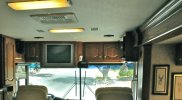
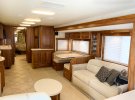
Some power subs have filters built in that roll off the bass to main speaker amplifiers feeding only the frequencies below the filters to the sub amp and woofer or woofers. I know my M&K sub with twin push pull 8 inch woofers had that option. But my NAD AVR had a LFE output so it wasn't necessary that I use the M&K subs filters in my Motor homes. I eventuallt had a 32 inch flat screen installed to replace the tube TV. The right front speaker is hidden by the sound cabinet and the right rear is just out of sight to left of the image facing toward the rear of the coach. DSC_2964.jpgIMAGE.JPG B.JPG
 
Last edited:
Wow! What a brilliant community. You've helped so much. I love learning about this stuff and you've all been really informative. Thank you all. Have a Merry Christmas.
 
FWIW, Some of my house`s 6 room`s stereo systems have active (powered) subwoofers, and some don`t . All subwoofers are the floor firing types.

The 2 higher quality separate based stereo system type ones use external 400 watt each power amplifiers, and the other 4 systems use passive dual voice coil woofer type utilizing their built in rebuilt passive crossovers to separate the lows from the small bookshelf sized main speakers connected through the subwoofer.

The 2 powered subwoofer stereos systems both use 2 individual L/R physically placed subwoofer configurations.
Only one of the rooms passive subwoofer stereo systems use 2 physically L/R placed subwoofers due to the nature of the room, and the very wide spacing of the room`s wall mounted bookshelf speakers.

And a Merry Christmas back to you, wazhead, Sir.
 
Back
Top Bottom