
• The move to the new server is done. There are some software and database maintenance updates in process. This has us passing the hat around to help out. We appreciate any donations. Seriously, even a dollar helps. The payment page may be found here - https://www.audiokarma.org/support.html

Peavey CS 1000 Hiss

AyEss

Member
Hey guys, and girls ofc :)

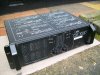
Recently started learning how to repair faulty amplifiers. My very first project was a Peavey CS 1000 Power Amp that i purchased off ebay.

Took me a while to get to grips with what im doing, But i eventually figured it out...
But to cut a long story short..
The amp had 4 shorted T-03 Output transistors in Channel B board, Which i found replacements and replaced, Along with the 8pic OPAMPS and Equivalent PNP and NPN Driver transistors...
Not 100% the same model code numbers, As peavey use an in-house numbering scheme.. But peavey theirself pointed me to replacing them with MJE340 NPN and MJE350 PNP's, as Peaveys numbered "MJE 6019" are discontinued...

The amp now works flawlessly and sounds fantastic. But got 1 small issue..
idle hiss....
I know this is usually not much to worry about, But its only 1 channel.. The channel board that i repaired...
Power the amp up, turn the gain pots all the way up (i control volume with a Behringer DJX 400 Mixer), and the speaker connected to Channel B, Has a noticeably louder idle hiss... It literally over powers the hiss from the Channel A speaker!!!

Is this something to worry about?!?! Also.... What general direction should i be looking?

I heard the OPAMPS in it, are "high noise", But i replaced them in the Channel A board too, Since i had a big pack of them, Just to have both channel boards freshened up, But yet, Channel A board doesnt hiss as loud....
(TL072CN and NE5532P OPAMPS)

I was going to wait to see if my repairs were successful, Then i was going to replace the driver transistors in the Channel A board too, Just to keep them both fresh, and equal with up-to-date equivalent and matching driver transistors as eachother..
But im worried, it may potentially be those that are causing the hiss in the Channel B board.. and dont want it to start happening to them both.

Channel A board has the original peavey "SJE6019 Drivers and the Channel B board has the newer, Available MJE340 and MJE350 drivers...

Thanks
-pic for attention.. and to show you which amp i have -
 

Attachments
  • 100_1779_2018-03-20_18-28-13.jpg
    100_1779_2018-03-20_18-28-13.jpg
    145.8 KB · Views: 13
Last edited:
Register to hide this ad
Using low noise parts (transistors and OPamps) at the 1st amplifier stages, and low leakage capacitors in the signal path, is the usual way to reduce the hiss. (BTW the tl072 and 5532 are low noise parts). Metal film resistors at the 1st amplifier stages can also contribute to reduce the noise floor. Even dirty soldering at a high gain circuit can introduce some noise.

Also, some malfunction could be creating the noise. DC voltages where they shouldn't be, for example. Check if the woofer moves back and forth when you move the volume control. Check also the voltage at the OPamps output (pins 1 and 7), it should be zero or just a few mV.

I'd try to spot any component replaced in that channel, even prior to your repair, and check for clean soldering at the 1st stages. Also out of specs resistors. I'll check the schematic later and see what components I'd check / replace in a case like yours. But definitely deep clean the soldering. You want a nice shiny solder spot without any residue or rosin between components leads.
 
Last edited:
Using low noise parts (transistors and OPamps) at the 1st amplifier stages, and low leakage capacitors in the signal path, is the usual way to reduce the hiss. (BTW the tl072 and 5532 are low noise parts). Metal film resistors at the 1st amplifier stages can also contribute to reduce the noise floor. Even dirty soldering at a high gain circuit can introduce some noise.

Also, some malfunction could be creating the noise. DC voltages where they shouldn't be, for example. Check if the woofer moves back and forth when you move the volume control. Check also the voltage at the OPamps output (pins 1 and 7), it should be zero or just a few mV.

I'd try to spot any component replaced in that channel, even prior to your repair, and check for clean soldering at the 1st stages. Also out of specs resistors. I'll check the schematic later and see what components I'd check / replace in a case like yours. But definitely deep clean the soldering. You want a nice shiny solder spot without any residue or rosin between components leads.

Hey, thanks for your reply..
I did check for any DC voltage at the speaker terminals, before i connected up my speakers, It came up with around 5mV on both channels... Perfectly acceptable :)
The hiss is the same also, With or without output TRIAC's in place.. (which i also replaced, from SAC187, To BTA16 700B's.. I checked this firstly, because i know the triac's are there incase of DC voltage etc, to protect the speakers..

I have remove and tested each capacitor on each Channel Board, aswell as the power supply.. Checked the uF rating of them, aswell as ESR meter, All tested super close to printed ratings, Which was surprising, Considering they are 30+ year old caps...

Ive checked solder joints too, One of the first things i checked tbh. Solder connections for cold solder joints or bridges, Just for good measure, since i did do alot of soldering on it..

I cant for the life of me, Think of what potential malfunction it could have... When repairing the channel B board, I inspected and tested every resistor, Diode, Transistor etc etc.. and replaced everything that didnt match to spec...

This is why im at a loss...
 
Checking the DC at the opamps output and at the volume pot would be the 1st thing I'd do.

Can you swap the preamp > output modules connectors? to see if the problem is at the drive circuit or at the power amp board.

BTW, do you have a link to the right schematic? there are several peavey models from different years with same name but different schematic.
 
Last edited:
Checking the DC at the opamps output and at the volume pot would be the 1st thing I'd do.

Can you swap the preamp > output modules connectors? to see if the problem is at the drive circuit or at the power amp board.

BTW, do you have a link to the right schematic? there are several peavey models from different years with same name but different schematic.

Okay, Sounds good.
Sorry but i am very new to amplifier repairs, This was my very first project, Im still learning.
Im pretty happy that i bought it back from blown up and smoking, To working and sounding good.. Its just the finer detail bits im not struggling with haha..

How do i test DC at the OPAMPS? Black lead on chassis ground, and Red lead on Pin 1 and 7 of the chip?
Just for a reference... IF there is DC at the OPAMP, what would that indicate as the problem?

As for schematic.. Nope.. I have a rough one that i found off internet, But i dont have anything for technical data etc..
Im new to reading schematics too :D

Appreciate your help this far :)
 
Also, Just checked.. No my speaker woofers dont go in and out, when i turn the potentiometer up and down..
Just the hiss gets louder...
Sounds like Static, Sort of noise...
Its audible when music is playing, if you hold your ear near the speaker, But not over-powering loud.. Definitely dont hear it through the audio from a couple meters away, its mostly loud and annoying at idle, with no signal being passed through it...

I also tried turning master volume up and down on the mixer, That makes the hissing louder / quieter too..
So does that mean, the hiss is potentially coming from the mixer?
If the mixer volume is having an affect on the hiss coming from the speaker?

EDIT: i still get the hiss with the mixer disconnected.. So nope...
Defo the amp :(
 
Last edited:
Ok. So if it goes up and down with the volume control, it comes from the 1st amplifier stage before the volume pot.

Check if hiss is louder even with volume at minimum.

Black probe to chassis and red to pins 1 and 7 is the way to measure DC at the opamps. Use the lower scale. Expect a few mV. BE CAREFUL. DON'T RISK EVEN 1%. PLAY 100% SAFE. If there is some point hard to reach, leave it alone and find another test point with easier access. I usually cover all the high voltage parts of the circuit with some rubber mat or heavy cloth to avoid touching in a bad movement.
 
Ok. So if it goes up and down with the volume control, it comes from the 1st amplifier stage before the volume pot.

Check if hiss is louder even with volume at minimum.

Black probe to chassis and red to pins 1 and 7 is the way to measure DC at the opamps. Use the lower scale. Expect a few mV. BE CAREFUL. DON'T RISK EVEN 1%. PLAY 100% SAFE. If there is some point hard to reach, leave it alone and find another test point with easier access. I usually cover all the high voltage parts of the circuit with some rubber mat or heavy cloth to avoid touching in a bad movement.

I have found the issue.. I checked the OPAMPS, and found one to be slightly leaky..
Although i already did replace them when i repaired the amp, I guess one was faulty from factory...
Popped a new one in, and its PERFECT now...

Thankyou for your help..
 
Back
Top Bottom