• The move to the new server is done. There are some software and database maintenance updates in process. This has us passing the hat around to help out. We appreciate any donations. Seriously, even a dollar helps. The payment page may be found here - https://www.audiokarma.org/support.html

Peerless cone tweeter sag

basplin

Active Member
Hi all - I've got a couple of vintage Peerless cone tweeters my speakers that distort at certain frequencies (most obvious in higher piano notes). Some of the tweeters distort, but not others, so I'm thinking it has to do with the driver(s) in question itself and not the crossover. I know that the large magnets can cause sagging in woofers, but can the same thing happen with such a small magnet in the tweeters? I'm thinking that rotating them could be the answer, but the tweeters are a pain to get to and I don't want to do it unless I know that it could actually solve the distortion/buzz, or if I should look for the problem elsewhere. Thanks in advance!
 
Last edited:
Register to hide this ad
Cone and voice coil sagging is more likely on larger drivers because the long term effects of gravity on the greater cone and voice coil mass is more likely to lead to sagging misalignment. Also, the more compliance both the speaker surround and centering spider allow (ie on woofers in particular), the more likely sagging will occur. Rotating the drivers 180 degrees allows gravity to start working in the opposite direction on such drivers to counteract the sagging.

If the tweeter drivers that distort are sharing the same cross-over circuit as the non-distorting drivers, then the problem will likely be in the tweeters themselves as bad capacitors would usually cause distortion in all the similar style tweeters in the same circuit. Even so it wouldn't hurt to install all new cross-over components just to be on the safe side.
 
Exceeding the power capability of those tweeters would cause distortion.
"Sagging" doesn't seem like it would apply as reason for distortion perhaps they are crossed over too low in your application?
I have a couple fine sounding vintage speakers that use Peerless cone tweeters that sound remarkably good.
 
Good input guys, thanks. I can rule out the crossover, assuming that the resistors are still fine (not sure why they wouldn't be). The caps have been replaced and upgraded to spec. Also, the distortion comes as all volumes, even super low, so I don't think it's a power issue. Stickman is probably right, they're probably just going bad. I do have extras which I can replace them with, but it would be nice to somehow 'revive' the ones in there....
 
tubed, you've got me thinking that perhaps they are crossed over too low. 6uf is the stock value, but, Stickman, I remember you told me once that 6uf was a little high for those Peerless tweets, and I might be better off trying 5.6uf instead. Even in the good drivers, I was noticing for the first time a slight amount of "sting" ...distortion/noise/etc....whenever a piano note was struck, so the crossover might have a role here. Might experiment with that this afternoon...
 
Last edited:
Because of tolerances in most cross-over style capacitors the difference between a 6 and 5.6 uf capacitor would probably not be noticeable. Dropping to a 5 uf cap with a tight tolerance (5% or less) would allow you to hear if the distortion is being caused by too low of cross-over frequency as you suspect. The larger Peerless cone tweeters were used in many two way systems and were crossed-over at lower frequencies than many other cone tweeters could handle due to the high cone compliance built into the design (by tweeter standards that is).

The problem with the simple 6 db per octave 1st order cross-over filter designs is the gentle roll off slope does allow some lower frequency signal energy to reach the tweeter. A 12 db per octave 2nd order design is a vast improvement as it drastically reduces the amount of lower frequency energy that makes it through to the tweeter below the cross-over frequency point.

One final point to consider is that the Peerless cone tweeters use a pad of polyester like damping material behind the cone which gives them them smooth sound as back reflections are greatly reduced. If this pad of material ever came loose or started to degrade the fibers could possibly get into the voice coil gap but this seems unlikely. It was unfortunate that Bozak used foam damping in their aluminum cone tweeters that does degrade over time and definitely mucks up those tweeters as they age.
 
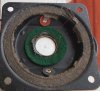
MT20HFC 003.jpg Here's my view on distorting Peerless tweeters.Look at the picture of a MT20HFC opened and you'll see how increadibly close the voice coil is to the green felt ring!
No wonder some rubs against the damping ring and we all know how bad that can sound in a big speaker.In a tweeter it can be a sizzling sound and/or distortion.
The later MT225HFC on the other hand has a space of 2-3mm between coil and damping.I have a picture somewhere.Maybe I'll find it.
 
Good point Stickman - I've actually got some 5uf motor run caps that should work great for this experiment. Should be next week when I get to it. If the problem is with the insulation, I suppose it could be feasible to try and open up the problem tweeters and see if I can find the issue.

Rolf - that is fascinating, thank you for sharing! I'd love to see the inside of the MT225 - that is the driver that I am dealing with now.
 
Back
Top Bottom