• The move to the new server is done. There are some software and database maintenance updates in process. This has us passing the hat around to help out. We appreciate any donations. Seriously, even a dollar helps. The payment page may be found here - https://www.audiokarma.org/support.html

Phono input vs Aux

laptop44

New Member
Hello to all My question is if the phono input is rated at is 82 dB and the AUX or Tape input is 103dB would the turntable be louder if either input was used with an external high quality tube phono preamp? I was not sure if the preamp signal gets boosted by the AUX or Tape output circuit

Its a Pioneer SX-3700 Totally recapped and serviced. FM and CD is loud at volume knob at 9 or 10. When using my Linn LP-12 turntable with a Grado Signature cartridge, volume knob has to be to be set at around 1 o'clock for decent volume

Thanks
 
Register to hide this ad
There is no reason you should be concerned that the volume knob has to be rotated more to up the sound from the turntable. The amplifier just doesn't have as large of a signal to start with. This doesn't cause any added stress to the amplifier.

The only issue is when you change sources and forget the volume knob was in the higher range. I avoid the problem by lowering the volume when switching sources. It's a habit I acquired long ago as any pops or clicks from switching makes my skin crawl a bit. I also drop the volume next to or at zero for the needle drop as well.

Finally, if you were to add an upgraded phono stage with adjustable gain, you might find one with a gain setting that put your phono front end output more in line with your other sources.
 
The phono input raises the signal from your cart to a level similar to the AUX or Tape input levels. Likely, the output of the internal phono preamp then gets routed to the same amp circuitry as the aux or tape. Now, if you use an external phono preamp, its output should be connected to the aux or tape inputs. If you connect it to the phono input, you will overdrive the internal phono preamp, and have a double hit from the stacked RIAA equalization curves from the two involved phono preamps.

As for your lower output with your turntable, that is likely due to the cart you are using. For example, if you are using a high output MC cart, they frequently put out a bit less than MM carts, so you will need to bump the volume control a bit. Now, if you have very low output with your table, you may have a low output MC cart on the table, or there may be something wrong with the internal phono preamp.

If you have a low output MC cart on the table, you will need an external phono preamp, designed for such carts, or a special transformer that will raise your cart signal to MM cart levels, then plug the output of the transformer into the phono input, to use the internal phono preamp.

Enjoy,
Rich P
 
Last edited:
Hello to all My question is if the phono input is rated at is 82 dB and the AUX or Tape input is 103dB would the turntable be louder if either input was used with an external high quality tube phono preamp? I was not sure if the preamp signal gets boosted by the AUX or Tape output circuit

Its a Pioneer SX-3700 Totally recapped and serviced. FM and CD is loud at volume knob at 9 or 10. When using my Linn LP-12 turntable with a Grado Signature cartridge, volume knob has to be to be set at around 1 o'clock for decent volume

Thanks

I believe you are conflating multiple issues. I think, and please correct me if I'm wrong, when you say "the phono input is rated at is 82 dB and the AUX or Tape input is 103dB" the spec you are actually quoting is signal-to-noise ratio - not gain.

Keep in mind the typical moving magnet (MM) phono cartridge has an output voltage in the 4 - 6 mV (that's millivolts - as in 4 - 6 THOUSANDTHS of a volt), but many of them are lower, and a few are higher. The typical line level source (CD Player, tuner, DAC, tape deck, etc.) has an output in the 1.0 - 2.0 volt range. The phono input of your Pioneer has an extra gain stage built in to attempt to boost it to the same level as your other components. Back in the day, this typically meant boosting the very small phono signal to the same level as a component with an output voltage of 1.0V. However, since they had no idea exactly what cartridge you'd be using and didn't anticipate CD players with output voltages in the 2.0V range, it was just an approximation on their part.

In the end it's close enough. Plug the CD players into the AUX input and the turntable into the PHONO input and adjust the volume as necessary.
 
Yup, in my opinion, it was irresponsible for CD players to be released with such a higher output than previous devices. They can even overload line level inputs on existing amplifiers. The only ones acceptable were/are those with adjustable output levels.

Doug
 
I believe you are conflating multiple issues. I think, and please correct me if I'm wrong, when you say "the phono input is rated at is 82 dB and the AUX or Tape input is 103dB" the spec you are actually quoting is signal-to-noise ratio - not gain.
^This is correct. Auxiliary inputs do not have gain of 103dB. If they did, the 2V from your CD player would be amplified to 200,000V :yikes:
It's not unusual for a turntable to be quieter than CDs or other line level sources, but having to turn the volume control up to the 1 o'clock position does seem a bit unusual. Is the cartridge a low output moving coil?
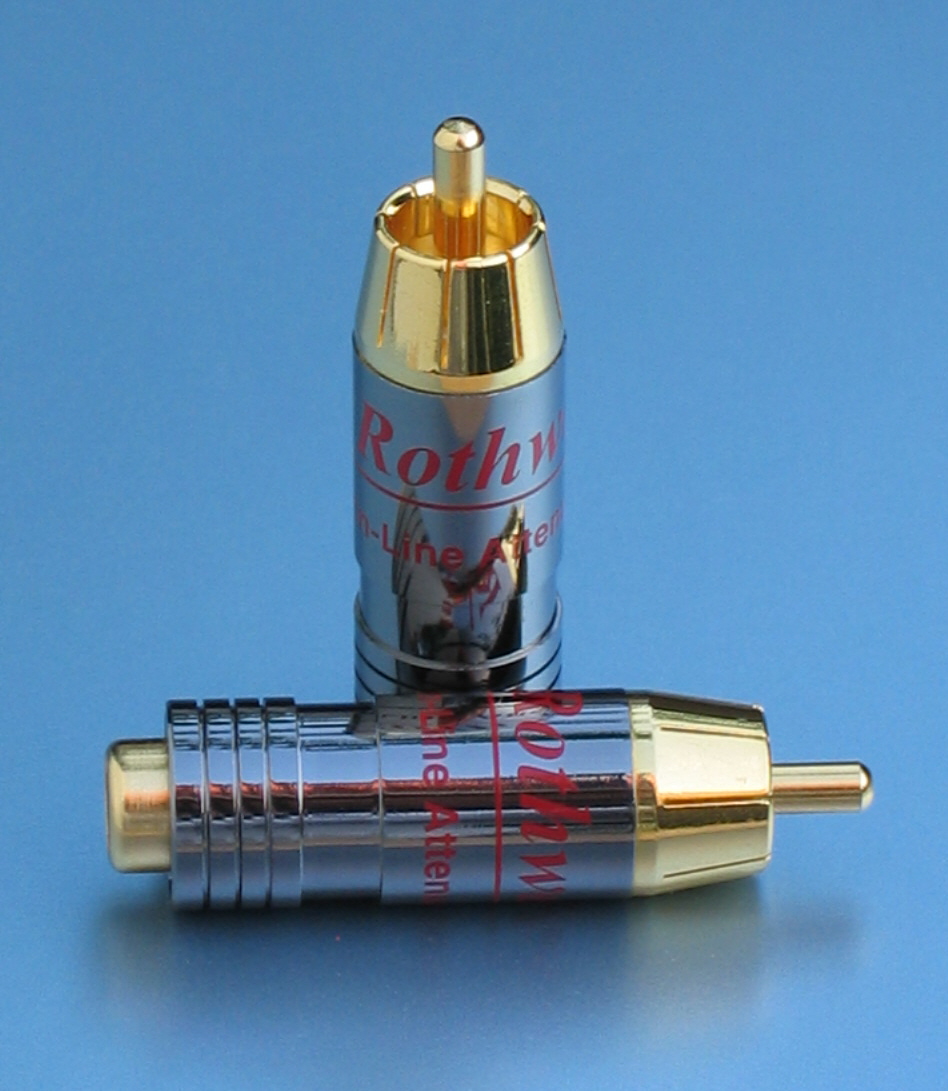
An alternative approach would be to attenuate the other sources to bring them down closer to the turntable.
attenuator.JPG

http://www.rothwellaudioproducts.co.uk/html/attenuators.html
 
You should never use the phono input for anything other than output from a phono cartridge. To do so will result in distortion and probable damage. Plus, mag phono inputs are equalized for the RIAA curve.
Not just MM. All phono inputs are equalized for the an RIAA curve and a few preamps have selectable RIAA curves available as there were several used about 75yr ago. Fortunately for us LP users, they standardized after a few years.
Most MM inputs have a gain around 40db, give or take 5db (or so). If your preamp has MC capablility, it is likely 60db, give or take 5db.
 
Not in the 'normal' audio lingo. MM - moving magnet. MC - moving coil & MI - moving iron. There are others, but in my experience if you talk to someone and mention a 'magnetic' cartridge they would default to MM, as they are the most common, unless you state otherwise. But, that could just be me.
 
Both are magnetic, but one has a magnet moving inside a coil and the other had a coil moving around a permanent magnet. Same principle, but in order to keep the weight low, the moving coil produces less output signal for the same motion. Before the introduction of "super magnets" I suspect moving coil cartridges produced better sound as the magnet required is pretty heavy. With the introduction of very high strength magnets in the early 60s and later, using a moving magnet involves less moving mass that a coil, the coil can be larger (more windings) and produces more output signal strength.

Higher output requires less amplification for the same final output level, hence inherently less distortion and noise.

TOTL systems often have dual inputs for moving magnet and moving coil cartridges, also variable capacitance on the phono input.
 
I used the term 'mag' short for magnetic. Is not a moving coil not a magnetic cartridge ??
Yes, strictly speaking, moving coils are magnetic in as much as they use magnets to provide a magnetic field for the coils to move within. However, usually "magnetic cartridge" is a term applied to moving magnet cartridges.
You're correct, ceramic cartridges need a different EQ from the standard RIAA.
 
I'm sorry, but I totally disagree. MM, MC, MI are magnetic cartridges. By definition. Not by how often the term is used. I answered the OP's question. When people pick apart my valid and accurate responses it makes me want to not even bother posting a response.

I agree with you. Most people don't refer to them simply as magnetic cartridges at all. I mean it's not common for someone to say, "Is that a magnetic cartridge?" unless they are inclusive and ask, "Is that a magnetic or ceramic cartridge?"

In the magnetic cartridge era, it's unlikely someone shortens the description of moving magnet to simply magnetic. But perhaps that's a mind trick and not really conversational.

Apologies to the OP for the slight derailment.
 
In the days before anybody released a moving coil cartridge like Denon, a magnetic cartridge was just referred to as a magnetic cartridge as opposed to a crystal or ceramic cartridge. After more appeared on the market, and with the introduction of moving iron cartridges, distinctions needed to be made.

Doug
 
Back
Top Bottom