

You are using an out of date browser. It may not display this or other websites correctly.
You should upgrade or use an alternative browser.
You should upgrade or use an alternative browser.
Phono preamp advice
- Thread starter Trance67
- Start date

What is the LP? Some have the distortion baked into the master. There’s really nothing you can do about that.I have a couple RCA red label LPs. All are above average but one is a sibilant nightmare. Unfortunate 'cause I like the music.

Any suggestions for remedies?
I have some old Prestige-Metronome MONO LPs that sound pretty good. 1950s Emarcy and, of course, Blue Note are very good, too.
Mose Alison. “Local Color.” Prestige 7121. Metronome (Denmark) pressing. Lacquer mastered and cut by Rudy Van Gelder. MONO. 1958.
Run-out: PRLP-7121A RVG
I gave my daughter all of my vinyl records when she was a teenager so since getting back in I've had to start over with my collection. I've purchased a few record collections that consist of late 60's, 70's and 80's albums and would say 90% of what I have is from those time periods. Some of them sound pretty good and some don't. It could be the condition of the albums but most of them look really nice and I've cleaned them all before playing. Even the new albums I've purchased can be hit and miss. Maybe that's just one of the things you have to deal with when playing vinyl?How old is old? There was a period late 60s to early 70s where the artist's ambition for what they wanted to put on the recording exceeded the capabilities of the equipment at the time. Simpler recordings still sound good from that era though.
Also pressing quality can vary a lot. Some 1970s re-issues of older albums are terrible compared to the original pressings. No phono stage in the world can fix that. If you look at the second hand prices of original pressings compared to the re-issues of the same album you'll see a lot of people have discovered this.
What is the LP? Some have the distortion baked into the master. There’s really nothing you can do about that.....
It's a 1958 pressing of a 19 year old Van Cliburn playing Tchaikovsky's concerto #1. I do believe you're right but hope springs eternal.

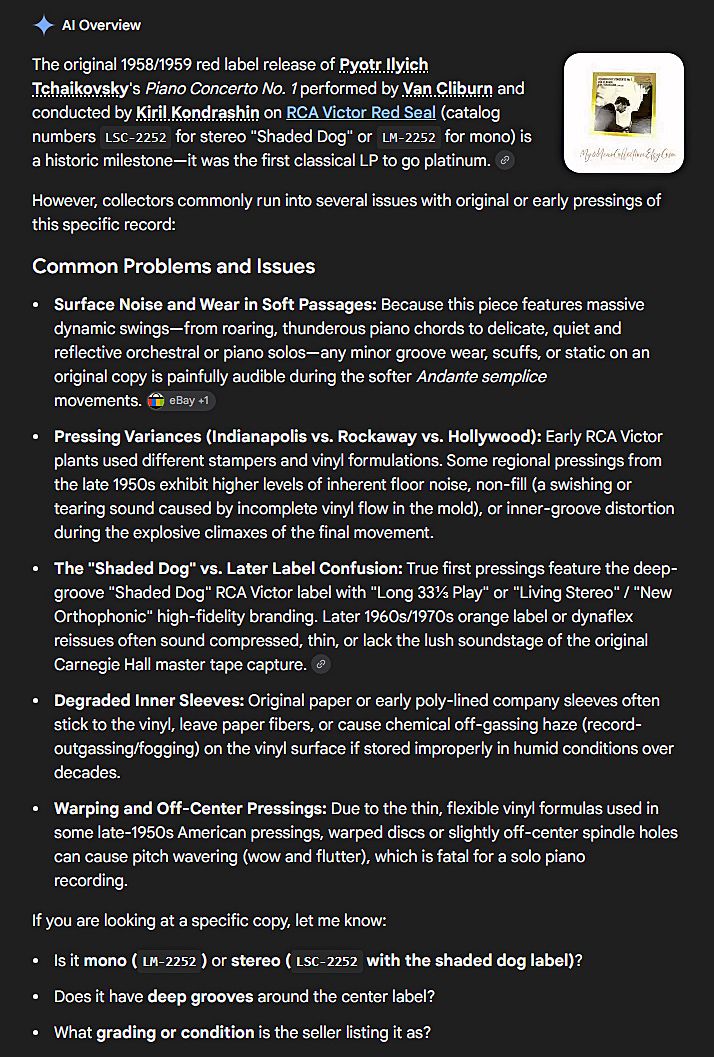
For whatever it's worth.... Google AI’s skinny on that LP.It's a 1958 pressing of a 19 year old Van Cliburn playing Tchaikovsky's concerto #1. I do believe you're right but hope springs eternal.

Mart Mccall
Well-Known Member
Pretty much.Maybe that's just one of the things you have to deal with when playing vinyl?

Yeah, not only different masters — but the pressing plants can make a difference.Pretty much.
Mart Mccall
Well-Known Member
Indeed.Yeah, not only different masters — but the pressing plants can make a difference.
Pal of mine somehow managed to substitute his re-pressing of 'The Best Of BB King' for my original pressing. For years I was thinking 'This album doesn't sound anything like as good as it used to.' Eventually I noticed that the back cover was different.
I don't know if he swapped it deliberately or by accident. Lives on another continent now so I'm never going to get it back. Bought the CD which is better than the repressing by a mile, but it's one of those where the original vinyl version just does sound better, at least to me.
How do you clean your albums today? What age is the stylus and remind me what cartridge? The type of tip can be important - some are more forgiving but less detailed. I found my supex sd 900 super to hate dirty records but wet cleaning and playing damp would sometimes pull more out than the vpi. So I would skip listening on one play, frequently stopping and cleaning the stylus off until it played clean. Generally then the album sounded great. This happened more with new records than old - I’ve been told it may have been mold release.
Sorry I’m just getting back. Yesterday was pretty busy. I’m actually just finishing up cleaning a bunch of records I purchased last month. This is what I’m using. As far as the cartridge and stylus it’s an Audio Technica VM540Ml and has about 40-50 hours on it.
Attachments


OK - after looking that cartridge up, the Denon you have may be pushing the capacitance a touch too high. This may make it sound overly bright and emphasize the groove noise. Additionally, the type of stylus you have is very detailed and sits deeper in the grooves. For most records this is good as it avoids some shallow damage - but it makes deep cleaning with liquid all the more important.Sorry I’m just getting back. Yesterday was pretty busy. I’m actually just finishing up cleaning a bunch of records I purchased last month. This is what I’m using. As far as the cartridge and stylus it’s an Audio Technica VM540Ml and has about 40-50 hours on it.
If you get the new phono stage you mentioned - try at 50 or 0 pF as the initial test setting not the 100 pF default. The reason is that your cartridge wants 100-200 TOTAL including your tonearm wiring, your rca cables and phono stage loading. Your existing Denon is about 150 pF to 200 pF according to what I read. With the tonearm and/or rca cables adding 80-120 pF, 50 pF seems like a safe starting point. 100 MAY work if the cabling you have is fairly low capacitance already.
Thanks for the help. I think the PS-X70 factory cables are low capacitance and I have a set of 3’ WBC low capacitance cables so I should be all set once I get the new preamp.OK - after looking that cartridge up, the Denon you have may be pushing the capacitance a touch too high. This may make it sound overly bright and emphasize the groove noise. Additionally, the type of stylus you have is very detailed and sits deeper in the grooves. For most records this is good as it avoids some shallow damage - but it makes deep cleaning with liquid all the more important.
If you get the new phono stage you mentioned - try at 50 or 0 pF as the initial test setting not the 100 pF default. The reason is that your cartridge wants 100-200 TOTAL including your tonearm wiring, your rca cables and phono stage loading. Your existing Denon is about 150 pF to 200 pF according to what I read. With the tonearm and/or rca cables adding 80-120 pF, 50 pF seems like a safe starting point. 100 MAY work if the cabling you have is fairly low capacitance already.
You may be ok at the default 100pF.Thanks for the help. I think the PS-X70 factory cables are low capacitance and I have a set of 3’ WBC low capacitance cables so I should be all set once I get the new preamp.