• The move to the new server is done. There are some software and database maintenance updates in process. This has us passing the hat around to help out. We appreciate any donations. Seriously, even a dollar helps. The payment page may be found here - https://www.audiokarma.org/support.html

Pilot 240 amp with “Simpli-Matic” test panel

rudedogg

AK Member
Subscriber
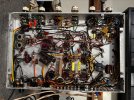
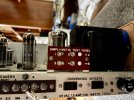
Hey all, i have a Pilot 240 EL84 integrated i am working thru. Replacing caps, checking resistors, cleaning etc. Anyway, i am still chasing a little bit of hum. I think it’s likely due to the crappy wiring layout, AC wires not well routed nor twisted much at all. But my main inquiry is how the Simpli-Matic panel is used for the power tube balance? If indeed that is it’s function.
Any help or info appreciated!
 

Attachments

  • IMG_4258.jpeg
    IMG_4258.jpeg
    326.3 KB · Views: 69
  • IMG_4260.jpeg
    IMG_4260.jpeg
    223.9 KB · Views: 68
Register to hide this ad
you may want to check all the gounds and make sure they are all good connections. Can you determine if the hum is 60 or 120 hrz? Not sure about this model but the Pilot 232 is well known for running AC mains next to the audio inputs. increasing the distance between them can help.
 
bias and/or balance, depending on the controls. If its got bias, its probably set each to some value measured to ground. If its just balance, most likely connect between the two tubes on each channel and set it to zero volts. Either way the cathode resistors must be on value or none of this means anything. If the tubes are not idling at the same current, it will tend to hum so this may be your problem.

A schematic or the manual would be helpful, I'm mostly guessing here.
 
I don't know about this amplifier, but I can tell you from much experience with HH Scott amplifiers, they will hum without the bottom plate attached. If you have a bottom plate, you might try it with the plate attached.
 
You definitely want to first look at the noise. 60 hz vs 120 hz will point you directly to the source.

My next step is to try an isolation transformer. You can get them rather cheaply with keyword "Jameco" and these are solid for bench testing. If you find that the isolation transformer eliminates noise, which it often does on on amps / preamps, you can then investigate the power plug. Often times the plug is non-polarized, and you can eliminate the noise by simply turning the plug. This is why many tube circuits used an AC noise filter which is known as a death cap. These can be replaced with a safety capacitor and kept, or you can wire it with correct polarity and earth ground.

After that I'd carefully investigate all grounding points. If you have a signal tracer you can listen to each amplification stage and figure out a grounding issue.

You could try replacing your tubes or moving them around and see if the hum changes, which would point to the tubes (yours look old / original)

But yeah sometimes you just need to put the bottom chasis on like kvflyer said. You can even connect a wire to ground and connect that to a copper plate (well taped up) and move that ground plane around the circuit to explore noise sources.
 
If I recall, you press the button on the panel while adjusting the pot until you no longer hear a pop out of the speaker. At this point it is nulled, you can also connect a voltmeter between the terminals and adjust pot until it reads zero. You have to depress the button to measure a voltage between the 2 points. The button is shorting the terminals on the back side of the terminal board.

I hope this helps. I use to own one of those, its a great amp I regret selling it off...
 
you may want to check all the gounds and make sure they are all good connections. Can you determine if the hum is 60 or 120 hrz? Not sure about this model but the Pilot 232 is well known for running AC mains next to the audio inputs. increasing the distance between them can help.
Yep! this amp uses AC heaters, and they are haphazardly run parallel to DC feeds. I was able to greatly reduce the hum, more so in one channel, by pushing the wires as far apart as possible. I also bent where they cross to shoot for a more perpendicular intersection.
 
Maybe, someone will post the service info/manual to this thread...
These amps have a following...
I did find a couple schematics for the circuit online. But unfortunately neither one is exactly identical to the chassis I have. Nor do they show the test panel. There must have been changes made along the way.
 
Sooo i dug back in just a little bit more this morning. With all but 4 (old film) caps replaced, it is getting much quieter. AND as you guys have stated, adding the bottom cover helps reduce the hum further, likely to acceptable levels. BTW it is a 60hz hum rather than 120hz. I noted one of the last few original film caps is indeed leaking a small amount of DC also, so i will go ahead and swap the rest out. Then the real test will be on my Altec 604 which are pretty sensitive. I will try and adjust further once i hear it on those speakers. I gotta say after the resto it is a very good sounding integrated
 
Preaching to the choir of course, but 60 cycle hum is probable coming from "outside". 120 cycle is usually from a full wave rectifier power supply.

If you are using a turntable, make sure that the frame of the turntable is connected to the chassis of the amplifier. And of course, if the hum is affected by the increase of the volume/loudness control, it's obviously before that.

As mentioned, I have a bit of experience with HH Scott amplifiers and open circuit tape head or phono inputs will often hum with no input connected.
 
poor lead placement or heater-cathode leakage can also make for 60hz. I had problems in my Pilot 590 that I ultimately traced to a heater lead being shoved against a lead to something that was in the audio path. Moving the two apart dropped it considerably.

open inputs can do it for sure, especially high gain ones like a phono or tape head.
 
It's hard to tell from the picture of the guts. Where does the center tap of the HV winding land? Since you replaced the power supply caps it should hit the negative of the first cap in the supply chain. Anywhere else can also cause 60Hz hum.
 
It's hard to tell from the picture of the guts. Where does the center tap of the HV winding land? Since you replaced the power supply caps it should hit the negative of the first cap in the supply chain. Anywhere else can also cause 60Hz hum.
I “think” the center tap does indeed terminate at the first cap. I will double check tho, I have been busy cleaning up after some storms that passed thru
 
Back
Top Bottom