• The move to the new server is done. There are some software and database maintenance updates in process. This has us passing the hat around to help out. We appreciate any donations. Seriously, even a dollar helps. The payment page may be found here - https://www.audiokarma.org/support.html

Pioneer PD1003 chip

johnhoef

Well-Known Member
Hello, everyone,
I am in the midst of repairing a Pioneer PL610 turntable. The problem is in manual speed control, the platter oscillates slowly back and forth. I have determined the problem is a defective oscillator chip PD1003. This chip handles either crystal controlled speed, which in my case works fine, or manual mode using a pitch control. So, looking for a replacement chip. These are obsolete, and very difficult to find! I did come across this site:


This supplier has a stock of these chips, surprisingly. They are located in Hong Kong. As with so many electronic parts out of China, many are counterfeit, and very unreliable. I have two concerns....is this supplier for real, and reliable? And if so, will they ship me some counterfeit part?
Any thoughts?
 
Register to hide this ad
If the originals are nonexistent who cares if it's counterfeit? Especially if it works?

If an entrepreneurial chap in China takes it upon himself to reproduce a chip that the oem has abandoned, i think that's a good thing and should be supported. Indeed it will be individuals like that who will keep this hobby and these electronic toys alive in the future. While I'm not a fan of intellectual theft, this isn't that. This isn't a cheap alternative to an oem part, this isn't a clone of a long polished circuit. These are the only option, and only useful if you have a broken one!
 
It's been my experience and the experience of many others here on AK, that these counterfeit chips are unreliable. I am not comfortable installing one of these in a unit, and returning it to the customer, declaring the unit repaired. Yes, it may run fine for now, but for how long? Then when it fails, the unit will be returned to me with the expectation of either a full refund, or a free repair. Been down this road before, and I tend to avoid this road!!
 
Why not contact the customer and describe the situation, especially if there is no easy solution. Let him make the decision to buy or not to buy.
I did have a similar experience with a customer’s receiver. We agreed that I would keep the receiver for a month, where the unit would play daily. If the part didn’t break down, we considered it a success.
And aren’t we just guessing that the parts are counterfeit? They could all be genuine for all we know.
 
Just two days ago, I returned a linear track turntable to a customer telling him "I think it is fixed". I told him, you are the ultimate test, and let's see if it holds up for you long term. If not, I'll see what I can do. He understood the dilemma. Let's face it, some repairs cannot be guaranteed, particularly when dealing with vintage equipment where the part we want to replace is obsolete. I have not yet heard back from that customer, but then, it has not been that long. So, yes, sometimes we have little choice but to return a unit to the customer without knowing 100% if the fix will hold. And yes, sometimes we have no choice but to settle for a possible counterfeit part that is known to be unreliable. I always try to put some effort into finding a reliable part before resorting to unknowns, and this is the point behind my starting this thread here at AK. As was mentioned by eiraved, I may just put my $8 at risk as a last resort, and take my chances. After all, losing $8 is not that big a deal. What would aggravate me more is the time I put into this project with a possible result of failure, particularly since I know that replacing this oscillator chip will definitely fix the problem.
 
I just tried to order the part from Tech-Electr - the above mentioned supplier. Not only is the total price $19.30, but they will not accept my order for a reason I do not understand - "PAYEE_ACCOUNT_RESTRICTED The merchant account is restricted". Whatever that means!! So, I am back to searching for a replacement PD1003! Ideally this chip from a parts unit.
 
This could have been an omen, who knows? Well, I pray you will be able to find another PD1003.
 
restorer-john......good to know. Thanks. Since this chip handles both quartz lock as well as manual speed control, I would guess the turntables you mention all have this dual speed selection option. If any of you AK members have one of these turntables as a parts unit, how about selling me this chip?
 
restorer-john....I took a look at a few of these motor boards for sale on ebay. I see a PXM-126A, and the C version. They use the PD1007 chip. I suppose only the motor board PXM-126 has the PD1003 chip? I'll research that.
 
If any of you AK members have one of these turntables as a parts unit, how about selling me this chip?
Very few AKers are visiting your thread. It’s best to post a WTB ad in BarterTown to have the maximum visibility and effect. Have to become a Subscriber first tho…
 
After all, losing $8 is not that big a deal. What would aggravate me more is the time I put into this project with a possible result of failure, particularly since I know that replacing this oscillator chip will definitely fix the problem.
My concern with a counterfeit chip, is not the cost of it up front, but the ultimate potential cost, including that it might take out a whole circuit if it is defective. It does seem with chips that maybe the safest alternative is to find a donor unit with an OEM part. There are also companies who design alternative chips and I would trust them more than someone who lies and supplies counterfeit chips, especially if they have a good reputation for producing a quality product.
 
sound hound, so true. This is particularly true when working with power amps that use the STK modules. You are almost guaranteed to get a counterfeit STK module. Then there are the obsolete output transistors. If one of those counterfeit fail, it would indeed possibly blow the entire power amp circuit! Circuits like we are dealing with here, concerning the PD1003, if it fails, it is far less likely to take out much of any other components. These circuits use a far lower voltage, and less currents involved, so less likely that a counterfeit would cause damage. Like I mentioned before, it's just an irritation and waste of more time having to revisit a repair due to a counterfeit failure.
Indeed, sound hound, you mention alternatives. Pyramid audio comes to mind. They make several discrete replacements for STK modules. I have used them a number of times, and have never had a customer return a failed repair. There is someone here on AK that has built an alternative to this very chip - the PD1003. It's a larger board with several chips on it. I fear it will not be cost effective in a repair, though. The PL610 is not particularly an expensive unit, so I expect the customer will not be willing to spend much for a repair.
 
I suppose only the motor board PXM-126 has the PD1003 chip? I'll research that.

It was used in a bunch of Pioneer tables. For example, the PL-S40 or PL-640 in some markets. Check PL-740 and perhaps even PL-600 (maybe). The PL-880 might use a later revision of the motor (cheaper)- can't remember. I think the PL-400 may use one too.
You'd need to check the S/Ms.

I would guess the turntables you mention all have this dual speed selection option.

No and in my experience, mostly not. They do however have the trim control for each speed (which does the same job effectively). IIRC, some tables had/have a series lower value linear pot which you centre, then adjust to 33.333 and then you have +/-x% pitch.

Check the S/Ms for the earlier Pioneer range (silvery champagne colour - early 80s) which had the rotting rubber/sprung feet with a steel base plate. The controls all ran along a slim front panel. Single point strobe and a variable speed quartz/on/off.

I'll dig out a few Pioneer motors and have a look at what's what in my box of parts. Mostly, they are scavenged from the later 80s plastic bodied units.

Have you got a copy of the schematic/S/M for that TT- it's not on VE AFAIK?
 
Last edited:
The thing with these Pioneer PD turntable control chips is that they were never available on the open market. They were manufactured only for pioneer. As said above, your only recourse is to buy a similar turntable (possible damaged) and use the chip or the motor board from that.

In any case, going back to the original post, I think its unlikely that the PD1003 chip is at fault as this provides the quartz crystal oscillator drive and the selectable frequency dividers. These functions provide the master frequency for motor speed control. This is apparently working as it provides stable speed control when in PLL mode. I would be looking elsewhere for the speed instability issue. Most likely a high, or intermittent, resistance on the selector switches or the manual speed pots. The PD1003 very rarely fails. The normal candidates for chip failure are the motor drive ICs on these boards. Note: on the PLL boards the preset pots on the circuit board, although labelled 33 & 45, are not actually speed adjusters. They are alignment pots which pull 2 pulse streams into alignment for speed stability control. These can only be set using a dual channel oscilloscope with the motor assembly set up on a test stand. The full service manual will have alignment data. Unfortunately I can't find one for this turntable. Check the number on the back of the motor board assembly and we may be able to find another unit with the same circuitry. Unfortunately Pioneer used the same motor assembly with various different control boards. I have 3 different versions in my workshop, from PL-200, PL-400 and PL-7 turntables -Identical motors with variations on the control boards.
 
The thing with these Pioneer PD turntable control chips is that they were never available on the open market. They were manufactured only for pioneer. As said above, your only recourse is to buy a similar turntable (possible damaged) and use the chip or the motor board from that.

In any case, going back to the original post, I think its unlikely that the PD1003 chip is at fault as this provides the quartz crystal oscillator drive and the selectable frequency dividers. These functions provide the master frequency for motor speed control. This is apparently working as it provides stable speed control when in PLL mode. I would be looking elsewhere for the speed instability issue. Most likely a high, or intermittent, resistance on the selector switches or the manual speed pots. The PD1003 very rarely fails. The normal candidates for chip failure are the motor drive ICs on these boards. Note: on the PLL boards the preset pots on the circuit board, although labelled 33 & 45, are not actually speed adjusters. They are alignment pots which pull 2 pulse streams into alignment for speed stability control. These can only be set using a dual channel oscilloscope with the motor assembly set up on a test stand. The full service manual will have alignment data. Unfortunately I can't find one for this turntable. Check the number on the back of the motor board assembly and we may be able to find another unit with the same circuitry. Unfortunately Pioneer used the same motor assembly with various different control boards. I have 3 different versions in my workshop, from PL-200, PL-400 and PL-7 turntables -Identical motors with variations on the control boards.

Sorry to inform you but the pd1003 chip is commonly the part that goes bad.

Member QSilver taught me this since he’s more of an expert on these. This is a direct quote from him and hope it helps anyone working on these units.

The first thing to try is a thorough cleaning of all the switch contacts around the speed control system as well as the speed control potentiometer. Then if you have an oscilloscope, check for the waveform at TP1 on the PA1003 PCB. IF this waveform is sporadic or non existent, then you have an issue with the PA1003 IC. The rocking back and forth to stationary is a symptom of the turntable loosing its drive signal produced with this IC.

Luckily I found one on eBay eventually you just have to do a saved search and work on another unit in the meantime. I like restorer John’s idea as well to find another unit for around $100 you’ll likely pay around that for just the chip anyways like I did but once it’s working it’s magic. The other thing you can do a saved search for is pioneer pl-630 oscillator board which contains the chip.
 
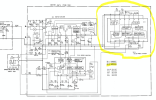
Powertech, thanks for your detailed explanation. Looking at the internal architecture of this PD1003 chip, it contains two more or less individual circuits. One for the crystal control, and one for the manual control. The chip could easily malfunction in the manual circuit section without affecting the crystal control section. Such is the case with my unit. I spoke with the customer just today. He is very close to taking the unit back as is. In his case, as I would guess in most cases, people exclusively use the crystal controlled mode. I would have to agree. Personally, I see no use for going to manual speed control. So, my problem here may well disappear by doing nothing!
 
Back
Top Bottom