

You are using an out of date browser. It may not display this or other websites correctly.
You should upgrade or use an alternative browser.
You should upgrade or use an alternative browser.
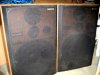
pioneer speaker Identification with pic this time
- Thread starter Tonkatoys
- Start date

Register to hide this ad

hello, i dont know about the model number, but judging from the cosmetics, those must be 1992-93 or so. they have the same looks as my CS-G503 4-ways that i have running with my top of the line VSX-D1S receiver(1990). do not listen to the guy above me. while these are certainly not pioneer's finest hour, they aren't "junk" either! in fact, my CS-G503s are the finest speakers i have yet owned! capable of honest high-fidelity, they trounce any "home theater" system! anyway, the most important thing is whether the drivers are in good shape or not, and from that pic, they appear to be!

MarkAnderson
Addicted Member
Though hard to see, the badge does appear to read Pioneer. My impression is that they indeed look like rack system junk, however I'd be willin' to shell out $10 to find out fo' sho', long as they aren't beat all to hell.

 They probably weigh 20 pounds each. Though, if you don't have any speakers right now, go for it. For $10 it is worth it just to have some speakers.
kfa888
Addicted Member
I have to agree with the others, i think those are most likely crap. I would not even spend the $10 for them because then you have big crappy speakers laying around doing nothing with cabs not good enough for DIY projects. Been there did that. Still got he speakers laying around to prove it. 

adupuy5
New Member
Lady Ayekn is correct. They are nothing to brag about but they do get loud. they are a good party speaker. For 10 dollars, it's a steal.
________
HAWAII DISPENSARY
________
HAWAII DISPENSARY
Last edited:
starchland
New Member
use the cabinets and place the speakers!

danj
modern primitive
I agree the woofer is too big for the cabinets and real bass won't go as low as a similar system with a properly matched woofer but they will play really loud. They might make good speakers for rock or hip-hop but not for jazz or classical, at least not without some heavy equalization.
Looks like rack system speakers. Worth a tenner for a garage or party system? Sure. For a nice home system they might do until you can find something better.
Can you audition before you decide?
Looks like rack system speakers. Worth a tenner for a garage or party system? Sure. For a nice home system they might do until you can find something better.
Can you audition before you decide?

Here's what I would do, is get them, find a cheap amp, and give them to a young teenager that likes music but only has an iPod....
I do that a lot.
I do that a lot.
actually, i would say those are pioneer CS-G403s. they were $130.00 per cabinet in the 1992 BEST catalog. true, the woofers might be a little big, but they use a pair at the fellowship hall in the church i occasionally go to, and they sound fine indeed despite the unexciting programming that they insist on running through them.
actually, judging from the grille cosmetics, those are DEFENATELY not CS-G403s. those have rounded corners. the G403s are squared. they appear to be 1993/'94s equivelent of them.

bluewizard
Active Member
$10? That's two cups of coffee at Starbucks, certainly these speaker are worth more than two cups of coffee. I think I might be willing to buy them just out of curiosity. Pioneer never made great speakers but they didn't make crap either. Assuming nothing is broken, I'm sure these are perfectly serviceable speakers and well worth the paltry sum.
Just one man's opinion.
steve/bluewizard
Just one man's opinion.
steve/bluewizard

actually, judging from the grille cosmetics, those are DEFENATELY not CS-G403s. those have rounded corners. the G403s are squared. they appear to be 1993/'94s equivelent of them.
That's true. I also first thought CS-G403s (the anime convention I work with has a number of pairs of these that we use in panel rooms), but the grilles are also wrong. The '403s have "square edge" grilles, instead of beveled edge.
Truthfully, the CS-G403 sounds surprisingly good, given how cheap the components look. Those woofers are nearly indestructible, too. We've been abusing a half-dozen of these things (using them as de-facto PA speakers, effectively!) for FIFTEEN YEARS now, and the woofers are ALL still good. And that's running them on 150+ watts per channel for 72 hours straight, at a time! Many of the mids and tweeters have been replaced, but the woofers are like the Energizer Bunny... they just keep going and going and going...
Regards,
Gordon.

RadShak1251
Super Member
For ten dollars, if you have some kind of use for them, IMO they are worth it. Like Gordon above, while selling audio gear in the early 90s I've heard Pioneers in this series and surprisingly they sound pretty decent, definitely better than they look.
I think this happens because Pioneer builds all their own drivers and can put togther a speaker system where one driver's deficiency can be made up for by another driver; and/or using some intelligent crossover choices can mask certain driver & cabinet problems.*
As weird as it seems, it requires really good engineering skills to build a decent-sounding cheap speaker (and Pioneer, being the huge corporation it is, has the deep pockets to enable this to happen) vs. an expensive one where you can use any material or manufacturing method you want. One mark of a good cheap speaker is that it produces few *irritating* sound qualities. Because at the lower price levels, an engineer has to pick & choose what he wants to include in a speaker system (great bass OR awesome mids OR heavily built cabinet, and so forth) so while such a speaker won't have super great detail resolution etc, at least it doesn't bother you when you listen to it.
* even if that xover only consists of one cap each for the tweeter and midrange and maybe an inductor for the woofer....which brings up another issue: if the drivers are being designed from scratch to operate together, then for example each driver can be designed so it has a built-in natural cut-off frequency slope that helps it more smoothly blend in with the other drivers it is working with. This way a less elaborate crossover can then be used....or none at all in the case of a woofer. This is much easier to do when the company that builds the speaker system also builds the drivers that will be used in that same system.
I think this happens because Pioneer builds all their own drivers and can put togther a speaker system where one driver's deficiency can be made up for by another driver; and/or using some intelligent crossover choices can mask certain driver & cabinet problems.*
As weird as it seems, it requires really good engineering skills to build a decent-sounding cheap speaker (and Pioneer, being the huge corporation it is, has the deep pockets to enable this to happen) vs. an expensive one where you can use any material or manufacturing method you want. One mark of a good cheap speaker is that it produces few *irritating* sound qualities. Because at the lower price levels, an engineer has to pick & choose what he wants to include in a speaker system (great bass OR awesome mids OR heavily built cabinet, and so forth) so while such a speaker won't have super great detail resolution etc, at least it doesn't bother you when you listen to it.
* even if that xover only consists of one cap each for the tweeter and midrange and maybe an inductor for the woofer....which brings up another issue: if the drivers are being designed from scratch to operate together, then for example each driver can be designed so it has a built-in natural cut-off frequency slope that helps it more smoothly blend in with the other drivers it is working with. This way a less elaborate crossover can then be used....or none at all in the case of a woofer. This is much easier to do when the company that builds the speaker system also builds the drivers that will be used in that same system.
RadShak1251
Super Member
And Pioneer can build some extremely high quality stuff when they want to:
Review of the S-1EX, $9000 per pair.
TAD is Pioneer's professional speaker division but they also sell some speakers for home use: TAD Reference One. 330lbs each, dual 10" woofers, beryllium midrange cone and tweeter dome. I couldn't find a price ("if you have to ask......").
Review of the S-1EX, $9000 per pair.
TAD is Pioneer's professional speaker division but they also sell some speakers for home use: TAD Reference One. 330lbs each, dual 10" woofers, beryllium midrange cone and tweeter dome. I couldn't find a price ("if you have to ask......").