• The move to the new server is done. There are some software and database maintenance updates in process. This has us passing the hat around to help out. We appreciate any donations. Seriously, even a dollar helps. The payment page may be found here - https://www.audiokarma.org/support.html

Pioneer SX-1080 No FM Mute, No FM Stereo Light

Brivan

Well-Known Member
Hello, all
I have a Pioneer SX-1080 receiver that won't mute FM or illuminate the FM stereo light. I'm getting normal FM audio on both channels, but not in stereo. FM stereo light works (it illuminates briefly on power-up). I went through the mute and stereo light set-up in the service manual without any luck.

I've tested voltages on PA1001A and have some discrepancies from what the service manual shows. Here's what I have:

1) 13.3
2) 3.1
3) 5.4
4) 8.6
5) 8.6
6) 10.9 - I should see close to zero for the stereo light
7) 0
8) 0.2 - should be 2.4
9) drops from around 1.8 when I place my meter probe on it - should be 0.8
10) 0.3, but slowly drops - should be 2.4
11) 2.5
12) 2.5
13) 2.5
14) 2.5
15) 3.6
16) 0.07 - should be 0.2

I'll keep plugging away at it - any ideas would be appreciated!

Thanks!
 
Register to hide this ad
I checked voltages on the PA3001A IC. Al were within spec, except for pin 12 "mute auto out", which was at 0.18 tuned - should be 2.7 tuned and 2.2 de-tuned, if I'm reading the schematic correctly. This would account for my low voltage on pin 8 pf the PA1001A, since it's labeled "auto in" and tied to the mute auto out on pin 12 of the PA1003A. As a whole, the FM reception on this receiver isn't as good as I've seen on others, but it isn't terrible, either.

I disconnected "mute auto out" of the PA3001A from "auto in" of the PA1001A to see if there was a change in voltage from that pin of the PA3001A - it stayed the same, so I definitely have low voltage coming from it without influence of anything else. I have about 5v coming from pin 13 of the PA3001A tuned and about 3.3v from that same pin de-tuned.
 
Last edited:
I replaced the PA1001A IC with a Toko KB4437 and all is right with the world. Thanks to all who offered advice on this (chuckle, chuckle)!
 
Thank you for the update. I THOUGHT I had posted something here about your question, but I must be remembering a different/similar tuner thread. Did the replacement for the PA1001A also improve the overall reception, or is there front-end work yet to be done?
 
Thank you for the update. I THOUGHT I had posted something here about your question, but I must be remembering a different/similar tuner thread. Did the replacement for the PA1001A also improve the overall reception, or is there front-end work yet to be done?
No problem. I know all the replies on AK are voluntary, so it's certainly not expected. I should have mentioned it, but the reception is definitely better with the PA1001A replaced. This receiver has some of the best reception I've seen. My workshop is in a basement and I get just a few FM stations down here. This receiver pulls in some of the weaker ones that don't always come in with other units. My eventual goal is to obtain some equipment that I can actually use for tuner alignment. As it is, I generally leave any adjustment alone that I can't see on a signal strength meter or multimeter connected to the tuner board. I can usually set the muting level, too. Thanks for checking in!
 
Same here - The "lair" in the basement limits signal, but I actually see that as a benefit. I usually do the repairs, work to get enough sensitivity to receive AM stations on a short wire or the loopstick, and FM stations on a 30" single lead (no dipole) at the subterranean workbench, then I know it's about as tweaked as it's ever going to get. As early as the '70s I had this "thing" about radio from commercial / DX to CB to SW, and it has stuck with me, so I appreciate really sensitive sets. Once I pull a unit out of the basement and simply move it 10' vertically to the garage, it's astounding how much it will receive (I'm limited to these isolated areas because Mrs. Watt doesn't fully appreciate the audible aspects of the hobby). When finally connected to an attic-installed FM or longwire AM, the signal is almost too much sometimes.

I can't imagine that the Sioux Falls radio spectrum is as jammed as my area (I've been there a couple times for softball tournaments). I'm at the center of the trapezoid defined by Chicago, Milwaukee, Madison, and the Mississippi. Lots of FM, and LOTS of AM powerhouses, including clear-channels, all they way down to hundreds of low-power AM and FM sources.

The alignment equipment is invaluable when a unit is way out after a repair, for FM stereo setup, or if a previous "tweaker" has been let loose in an RF front end, but from my experience the final front end dial-in/peaking is done simply with a meter and ears, and trimmer tool. That may not be the "textbook" method, but the results are indisputable.
 
Agreed on the "weak FM station scenario" in the subterranean level. It's nice to have a few weak ones for fine-tuning. The Sioux Falls area FM dial is surprisingly full of stations (well, assuming I've done a proper job of alignment - heh, heh). I've had an FM transmitter around the house for many years and I'm down to one or two "open" areas that don't interfere. I bought the transmitter from the UK (FCC gets a little grumpy about them being sold here) and it's simply been an invaluable piece of equipment. Used in conjunction with the music I have saved to my computer, having my favorite tunes in any room is as simple as getting on Ebay and buying a receiver I've been drooling over, getting it home, gone through and hooked up.

My fave clear-channel station in my younger years was KAAY out of Little Rock, AR. I did some internet sleuthing about the old station and found some interesting information. I particularly enjoyed the photos of the old transmitter that was in use back when I was tuning in - a nice trip down memory lane. I went to school to fix radio transmitters, so that kind of stuff is pretty neat-o to me. Oddly, I never worked on one - the job offers were for other things, so I strayed.

In my younger years when I had squat for equipment (or schematics) I'd just start tweaking on tuners. It might take longer, but I usually ended up with something better than I started with. I refurbed a Pioneer SX-780 this past week, and had a moment of "what do I do now" when I discovered there was no signal meter. I had to actaully get motivated and connect up the DMM! Sheesh!
 
Yeah...Umm... Well...

We won't discuss in too much detail whether or not how many and what wattage any FM transmitters which some of the members here might or might not have. Our friendly cousin Charlie has no sense of humor about that. All I can say about that is that I somehow have a clear understanding of how helpful something like that might or might not be for tuning equipment, regardless of whether or not we might or might not actually have access to any of that kind of thing, let alone where they might or might not have come from. ;).

(How's that for being ambiguous?)
 
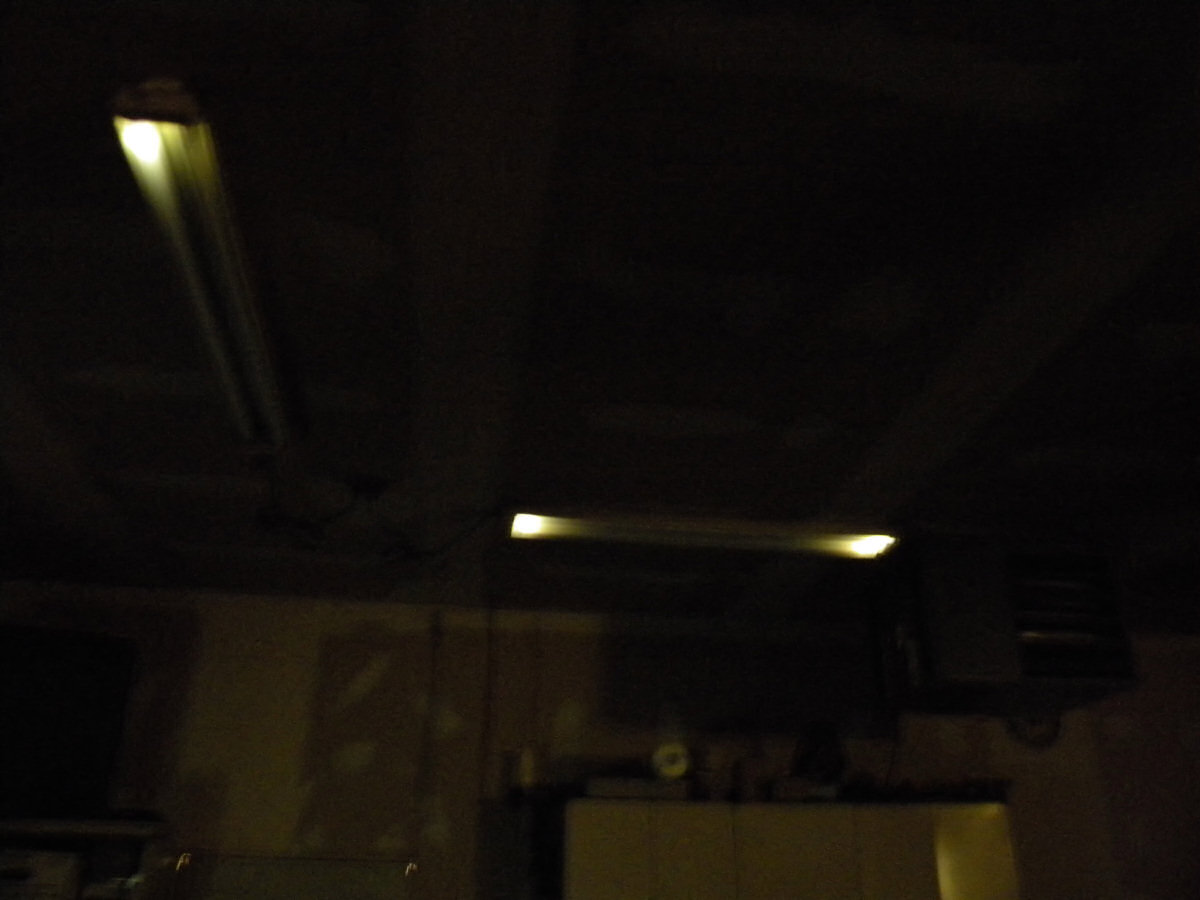
But if we were to experiment with such a device, we might find that at some moderate output power, with a vertically-polarized ground plane antenna in an undisclosed but nearby location, sufficient energy might be imparted upon surrounding equipment to cause this sort of phenomena:

15WRFPowerEffect.jpg
 
But if we were to experiment with such a device, we might find that at some moderate output power, with a vertically-polarized ground plane antenna in an undisclosed but nearby location, sufficient energy might be imparted upon surrounding equipment to cause this sort of phenomena:

15WRFPowerEffect.jpg
Yikes! You don't sit in that room and drink your beer, do you? I mean, your beer would get warm pretty quickly! Who needs wired fluorescent tubes when wireless will do just fine!
 
Back
Top Bottom