

You are using an out of date browser. It may not display this or other websites correctly.
You should upgrade or use an alternative browser.
You should upgrade or use an alternative browser.
Pioneer SX-D7000 - another adventure in recapping
- Thread starter w1jim
- Start date

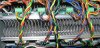
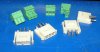
Here are some pictures of the old (white) and new (green) connectors.Nice work. Do you have any pics of the connector replacement?
I've done the top row in the picture, the bottom remains to be done.
The old connectors were in good shape but the new ones fit tighter.
Attachments
Wrapping it up!
Replaced the 4 current regulator transistors on the amplifier board with larger parts that are better able to handle the heat. I kept them spaced away from the board to limit heat damage. The pin-outs on these are reversed so they needed to be installed 180 degrees "reversed".
2SA905 (BCE) replaced with KSA1220AYS (ECB)
2SC1915 (BCE) replaced with KSC2690AYS (ECB)
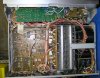
Tweaked the power amp in accordance with the service manual instructions, replaced the stereo light with a red LED and cleaned up the interior with some wire ties.
Now for some preassembly listening...
Replaced the 4 current regulator transistors on the amplifier board with larger parts that are better able to handle the heat. I kept them spaced away from the board to limit heat damage. The pin-outs on these are reversed so they needed to be installed 180 degrees "reversed".
2SA905 (BCE) replaced with KSA1220AYS (ECB)
2SC1915 (BCE) replaced with KSC2690AYS (ECB)
Tweaked the power amp in accordance with the service manual instructions, replaced the stereo light with a red LED and cleaned up the interior with some wire ties.
Now for some preassembly listening...
Attachments


Well, I think I've munged up an unobtainable part.
The phono section appears to be bad on one side. I've traced the signal (comparing sides) and it appears that one of the (unobtainable) 2SK129A JFETs is bad.
Partstore.com lists these - but they tend to be a bad joke (and they're $30 per).
Here's a MTF question - would 2 2SK117 JFETs be my best alternative?
Second choice would be to replace the entire phono stage with another aftermarket phono stage.
Damn.
The phono section appears to be bad on one side. I've traced the signal (comparing sides) and it appears that one of the (unobtainable) 2SK129A JFETs is bad.
Partstore.com lists these - but they tend to be a bad joke (and they're $30 per).
Here's a MTF question - would 2 2SK117 JFETs be my best alternative?
Second choice would be to replace the entire phono stage with another aftermarket phono stage.
Damn.

Well, I think I've munged up an unobtainable part.
The phono section appears to be bad on one side. I've traced the signal (comparing sides) and it appears that one of the (unobtainable) 2SK129A JFETs is bad.
Partstore.com lists these - but they tend to be a bad joke (and they're $30 per).
Here's a MTF question - would 2 2SK117 JFETs be my best alternative?
Second choice would be to replace the entire phono stage with another aftermarket phono stage.
Damn.
Quicker to try, than for me to try and analyze it. Diff amps are remarkably forgiving, at least if you want them to pass a reasonable (but not perfect) signal.
Then there's the spares pile. But when I saw them in various schematics myself, my house was bug free for a week, the neighborhood was curiously silent, there was a slightly singed odor wafting about... and kids 5 miles away MAY have learned new words...
Last edited:
Good news - I found that the 2SK129a FETs are in fact good. I swapped them left to right and the problem stayed in the left channel - my problem was a teenie-tiny crack (doh) in one of the PCB traces (yay).
Things seem to be working, it's all going back together today, I learned lots about FETs and my frustration level has dropped back to sociable levels (double yay)!
I'll be posting the cap list shortly and giving my listening assessment as well.
Things seem to be working, it's all going back together today, I learned lots about FETs and my frustration level has dropped back to sociable levels (double yay)!
I'll be posting the cap list shortly and giving my listening assessment as well.
Capacitor list for Pioneer SX-D7000 / SN AG2903562S
There were no tantalum caps in the SX-D7000.
All electrolytic caps of 1.0uf and less should be replaced with poly film caps.
The LR caps are low leakage types.
There are 2 BP or BiPolar electrolytics.
I'd additionally recommend paralleling a 0.22uf poly film cap with the 2-4.7uf input caps on the amplifier board.
These parts are cheap - I'd suggest buying a few extra of each just in case I erred on the list or you drop / break one.
This list doesn't include the main power supply caps.
Tuner GWE-138
Power supply AWR-216
Flouroscan PCBs AWV-015 & GWV-102
Amplifier AWH-097
Phono EQ AWF-046
Tone/volume GWG-150
xxxxx
There were no tantalum caps in the SX-D7000.
All electrolytic caps of 1.0uf and less should be replaced with poly film caps.
The LR caps are low leakage types.
There are 2 BP or BiPolar electrolytics.
I'd additionally recommend paralleling a 0.22uf poly film cap with the 2-4.7uf input caps on the amplifier board.
These parts are cheap - I'd suggest buying a few extra of each just in case I erred on the list or you drop / break one.
This list doesn't include the main power supply caps.
Tuner GWE-138
- 1 - 6.8uf/50v LR
- 1 – 1.0uf/50v LR
- 1 – 0.33uf/50v LR
- 1 – 0.47uf/50v
- 1 – 470uf/16v
- 2 – 470uf/10v
- 2 – 220uf/10v
- 1 – 220uf/16v
- 2 – 330uf/10
- 2 – 0.22uf/50v
- 2 – 0.47/50v
- 1 – 100uf/10v
- 1 – 47uf/25v
- 8 – 1uf/50v
- 6 – 2.2uf/50v (on some of these the decimal point is quite small – below/between the “2”s)
- 4 – 4.7uf/50v
- 5 – 10uf/50v
- 2 – 22uf/50v
- 2 – 22uf25v
Power supply AWR-216
- 1 – 3300uf/10v
- 1 – 1000uf/35v
- 1 – 2200uf/16v
- 2 – 220uf/80v
- 1 – 470uf/10v
- 2 – 100uf/25v
- 2 – 47uf/50v
- 2 – 100uf/35v
- 2 – 47uf/63v
- 1 – 220uf/16v
- 1 – 10uf/63v
- 1 – 2.2uf/50v (small decimal point)
- 1 – 10uf/50v
Flouroscan PCBs AWV-015 & GWV-102
- 2 – 1.0uf/50v
- 2 – 2.2uf/50v (small decimal point)
- 2 – 10uf/50v
- 1 – 47uf/10v
- 1 – 47uf/25v
- 1 – 47uf/50v
Amplifier AWH-097
- 2 – 0.22uf/50v BiPolar (BP)
- 2 – 4.7uf/50v
- 1 – 100uf/25v
- 1 – 470uf/6.3v
Phono EQ AWF-046
- 4 – 4.7uf/50v LR
- 2 – 3300uf/6.3v
- 4 – 47uf/50v
- 2 – 220uf/10v
- 2 – 10uf/50v
Tone/volume GWG-150
- 4 – 0.15uf/50v LR
- 4 – 0.68uf/50v LR
- 2 – 4.7uf/50v LR
- 2 – 1.0uf/50v LR
- 2 – 47uf/10v LR
- 4 – 10uf/16v LR
- 4 – 47uf/50v
- 2 – 100uf/10v
xxxxx
Those are the ones with the "LR" in the description.Jim, thank you for the list... it is much appreciated. If it isn't too much to ask, just for future reference by others (and myself) Which ones were the ceanl caps?
I just listed the values post recap as they came out of the plastic bags. I have not specified Mouser or Digikey part numbers as different people favor different caps - I'll leave those selections up to the reader.

bbauer01
Active Member
Those are the ones with the "LR" in the description.
I just listed the values post recap as they came out of the plastic bags. I have not specified Mouser or Digikey part numbers as different people favor different caps - I'll leave those selections up to the reader.
 I must have been sleeping at the wheel when I read through your list, because the "LR" is very obvious now when I go back and read it. I really don't know why I missed it. Sorry for the ignorant post and thanks again for your documentation.
Is there more to each list entry than you posted, right now to check it I would have to start from scratch. The Cx designations and ceanl/cssa/csza whatevers are kinda important. I can infer a board number, but...

pioneervato
Lunatic Member
Jim, great job on the recap. I was holding my breath hoping your issue was a simple one. Nice detective work! Congrats! I will bookmark this for future reference if ever I decide and/ or brave enough to do mine.
MTF-Is there more to each list entry than you posted, right now to check it I would have to start from scratch. The Cx designations and ceanl/cssa/csza whatevers are kinda important. I can infer a board number, but...
How do I determine those designators?
The majority of the caps were the "regular" black ones - are those just "CE"?
The others were the orange ones that had "LR" on them - CEANL?
Then there were the 2 black bipolars - what are those?
No tantalums or tiny blue electrolytics so that simplifies things a bit.
The service manual that I have access to doesn't have a parts list so i can't use that as a guide.
This forum section has helped me figure out at least where the phono board is. I have never done any transistor replacements, so based on what I read, it is recommended to take it to someone that knows what they are doing. My phono 1 and 2 are putting out a rumbling noise (without anything connected to it) and one of the members on here recommended to replace the transistors on the phono equalizer amp. I have not been able to find anyone local here that works on vintage. So I might be on my own on this. Any recommendations for a beginner? I have soldered before, have a decent soldering station and have a lighted magnifying glass.
And just to make sure, the Phono board, is the board that is upside down when stand above the Amplifier in the front off the amplifier
And just to make sure, the Phono board, is the board that is upside down when stand above the Amplifier in the front off the amplifier
