• The move to the new server is done. There are some software and database maintenance updates in process. This has us passing the hat around to help out. We appreciate any donations. Seriously, even a dollar helps. The payment page may be found here - https://www.audiokarma.org/support.html

Please Help -- How to choose replacement drivers with little information -- Pics and Some Specs

BigRiver

Member
Hi,

I just cracked open a set of Vintage Teac LS-400 speakers. Each cabinet has 2 tweeters, 2 mids and 1 woofer.

This is a hobby project and one that I am not worried about the value of the speakers, or what they will be worth in the end, I simply want to make them sound the best they can. They have SUPER heavy cabinets and are actually very good looking speakers.

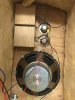
The problem is that one of the 12 inch woofers has been replaced with a 10 inch radio shack driver. Using the numbers on the back of the other, I can find zero information on it. So I was thinking I would go ahead and replace both of them so they match.

This means all I have to go off of is the following on what I think is the original driver. Item Number: 95078-2 -- 8 OHM -- MAX 10W Japan.

I have found that crossover frequency is 500Hz/5000Hz and Frequency Response 30-20,000Hz

Does anyone know how I would go about choosing replacements for these? I am sorting through Parts Express and just don't really even know where to start. Any help or a way to start would be very greatly appreciated.
 

Attachments

  • teacfront1.jpg
    teacfront1.jpg
    64.4 KB · Views: 104
  • teac2.jpg
    teac2.jpg
    76.6 KB · Views: 100
  • teac3.jpg
    teac3.jpg
    96.3 KB · Views: 101
  • teac4.jpg
    teac4.jpg
    73.5 KB · Views: 96
Last edited:
Register to hide this ad
Nothing?

Can I just choose a woofer driver where they ohms match and is the right size? Are there any other considerations I should be concerned about?
 
Thanks Rockfan! -- I'm assuming this would be the standard. Have you found that you can get better performance with a higher budget?
you would probably get better performance
with a more expensive driver. those Teac speakers
dont look very high quality to me. the dayton
is a good mix of quality/price.
 
you would probably get better performance
with a more expensive driver. those Teac speakers
dont look very high quality to me. the dayton
is a good mix of quality/price.
Yeah, I think they were probably very middle of the road, but for some reason I really like them and if can get them sounding pretty good wouldn't mind living with them for a while. Just wondering how far I can push them by replacing components, updating/upgrading the X-overs, and adding some bracing and damping. I typically don't try to make $$ on speaker projects, I just really like working on them...
 
You might calculate the internal volume of the cabinet then check the various woofers on PE website to see which if any might better match up. They list recommended box volume for many of their drivers.
 
You might calculate the internal volume of the cabinet then check the various woofers on PE website to see which if any might better match up. They list recommended box volume for many of their drivers.
Thanks, that's a good suggestion, going to do that now.
 
You can figure out how to load the driver into the cabinet using various online tools. The problem would be matching the efficiency of the new woofers with the existing mids/tweeters. If that is way off it’s not going to sound right.

there are ways to test the existing woofer (Parts Express DATS system probably being the easiest, but not free).

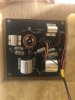
Judging by the crossover those look to be good quality. Worth saving.
I was actually wondering about this exact thing in terms of the efficiency. Since I have determined that both of the woofers are replacements already, and they are both different, one is actually an 8 inch rat shack and the other a no name that I can find zero information on.

Given this, do you know fo a way to tell the efficiency on the mids and tweeters? I am also having a hard time locating these as well... Would that PE DATS systems work for this too?

Also, I think that I am definitely going to overbuild these, after all if you can't have fun with it!
 
Is that box sealed or vented?

Is the woofer wired directly to the input or are there crossover components involved?

Efficiency is not really and issues since there are level pots on the other drivers,
normal may not be in the center anymore.

You can actually see the wire turns on the level pot, check if they look overheated.
 
I think Coral is the maker of the 12 in woofer in your speaker. The midranges look similar to the coral holey baskets that people rave over.
 
Is that box sealed or vented?

Is the woofer wired directly to the input or are there crossover components involved?

Efficiency is not really and issues since there are level pots on the other drivers,
normal may not be in the center anymore.

You can actually see the wire turns on the level pot, check if they look overheated.

The box is sealed, and the mids are sealed in their own box and separated as well.

Thank you for the efficiency suggestion, I didn't think iff that. Though if I was to guess I think they are pretty efficient as they are 16 ohm components, but IDk really.

The large pots look almost brand new which is such a relief from all those terrible ar pots! Just finishing up some ar5's right now and ended up having to buy new ones, not the l-pads.
 
How many Watts do you plan to drive them with?
I guess that all depends, if they are efficient enough I will try them on the Sherwood S 5000 tube integrated (maybe 30wpc), that's my current favorite. If they feel hungrier I will try the Sansui au-999 (rebuilt/refurbished up to about 80wpc) and if I need real power I can always try the Sansui b2102 power amp.
 
Because impedance curves differ between drivers (even with those with the same rated nominal impedance), the crossover frequency will be changed somewhat. Hopefully it's not an audible change, but if it's too far up or down compared with the original, there may be an audible hump or gap in the spectrum. You can use an iPhone* app to measure the current speaker's response, and then see what you give up when the new one is replaced. The woofer crossover looks more complex than just a single inductor and capacitor (I see a second inductor and a resistor in there), so a simple crossover calculator will probably not allow you to design the same sort of crossover (in fact, this suggests that the crossover was tuned somewhat for the system, rather than just designed using formulas). If you find with listening or measurements that there is a hump or gap, you could try to design a new second-order crossover for the woofer, based on Teac's specified woofer crossover frequency, to replace what's there and see if it improves things somewhat. But I wouldn't rip out the old one, just disconnect it and install the new one somewhere else in the cabinet.

One thing you could try to do when searching for a replacement is to match up the impedance around the crossover frequencies. For this you'll need to measure the impedance of the existing woofer (method 2; continue to step 11, and to this only for the disconnected original woofer, not the entire system. You can use a smartphone frequency generator app). Then you compare your results from your tests with the published impedance graph for the woofer you're considering purchasing.

One thing to be cognizant of is that you will almost definitely change the sound of the speaker. For this reason you'll want to replace both woofers (hang onto the original). Whether it sounds better, worse, or just different is something you'll have to decide for yourself, so I'd replace just the one woofer first and compare with the original. If the replacement is objectionably bad, then don't go any further; return those and try a different driver. If you're lucky, the change will be barely audible, or only measurable but not audible at all.

* Since iPhones are all made by one manufacturer, and the number of models made and microphones used fairly small, it's relatively easy for the app to calibrate the built-in microphone once it knows the phone model. Android apps are a lot more difficult because of how many different manufacturers and models there are.
 
Last edited:
Because impedance curves differ between drivers (even with those with the same rated nominal impedance), the crossover frequency will be changed somewhat. Hopefully it's not an audible change, but if it's too far up or down compared with the original, there may be an audible hump or gap in the spectrum. You can use an iPhone* app to measure the current speaker's response, and then see what you give up when the new one is replaced. The woofer crossover looks more complex than just a single inductor and capacitor (I see a second inductor and a resistor in there), so a simple crossover calculator will probably not allow you to design the same sort of crossover (in fact, this suggests that the crossover was tuned somewhat for the system, rather than just designed using formulas). If you find with listening or measurements that there is a hump or gap, you could try to design a new second-order crossover for the woofer, based on Teac's specified woofer crossover frequency, to replace what's there and see if it improves things somewhat. But I wouldn't rip out the old one, just disconnect it and install the new one somewhere else in the cabinet.

One thing you could try to do when searching for a replacement is to match up the impedance around the crossover frequencies. For this you'll need to measure the impedance of the existing woofer (method 2; continue to step 11, and to this only for the disconnected original woofer, not the entire system. You can use a smartphone frequency generator app). Then you compare your results from your tests with the published impedance graph for the woofer you're considering purchasing.

One thing to be cognizant of is that you will almost definitely change the sound of the speaker. For this reason you'll want to replace both woofers (hang onto the original). Whether it sounds better, worse, or just different is something you'll have to decide for yourself, so I'd replace just the one woofer first and compare with the original. If the replacement is objectionably bad, then don't go any further; return those and try a different driver. If you're lucky, the change will be barely audible, or only measurable but not audible at all.

* Since iPhones are all made by one manufacturer, and the number of models made and microphones used fairly small, it's relatively easy for the app to calibrate the built-in microphone once it knows the phone model. Android apps are a lot more difficult because of how many different manufacturers and models there are.

Wow, thank you.

Unfortunately there is a pretty big hurdle to proceeding in this manner in that neither of the woofer drivers are original. One is a Radio Shack that does not even fit the space, it is likely a 10 inch driver and there is a large gap in what is supposed to be a sealed cabinet. The other is a 12 inch driver, but I do not think it is original either as I have now compared it to two other sets of the LS-350 and they are different. There is a chance that the LS-400 used a different woofer, but this seems very unlikely as all of the other components, tweeters, mids, crossover components are exactly the same.

I don't know what this speaker is supposed to sound like, it voicing, anything really.

All of this makes me feel like I am "taking a shot in the dark". Now, I know that the woofer is an 8ohm and that based on the small bits of information that I have ben able to track down that these crossover at 500Hz/5000Hz. The cabinet is 2.39 sq ft. with a frequency response of 30-20000Hz. This makes me think to start that I should choose a woofer that hits all of these as close as it can, right?

I thought I would do this, and recap and see where it is at. Thoughts?
 
Back
Top Bottom