

You are using an out of date browser. It may not display this or other websites correctly.
You should upgrade or use an alternative browser.
You should upgrade or use an alternative browser.
Please help me find the crossover capacitor for Beovox M75 speakers.
- Thread starter beolover
- Start date
Register to hide this ad

A hotly debated and discussed topic - the best way forward is probably just to keep listening to them and see what you think.
I personally do find that initial dry, raw sound only lasts for a few hours with new caps and then smooths out. (Or maybe it's my ears that get used to it - I dunno.)
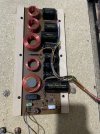
Can I ask a practical question - why didn't you replace that polarized capacitor at the bottom of the circuit board in your picture?
I personally do find that initial dry, raw sound only lasts for a few hours with new caps and then smooths out. (Or maybe it's my ears that get used to it - I dunno.)
Can I ask a practical question - why didn't you replace that polarized capacitor at the bottom of the circuit board in your picture?


Beobloke
Super Member
I know I'm a bit late with this advice but, if you want to re-cap old B&O speakers, just go straight to the Danish company Beoparts and buy the capacitor kit for your model.
The site owner, Martin, is an ex B&O employee and everything he sells is either to B&O's original specifications, or incorporates improvements where appropriate. He has even gone to the trouble of having batches of capacitors specially made by the original manufacturers in the case of modern equivalents no longer being available.
Website here: https://www.beoparts-shop.com/
M75 re-cap kit here: https://www.beoparts-shop.com/product/capacitor-kit-beovox-m75/
The site owner, Martin, is an ex B&O employee and everything he sells is either to B&O's original specifications, or incorporates improvements where appropriate. He has even gone to the trouble of having batches of capacitors specially made by the original manufacturers in the case of modern equivalents no longer being available.
Website here: https://www.beoparts-shop.com/
M75 re-cap kit here: https://www.beoparts-shop.com/product/capacitor-kit-beovox-m75/
Beobloke
Super Member
The polarised capacitor is in the overload cut-off circuit. It is not in the signal path and changing it for non-polarised would be of no benefit.Can I ask a practical question - why didn't you replace that polarized capacitor at the bottom of the circuit board in your picture?
Polarizing the bottom electrolytic capacitor on the circuit board is not really necessary, but I really appreciate your contribution. I will replace them when I have the opportunity to open the speaker cabinet again.A hotly debated and discussed topic - the best way forward is probably just to keep listening to them and see what you think.
I personally do find that initial dry, raw sound only lasts for a few hours with new caps and then smooths out. (Or maybe it's my ears that get used to it - I dunno.)
Can I ask a practical question - why didn't you replace that polarized capacitor at the bottom of the circuit board in your picture?

I've recently replaced all the old electrolytic capacitors in my Beovox M75 with new ones, and after the change, I noticed the sound is a bit dry and somewhat harsh. Is this normal, and do capacitors require some time to break in for better sound quality?
View attachment 3024102
Nice work indeed! It could be "break in" or it could be that you are hearing these speakers for the first time the way they were intended. Also, triple check your wiring.
And yes, those bottom caps are only for the protection circuit. No need to replace them unless they have failed.


I recapped a Tandberg TR 2080 which if I recall used the same purple type caps that are shown in the overload circuit here. And they'd all drifted significantly.Nice work indeed! It could be "break in" or it could be that you are hearing these speakers for the first time the way they were intended. Also, triple check your wiring.
And yes, those bottom caps are only for the protection circuit. No need to replace them unless they have failed.
Can I ask the OP how he gained access to the crossover network and removal advice? I didn't see an obvious simple way to remove the crossover since the midrange box lay directly over the crossover board.