
• The move to the new server is done. There are some software and database maintenance updates in process. This has us passing the hat around to help out. We appreciate any donations. Seriously, even a dollar helps. The payment page may be found here - https://www.audiokarma.org/support.html

Please help me understand this speaker protection circuit

c.coyle

Fighting the Dunning-Kruger effect.
When it comes to tinkering with electronic stuff, I'm pretty good at "fake it 'till you make it," but my lack of formal training sometimes limits me. I'm trying to get a handle on exactly how this speaker protection circuit works. Please help me.

1. Normal operation: Power on, no DC at R759 or R760: Q721 has 0V at base, and is off. Q722 and Q723 are also off. There is voltage from +B1 at the base of Q724, so it is on, and current flows through the relay coil, which closes the contacts and the speakers are connected. The Q724 turn-on delay is set by the time needed to charge C726. Right so far?

2. Protection mode: Power on, high DC at R759 or R760. C726 charges and there is voltage at the base of Q721, so Q721 turns on and its collector goes to ground, removing voltage from the base of Q724. Q724 turns off, the relay coil circuit opens, and the relay clicks off, disconnecting the speakers. Right?

3. I'm not sure what Q722 and Q723 do in either situation. Something to do with pulling Q724's base to ground?
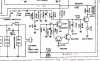
protection circuit.jpg
 
Register to hide this ad
1. Normal operation: Power on, no DC at R759 or R760: Q721 has 0V at base, and is off. Q722 and Q723 are also off. There is voltage from +B1 at the base of Q724, so it is on, and current flows through the relay coil, which closes the contacts and the speakers are connected. The Q724 turn-on delay is set by the time needed to charge C726. Right so far?

Right so far.

2. Protection mode: Power on, high DC at R759 or R760. C726 charges and there is voltage at the base of Q721, so Q721 turns on and its collector goes to ground, removing voltage from the base of Q724. Q724 turns off, the relay coil circuit opens, and the relay clicks off, disconnecting the speakers. Right?

Right, but only applies if the output voltage goes positive.
What if the output goes negative?

3. I'm not sure what Q722 and Q723 do in either situation. Something to do with pulling Q724's base to ground?

Aha! If the output goes negative, the emitter of Q723 is pulled down, causing it to conduct, and turn on Q722, which will pull down the base of Q724, which shuts the relay off.
 
Three nore comments -
C725 is a bipolar cap, because output can go positive or negative.
Also, so companies use different values for the two input resistors from the amplifiers. (like 120 K and 82K instead of two 120K resistors) this is in the rare event that one channel goes to positive rail, and other goes to negative rail, leaving zero voltage at the junction, and no relay disable. (for the record, I only saw this once on the bench, in a bad ground related problem. One channel had plus rail, one had minus rail, and the relay clicked on - poor speakers)
Third - the .1 amp fuse , diodes D713 D714, C721 and resistor R768 are to shut off relay as soon as AC is removed, not to wait for the power supply to drain off.
My 2 cents....
 
Thanks a million. I owe you you a few beers! As soon as I saw "but what if the output goes negative?" I slapped the table and scared my cat.

The circuit is from a Nikko TRM-750 amp. I have replaced the caps (new bipolar at C725), but no other components. I've noticed two things:

1. The turn on delay is less than one second, resulting in a small speaker thump if I have the volume up at power on. I would like a little longer turn on delay. I think this would require increasing the value of C726 and/or changing the value of the nearby resistors. Right?

2. Putting 9vdc into the circuit with a battery at the speaker side of R759 or R760 (and no speakers hooked up) does not de-energize the relay. Before I start throwing parts at it, I would like to know why, or why my battery test is wrong.
 
The battery should work (either polarity, too) Is amplifier disconnected (or else you are just putting a battery across the load, which should pop a circuit breaker or kill the battery). Hopefully you are unsoldering the amplifier side of the resistor and then hooking up the battery. (or you could even use a separate resistor and connect it to the point where the resistors come together.
As far as fast turn on - perhaps Q724 is leaky or bad. Then all the other stuff wouldn't work and the relay will always engage as soon as supplies up to voltage. See if base voltage on Q724 goes down (Id estimate around .7 for relay on, less for relay off) If it goes down and relay doesn't shut off, then the transistor is probably bad. When everything okay, you should have around 2.5 volts and junction of R762, R765m D714m Emitter of Q 723, and Collector of Q721
And you are correct, increasing C726 should slow down the turn on.
 
Last edited:
The battery should work (either polarity, too) Is amplifier disconnected (or else you are just putting a battery across the load, which should pop a circuit breaker or kill the battery). Hopefully you are unsoldering the amplifier side of the resistor and then hooking up the battery. (or you could even use a separate resistor and connect it to the point where the resistors come together.

I wasn't lifting the amp ends of the resistors, although I wasn't popping anything nor heating up the battery. Once I did, the relay disengaged as expected, although it's not lightning fast.

As far as fast turn on - perhaps Q724 is leaky or bad. Then all the other stuff wouldn't work and the relay will always engage as soon as supplies up to voltage. See if base voltage on Q724 goes down (Id estimate around .7 for relay on, less for relay off) If it goes down and relay doesn't shut off, then the transistor is probably bad. When everything okay, you should have around 2.5 volts and junction of R762, R765m D714m Emitter of Q 723, and Collector of Q721
And you are correct, increasing C726 should slow down the turn on.

I'm going to check Q724, and probably replace it no matter what.

Thanks again for your help. This is why I like AK.

Chris
 
Back
Top Bottom