
• The move to the new server is done. There are some software and database maintenance updates in process. This has us passing the hat around to help out. We appreciate any donations. Seriously, even a dollar helps. The payment page may be found here - https://www.audiokarma.org/support.html

Poor Man's Diffusion Behind Speakers

AvFan

Super Member
My system sits in front of a bay window and one issue I had resigned myself to was that there are likely reflections from the rear of the speakers off the windows and blinds. However, I figured that treating first reflection points with absorption between the speaker and the listening position was far more important and enough.
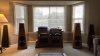
IMG_4251.JPG

Quite often folks put absorption, diffusion or a combination of both behind the speakers to address those reflection points. It is also pretty common to also place diffusion between the speakers. So, a no-cost approach was to twist the individual slats of the three sets of blinds to create a poor man's diffusion:
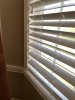
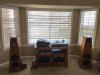
IMG_4332.JPG

IMG_4333.JPG

They are far from the common mathematically based diffusion panels but I have been quite surprised and pleased that the imaging of my system has noticeably improved. I have put some 1" OC703 between the windows and the blinds directly behind the speakers and I believe that also had a positive effect but not nearly as significant as twisting the blinds.

Lessons learned? First, rear wall reflections absolutely can smear the sound so it is important to address them if possible. And second, acoustic treatment doesn't need to be ideal to have a noticeable and positive impact.
 
Register to hide this ad
Excellent that you've addressed the acoustic behavior in your room and have implemented some methods to help improve it.

The reality of what's occurring in your scenario (according to physics) is this...unless the speakers are using rear firing drivers or an open back to propagate mid and/or high frequency content behind the speakers (dipolar or bipolar), the only sonic energy coming directly from the speakers and propagating behind them will be from the lower frequencies. Mid and high frequency energy is directional and will be propagated ahead of the frontal plane of the speaker baffle if the mid and high frequency drivers are on the front baffle and the backs of the drivers fire into the speaker enclosure. Mid and high frequency energy does not wrap around and go behind the speaker (put your head behind the speaker while music is playing and you'll clearly hear significantly attenuated mids and highs). Any mid and high frequency energy that is reflecting off the front wall (the wall behind the speakers) is not coming from the speakers directly, but is instead energy that has reached another boundary (wall, floor, ceiling) in front of the speakers and has been reflected back to the front wall. When discussing reflections from the front wall, by the time any mid range and high frequency sonic energy has made the journey from the speaker to a boundary and back to the front wall, it's no longer an early arriving reflection...which means it's a lot less likely to have an adverse effect on fidelity (image and sound stage resolution, for example). That said, room dimensions certainly have to be considered here, and the shorter the path these reflections travel, the greater the likelihood that these secondary reflections off the front wall could have an adverse effect on fidelity.

I'm curious...what's the distance from the front wall to the rear wall (the wall behind the listening spot) in your room?
 
Any mid and high frequency energy that is reflecting off the front wall (the wall behind the speakers) is not coming from the speakers directly, but is instead energy that has reached another boundary (wall, floor, ceiling) in front of the speakers and has been reflected back to the front wall.

My living/dining room is an acoustic mess so I think the above comment is correct. By twisting the individual blinds the sound, whatever the source, hitting the bay window results in it being scattered and not smearing what is directly coming from the speaker drivers. As to the source of the sound hitting the bay window, the back of the speakers do contribute IMO, but it is also coming from the walls opposite the speakers (varying distances of 30', 23' and 19') that all arrive back at the bay window at different times. My room actually has slap echo between front and rear walls complicated by a cathedral ceiling over the entire space. One of my other no-cost tweaks was to toe in my speakers to reduce room effects and I'm looking at a variety of ways to tame the rest of the space that is aesthetically pleasing.

Regardless of the acoustic challenges posed by my living/dining/listening room acoustic improvements don't have to be expensive and twisting the blinds only cost some quizzical looks. I drew some inspiration from Jim Smith's book Get Better Sound.
 
Back
Top Bottom