• The move to the new server is done. There are some software and database maintenance updates in process. This has us passing the hat around to help out. We appreciate any donations. Seriously, even a dollar helps. The payment page may be found here - https://www.audiokarma.org/support.html

Power of Headphone Section on Speaker Amps

cscottrun4it

Active Member
I have several pre 1980s amps and one Denin PMA 2000r in the house. I also just got a great set of Sennheiser HD-424 headphones, which have a resistance of 2,000 Ohms. With the exception of one, all the pre 1980s amps drive the HD-424s. The Denon does the best job of driving the 424s, but it is not the highest watt amp I own. So it appears amp wattage does not equal headphone capability.

On top of this mystery is, all the amps seem to disengage the speaker outputs when the headphones are plugged in. Thank god, because I don't own any 2,000 Ohms speakers...

These conditions suggest to me the amps are all going into a "headphone amp" mode when I plug in the 1/4" jack. Is that right?

With all of that in mind, the 424s have a sensitivity of 94 dB with 1 mW input. However, looking at headphone amps, achieving 1mW at 2,000 Ohms seems to be a trick. The guys at Shiit laughed and told me they had nothing that could drive the 424s. The Denon achieves excellent listening volume with its dial at about 9 o'clock, tho.

So, I have an idea: how do I figure out what the output is on the Denon's headphone section? If I know this, I can start looking at headphone amps with similar power specs, yes? I can't find the value in the Denon literature. I can't see that anyone has asked such a knuckleheaded question before.

Can anyone help me out?
 
Register to hide this ad
Power of a receiver isn't so much the issue. I'd think with high impedance cans the concern is moreso voltage swing.

For example, to "drive" 10mW into 300 ohm cans requires ~1.7V swing. To do 10mW into 2000 ohm cans requires ~4.5V swing.
 
Some amplifiers have an output to drive loudspeakers and an entirely separate (though internal) amplifier to drive the headphones. Other amplifiers drive the headphones from the main speaker outputs, but do so via a high(ish) resistance. Roughly speaking, about 1mW in headphones is equal to about 1W in loudspeakers. Lot's of headphones are 32 ohms, which is only 4 x a typical 8 ohm loudspeaker. Your new headphones are 2000 ohms, which is obviously in a different ballpark altogether.
The big advantage of 2000 ohm headphones is they can be driven from the main loudspeaker outputs of an amp. For example, 2.8V into 8 ohms = 1W and 2.8V into 2000 ohms = 4mW, which is close enough.
However, when using 32 headphones you can't run them straight of the speaker outputs because they would dissipate too much power and a series resistor has to be employed to make the system usable.
Anyway, I've forgotten the question now! :rflmao:
 
Power of a receiver isn't so much the issue. I'd think with high impedance cans the concern is moreso voltage swing.
Correct. The attraction of high impedance headphones is you can put lots of them in parallel and run them straight off a power amp - which is ideal in a studio where many musicians may need to wear cans simultaneously to hear a monitor mix.
 
For most vintage gear isn't the headphone jack driven from the main outputs running through some dropping resistors. AFAIK very few if any have a separate headphone amp.
 
I have several pre 1980s amps and one Denin PMA 2000r in the house. I also just got a great set of Sennheiser HD-424 headphones, which have a resistance of 2,000 Ohms. With the exception of one, all the pre 1980s amps drive the HD-424s. The Denon does the best job of driving the 424s, but it is not the highest watt amp I own. So it appears amp wattage does not equal headphone capability.

On top of this mystery is, all the amps seem to disengage the speaker outputs when the headphones are plugged in. Thank god, because I don't own any 2,000 Ohms speakers...

These conditions suggest to me the amps are all going into a "headphone amp" mode when I plug in the 1/4" jack. Is that right?

With all of that in mind, the 424s have a sensitivity of 94 dB with 1 mW input. However, looking at headphone amps, achieving 1mW at 2,000 Ohms seems to be a trick. The guys at Shiit laughed and told me they had nothing that could drive the 424s. The Denon achieves excellent listening volume with its dial at about 9 o'clock, tho.

So, I have an idea: how do I figure out what the output is on the Denon's headphone section? If I know this, I can start looking at headphone amps with similar power specs, yes? I can't find the value in the Denon literature. I can't see that anyone has asked such a knuckleheaded question before.

Can anyone help me out?
I don't know what to say about issues between amps but I love the 424s... very comfortable and very lite weight, and the open ear design. They do need to be centered over the ear for best sound but overall they are hard to beat. I used to use them with the speakers on, the combination was good. I remember when they were new people would look at them and say 'what's this' until they put them on. In some ways cheap plastic looking things with that small lite weight cord for 75 dollars, it was necessary to demonstrate.
 
For most vintage gear isn't the headphone jack driven from the main outputs running through some dropping resistors. AFAIK very few if any have a separate headphone amp.
Most did not have a separate section for the headphone output... a few did, very few though. Mostly from the main output through dropping resistors.
 
@rothwellaudio - I'm slow... Do you mean that an 80-watt amp will produce 80 mW from the headphone section or are you saying that, generically, one headphone mW is roughly equal to one speaker watt?

As an aside, the Sennheiser owner's manual talks about plugging the headphones directly to the speaker terminals. That seems like a very non-potable solution, however. The Denon weighs roughly 50 pounds...
 
@rothwellaudio - I'm slow... Do you mean that an 80-watt amp will produce 80 mW from the headphone section or are you saying that, generically, one headphone mW is roughly equal to one speaker watt?

As an aside, the Sennheiser owner's manual talks about plugging the headphones directly to the speaker terminals. That seems like a very non-potable solution, however. The Denon weighs roughly 50 pounds...
One headphone mW is roughly equal to one speaker watt.
No, 50 pounds isn't very portable.
 
Most did not have a separate section for the headphone output... a few did, very few though. Mostly from the main output through dropping resistors.
I was looking at a JVC amp schematic today that showed 270 ohm resistors in series with the headphone output, driven from the main speaker outputs. 2.8V into 8 ohm speaker would give 1W, but the same 2.8V via the 270 ohm resistor into 32 ohms would give 2.7mW. Sounds about right. Into 2000 ohms the power would be 3mW, so would be alright too. The large voltage swing of the power amp plus the series resistor does a good job of making the amp compatible with a wide range of headphones.
A separate/dedicated headphone amp would need the same high voltage swing to cope with 2000 ohm headphones.
 
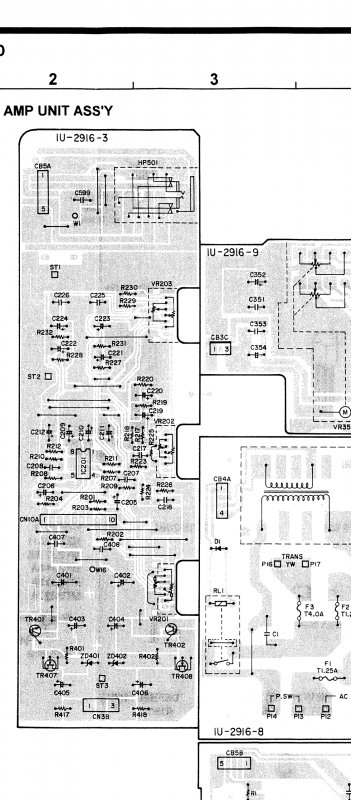
I've been looking at the schematics for two hours. I understand the system flow. I sort of understand the wiring. The actual electrical components are like Latin to me.

I've attached a picture...
The headphones are in the upper right corner, I think. That's where they are in the wiring and schematic diagrams anyway.

I need another G&T.
 
Maybe I'm going about this wrong, then. Let's change directions. Last night, I stumbled on this -


The HD-424s have a 2000 resistance with 94 dB at 1 mW sensitivity. Based on these, the calculator says I need...

40 mW
9 volts RMS
4.5 milliamps RMS​

... to achieve 110 dB SPL, which will make my ears bleed after 30 min, or so I've read. (Apparently that's the standard?) Do these sound right?

The tool also makes some amp recommendations for amps, based on these specs, albeit outdated models in some cases. One of the recommendations is the Magni 2 Uber, the equvilant of the Magni 3+? It also recommends the Woo Audio WA8. That's out of my price range.

Shiit does sh!t when it comes to publishing specs like these. Anyone know anything about the Magni 3+ and these specs?

If this tool is good, we should get it up on the headphone page, don't you think?
 
Maybe I'm going about this wrong, then. Let's change directions. Last night, I stumbled on this -


The HD-424s have a 2000 resistance with 94 dB at 1 mW sensitivity. Based on these, the calculator says I need...

40 mW
9 volts RMS
4.5 milliamps RMS​

... to achieve 110 dB SPL, which will make my ears bleed after 30 min, or so I've read. (Apparently that's the standard?) Do these sound right?

The tool also makes some amp recommendations for amps, based on these specs, albeit outdated models in some cases. One of the recommendations is the Magni 2 Uber, the equvilant of the Magni 3+? It also recommends the Woo Audio WA8. That's out of my price range.

Shiit does sh!t when it comes to publishing specs like these. Anyone know anything about the Magni 3+ and these specs?

If this tool is good, we should get it up on the headphone page, don't you think?
I'm not sure what your problem is and what you're trying to achieve. You "need" 40mW to drive those headphones is like saying you "need" 40W to drive a pair of speakers. What's the big revelation from that website?
So, I have an idea: how do I figure out what the output is on the Denon's headphone section? If I know this, I can start looking at headphone amps with similar power specs, yes? I can't find the value in the Denon literature. I can't see that anyone has asked such a knuckleheaded question before.
As pointed out in post #10, the power delivered to the headphones depends on the impedance of the headphones.
 
The original Sennheiser HD414 with 2000 Ohms per system was brought into the market in 1968. The 424 is a very similar can, it followed one or two years later. It was an upmarket - version of the 414, also with 2000 ohms per system. Later versions had differing impedances and also differing sound. Original 414 and 424 sound very similar, with an edge in the bass for the 424. It can be that the drivers of the headphones were similar then and that the better bass of the 424 is generated by the different housing and the much thinner foam pad.

By the way: foam pads for both cans are still available.

When those cans were sold practically all amps in the market connected the headphone outputs via resistors to the speaker outputs. E.g. 300 Ohms at my Rotel RX-303, 150 Ohms at my Pioneer SX-550 and the SA-8500 II. The latter gets furiously loud with my 414 I own since 1968! (My 424 is a later 600 Ohms type I salvaged from the dust bin of a colleague)

Interestingly my Kenwood Basic C1 preamp has no headphone connection, the power amps of the series (M1 and M2) have.

And the portability? Well, the only portables then have been devices like the Uher Report RtR, and it is said the very first Walkman was equipped with the 414...
 
Last edited:
Let's change directions.

No, that just distracts. Just post that schematic section of your PMA2000R - so one can see, what's going on (*). What that section needs to show, basically is just the last bit of the power amp section and the path to the speaker-outs and headphone-out.

Well and generally speaking, what Andrew has already tried to explain to you, is that in most integrated amps and stereo receivers the headphone-out is simply driven by the power-amp section - either just via series resistors, in which case the impedance of the headphone itself becomes the second part of the voltage divider, that it forms together with the series resistors (typically one per channel), or in some cases (e.g. Kenwood DA-9010) also via a voltage divider (in case of that Kenwood the first part of that is formed by a 330 Ohm and a 150 Ohm in series, and the second part is formed by another 150 Ohm resistor), so that the impedance of the headphone merely alters the voltage division to a certain degree.

Example: For simplicity of calculation in your case, let's assume a series resistor solution wth 500 Ohm, then with your 2000-Ohm-Sennheiser the power-amp output voltage would "see" a total load of 2500 Ohm, so that 1/5 of the voltage would drop at the series resistor and the rest (= 4/5) would drop at the headphone. In case of an amp with ca. 80 W @ 8 ohm, that output voltage would be ca. 25 V(eff.) maximum, so that a 2-kOhm-headphone would still get ca. 20 V(eff.) maximum. See?

Now let's assume a 50-Ohm-heaphone instead - then the total load would be 550 Ohm, so that 10/11 of the output voltage would already drop at the series resistor and 1/11 would remain for the headphone - and that remaining part would be ca. 2.3 V(eff.) of those ca. 25 V(eff.).

So, as one can see, such a series resistor solution has the advantage, that it practically adapts to the requirements of different headphone models, providing a pretty high output voltage to high-impedance models and a much lower output voltage to low-impedance models. However, the disadvantage is, that the output impedance is comparatively high - and of course in case of headphone models with rather variable impedance over frequency the voltage division would also vary accordingly, so that the frequency response could differ quite a bit from the frequency response in combination with a dedicated headphone amp with pretty low output impedance.


If this tool is good, we should get it up on the headphone page, don't you think?

Oh, well, of course such calculators can be convenient for lazybags. But in my view it's always better to know the necessary formulae oneself, especially if these aren't relly complicated.

For example, in your particular case: 110 dB - 94 dB = 16 dB. And if one knows the db fomula (= 10 * log (P2/P1)), these 16 dB accordingly simply represent a factor of 10^(16/10) = 10^1.6 = ca. 39.8. And 1 mW * 39.8 = 39.8 mW.

Well, and P = U * I = U² / R = I² * R. So U = (0.0398 W * 2000 Ohm)^0.5 = ca. 8.92 V(eff.) and I = (0.0398 W / 2000 Ohm)^0.5 = ca. 4.46 mA(eff.)

So in my view that's nothing, one couldn't easily calculate oneself, unless one would be sitting in front of a computer(/tablet/smartphone/whatever...), that only provides a very basic, non-scientific calculator application.

These conditions suggest to me the amps are all going into a "headphone amp" mode when I plug in the 1/4" jack. Is that right?

That would rather seem highly unlikely. Most usually the headphone-outs are just fed in parallel to the speakers. But in some cases (most usually, if the integrated amp or receiver doesn't sport full speaker selection control) headphone jacks with additional switch contacts are implemented, which will disable the speaker outputs, as soon as a headphone plug is inserted, based on the assumption, that the user would prefer that (which of course could just as well be a wrong assumption, e.g. if the speakers are in another room...). Over here we even had DIN "dice 5" headphone plug variants with a single-sided cutout, so that in matching jacks the speakers would either de disabled or not, depending on which way around the plug was inserted - whether that feature actually was supported, was model-dependent, though.

Greetings from Munich!

Manfred / lini


*) Actually I already tried to have a look into the service manual myself, but while I could still see the block diagram, my old notebook simply doesn't have sufficient RAM capacity to render the schematic within a reasonable time... Hence so far I can only confirm, that the PMA-2000R also belongs to the models, on which the headphone-out is fed by the power-amp section.
 
Manfred,
Sending you a PM regarding a similar subject you may be able to help me answer, and don’t want to derail OP's post.

Bill
 
As an amendmend to Manfreds informative post:The problem with the over the frequency range changing impedance of the headphone generates less inlinearities when the nominal impedance is as high as that of the Sennheiser. This might be one reason why 414 / 424 were so superior to other phones then. Another reason of course was the open type of construction. They were the very first open headphones
 
As an amendmend to Manfreds informative post:The problem with the over the frequency range changing impedance of the headphone generates less inlinearities when the nominal impedance is as high as that of the Sennheiser. This might be one reason why 414 / 424 were so superior to other phones then. Another reason of course was the open type of construction. They were the very first open headphones
Hi impedance is almost always good, like 1 uf coupling capacitors between stages, practically invisible to the signal with the impedance involved. What ever the reason the 414, and especially the 424 were quite the headphones, and the open design with light weight made them very pleasant to wear. The replacement cords and the foam pads were always kept in stock. Would like to have my new purchased 424s now but they got away from me.
 
Well, the first 414 (light grey with darker grey cushions) were not that easy to wear, they felt like a vice. The 424 however...

The nice thing is, all my Sennheisers can be equipped with the same cables, 414, 424, 250 Linear, the HD25 - version Amperior, and several others.
 
Back
Top Bottom