• The move to the new server is done. There are some software and database maintenance updates in process. This has us passing the hat around to help out. We appreciate any donations. Seriously, even a dollar helps. The payment page may be found here - https://www.audiokarma.org/support.html

Power Supplies -

David_NC

Super Member
I've got access to a few power supplies like the ones shown below. These are 12V / 9A, 15V / 5A, and 24V (I can't recall the current rating). These are nice, industrial units that are in metal cases with removable input and output cords. They are a bit large, but have cords (vs vs being wall warts), so that's fine. I have a few audio devices that use 12 and 15 volts, and I'd like to use these.
How does one test such a power supply for clean output? How can I tell if they are linear or switching? I've got a 'scope and a couple multi-meters to use. I suppose one can set the meter to AC volts and check for that, but is that the best way to check them?


s-l1600.jpg

s-l1600.jpg
 
Register to hide this ad
(...) How can I tell if they are linear or switching? I've got a 'scope and a couple multi-meters to use. (...)

Scope would most likely be better suited for showing ripple.

And due to the comparatively wide input voltage range(s) my guess would be switched mode (even more so, if there's no switch for choosing between the two voltage ranges). And the size would also seem quite compact for 12 V / 9 A. And a linear-regulated conventional model of that size would pretty surely require a fan for cooling the regulator(s).

Greetings from Munich!

Manfred / lini
 
A hand-held meter probably will not have enough bandwidth to measure noise and ripple, an O'scope is the instrument of choice.
Power supplies are often measured under no load and full load at both extremes of the rated input voltages and worst-case is usually full load and lowest input voltage.
 
Scope would most likely be better suited for showing ripple.

And due to the comparatively wide input voltage range(s) my guess would be switched mode (even more so, if there's no switch for choosing between the two voltage ranges). And the size would also seem quite compact for 12 V / 9 A. And a linear-regulated conventional model of that size would pretty surely require a fan for cooling the regulator(s).

Greetings from Munich!

Manfred / lini


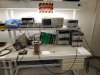
The two units on the bottom-right are linears that can do 30 volts and 10 amps and are not fan cooled.

Although I did just see that you mention of size..I couldn't see the original images so these are probably bigger.

20210323_083810.jpg
 
(...) Although I did just see that you mention of size. (...)

Yup - I've guesstimated that from the size of barrel plug. And a passively cooled, linear-regulated unit of that size with an inside heatsink would also seem extremely likely to have pretty large venting holes both on the bottom and at the top.

Greetings from Munich!

Manfred / lini
 
Ha, I love the "Safety Third" sign. Did you by chance get that from Mike Rowe?

I was lucky enough to have a lot of autonomy in my lab and my various "personalizations" were well tolerated.
But I'm afraid that I don't know where I first saw that.
 
Those are definitely switching PS's.

You could just try to use them for your intended purposes, however, there may be some hi frequency harmonics that may or may not affect your devices.

A few years ago I was contracted by a customer to figure out why some older industrial automation robotics were "going crazy" every so often. It turned out the original linear power supplies (which were massive, BTW) were removed and replaced by some very good, expensive, modern switchers. Even as good as they were, they still had enough HF noise on the line to occasionally affect operations. Additionally, the power up/power down of a switcher was different than a linear, causing systems to power-down in a disorderly manner (wouldn't likely affect audio gear).
I ended up using my DSO (oscilloscope) to devise a capacitive HF snubber network to handle the HF noise that was polluting the stepper/encoder signals.

How "clean" these are will mostly be determined by what your equipment thinks of the possible HF noise these can induce....
 
It's a modestly priced switcher used to charge Symbol barcode guns.

https://onlybatteries.com/12-volt-switching-power-supply-9-amp/
Correct. These are very well built and were not modestly priced at all when new!

Scope would most likely be better suited for showing ripple.

And due to the comparatively wide input voltage range(s) my guess would be switched mode (even more so, if there's no switch for choosing between the two voltage ranges). And the size would also seem quite compact for 12 V / 9 A. And a linear-regulated conventional model of that size would pretty surely require a fan for cooling the regulator(s).

Greetings from Munich!

Manfred / lini
The are actually pretty large. I can take a pic with something to give perspective, but I used generic pics vs digging them out of the garage.

Yup - I've guesstimated that from the size of barrel plug. And a passively cooled, linear-regulated unit of that size with an inside heatsink would also seem extremely likely to have pretty large venting holes both on the bottom and at the top.

Greetings from Munich!

Manfred / lini
Some of them actually have small fans in them. The ones that don't have fans still have the same vent holes on each end. The cases are fairly substantial aluminum, FWIW. I've opened one that had failed, and there are large heatsinks in there too.
 
Those are definitely switching PS's.

You could just try to use them for your intended purposes, however, there may be some hi frequency harmonics that may or may not affect your devices.

A few years ago I was contracted by a customer to figure out why some older industrial automation robotics were "going crazy" every so often. It turned out the original linear power supplies (which were massive, BTW) were removed and replaced by some very good, expensive, modern switchers. Even as good as they were, they still had enough HF noise on the line to occasionally affect operations. Additionally, the power up/power down of a switcher was different than a linear, causing systems to power-down in a disorderly manner (wouldn't likely affect audio gear).
I ended up using my DSO (oscilloscope) to devise a capacitive HF snubber network to handle the HF noise that was polluting the stepper/encoder signals.

How "clean" these are will mostly be determined by what your equipment thinks of the possible HF noise these can induce....
How does one tell if a PS is switching or not, for future reference? I'm fairly new to 'scopes. Any suggestions as to what I'd do? I assume I'd connect the leads to the barrel plug and set the scope for AC triggering, but that's just a guess!
 
How does one tell if a PS is switching or not, for future reference? I'm fairly new to 'scopes. Any suggestions as to what I'd do? I assume I'd connect the leads to the barrel plug and set the scope for AC triggering, but that's just a guess!
multi-voltage input is a giveaway, and also traditional linear PS's have very heavy transformer and relatively low power output for the size.

One of the PS you showed is 108w output, traditional linear PS would be much larger at that rating.
 
What are the audio devices that you have that can use 12 and 15 volts?
DAC and Tube01 preamp.

Just wouldn't use one for audio applications.
!
It'd be hard to believe that the cheapo wall warts that came with these devices, especially a $30 Tube01 preamp would be any better than these. To prove this, I posted the question of how to test them to ensure that they have clean output, and then I'd compare them to the ones that came with the devices. I figured testing was the best way. Still, I'm not sure what to look for when I to test them, which brings me back to my original question!
 
Certainly not. Replace them with battery or linear power supplies for best results.

Thanks, I'll keep that in mind if I multiple batteries (12V and 15V) are appropriate for this situation or if I come across linear PS's that will fit. Still, my question was how to test power supplies for clean output.
 
Back
Top Bottom