• The move to the new server is done. There are some software and database maintenance updates in process. This has us passing the hat around to help out. We appreciate any donations. Seriously, even a dollar helps. The payment page may be found here - https://www.audiokarma.org/support.html

PP vs SET Same tubes = different sound?

playittwice

Super Member
While trying to learn about tube amps, I have a question regarding PP and SE amps using the same el34 tubes, are they more alike or different sonic-wise. I know power difference is more with PP, but from a sonics view point what’s the difference?
Maybe a dumb question but would like to know.
 
Register to hide this ad
While trying to learn about tube amps, I have a question regarding PP and SE amps using the same el34 tubes, are they more alike or different sonic-wise. I know power difference is more with PP, but from a sonics view point what’s the difference?
Maybe a dumb question but would like to know.

No, it's not a dumb question at all. I can only give you my experience. Apart from the obvious power limitations, in my experience there are three main sonic differences between SE and PP:

1) Bandwidth. An SE output transformer must handle unbalanced current, which means it must be very large and extremely well-constructed to even approach the frequency response of a PP amplifier. A lot of people don't mind this limitation. I used SE amps for years but in the end I felt that a lot of modern digital recordings, especially of classical piano, are not well-served by a limited-bandwidth SE amp. Others would disagree and not find this a problem, but technically-speaking an SE amp is not going to have the bandwidth of a good PP amp. Bass response in particular can be problematic.

2) Imaging. There's definitely a clarity, directness and transparency to SE amps that is very appealing. On the other hand, they can sometimes feel "flat," in the sense that the instruments and voices lack a convincing three-dimensional quality. SE amps can also sometimes lack a sense of "complexity" in conveying vocal and instrumental textures that PP offers.

3) Simplicity. It's easy to build a pretty good SE amp that makes nice music. Generally there's no feedback involved, which takes some expertise to apply properly. But it's also the case that a very good SE amp can get expensive in terms of components, mostly the output transformer but also the tubes.

Others will chime in, I'm sure. ;-). My DIY journey was from SE 300B to SE 845 (very expensive, heavy and hazardous, to say the least) back to 300B, then to PP 300B, where I heard a sense of depth and fullness *combined* with a purity of tone that was appealing. But the expense got out of hand, and it's hard to pull off a good PP 300B amp because of the drive requirements. Then I experimented with a classic Williamson triode design and found a very happy medium for me--beautiful tone, excellent bandwidth and reasonable cost.

In the end it depends on your system, your preferences and your budget. SE amps can be very lovely, easy to maintain and fun to listen to. PP has more to offer, IMO, but it also has to be a quality build.
 
The words I use to describe my SE amp (mine is not a SET but rather an SE-UL) are "beguiling, seductive, and voluptuous." The words I use to describe my PP amp are "powerful, articulate, resolving."

Don't know if that helps or not...
 
The words I use to describe my SE amp (mine is not a SET but rather an SE-UL) are "beguiling, seductive, and voluptuous." The words I use to describe my PP amp are "powerful, articulate, resolving."

Don't know if that helps or not...

I could get on board with that comparison. ;-)
 
Very limited experience but the SE amp is pretty particular about the speaker setup, get them right and the little amps can really sound nice. A PP amps is not so picky seems like. And the visual part of the deal sure favors the PP amps.
 
So to sum this up the same tube in different amps will sound different because of amp topology/design?

Essentially, yes. A single-ended EL34 amp is not going to sound the same as a push-pull EL34 amp. But certain tubes will maintain a characteristic sound regardless of SE or PP.
 
Essentially, yes. A single-ended EL34 amp is not going to sound the same as a push-pull EL34 amp. But certain tubes will maintain a characteristic sound regardless of SE or PP.


Okay thanks to all for the great info! I have a SE el84 and a ST-35. They each have their own attributes. The PP amp has more authority, where the SE has more finesse if that makes sense. Both good in their own way. I wonder how a el34 tube amp would compare? I don’t need power so maybe the el84 is a better option.

I seem to have finally found a good match-up with pre-amps for each set-up. That took me longer than I expected. Now I’m just curious about how a different tube would sound to have a comparison. It never ends does it?!!!!!
 
Finesse is not a word I would attribute to an SE amp when comparing it to a PP amp. Finesse being defined as “intricate and refined delicacy.” It’s all relative though.

Technically speaking the best PP amps usually have a lower noise floor, have significantly less distortion, have wider bandwidth, but might be slightly cool sounding, as compared to the best SE amps.

If you think of a digital picture as an analogy, a PP amp would have a higher dots per inch ratio, a wider color range, but with slightly cool and sterile color blend, whereas an SE amp would have slightly lower DPI, more limited color range, but would have richer and warmer color blend.

May be splitting hairs but the best PP amps IMO have better refinement and “feather light” qualities, especially in the ability to resolve fine detail.

What SE amps do very well, which is nigh impossible for PP amps to do as well, is midrange—drawing the listener in, placing the musicians around you, enveloping you with rich harmonic content.

That’s just my opinion. I’m sure there are a dozen differing opinions.

What I can say is for the last 2 or 3 months my SE-UL KT120 amp has occupied center stage in my listening room, and I have no desire currently to swap it out. :)
 
Last edited:
Wha t I do seem to find in my set-ups is the volume needs to be turned up a bit for them to do most things right. I attribute that to my sensitive speakers. To get things to “blend” they need to be pushed a bit. IME. This is with SS or tubes.
 
Finesse is not a word I would attribute to an SE amp when comparing it to a PP amp. Finesse being defined as “intricate and refined delicacy.” It’s all relative though.

Technically speaking the best PP amps usually have a lower noise floor, have significantly less distortion, have wider bandwidth, but might be slightly cool sounding, as compared to the best SE amps.

If you think of a digital picture as an analogy, a PP amp would have a higher dots per inch ratio, a wider color range, but with slightly cool and sterile color blend, whereas an SE amp would have slightly lower DPI, more limited color range, but would have richer and warmer color blend.

May be splitting hairs but the best PP amps IMO have better refinement and “feather light” qualities, especially in the ability to resolve fine detail.

What SE amps do very, well which is nigh impossible for PP amps to do as well, is midrange—drawing the listener in, placing the musicians around you, enveloping you with rich harmonic content.

That’s just my opinion. I’m sure there are a dozen differing opinions.

What I can say is for the last 2 or 3 months my SE-UL KT120 amp has occupied center stage in my listening room, and I have no desire currently to swap it out. :)

Which design is this, kward, the 6EJ7 one?
 
"The PP amp has more authority, where the SE has more finesse if that makes sense."

Like a fullback in a short yardage situation vs. a tailback or wide receiver in the open field....

......or Darryl Dawkins dunk vs. Dr J dunk (from Dr J favorite player BB fan).
 
Last edited:
Which design is this, kward, the 6EJ7 one?

It’s a 12AT7 coupled to a KT120 with both secondary-derived and primary-derived OPT feedback. Both feedback paths go back to the cathode of the 12AT7. The 12AT7 runs in fixed bias mode (as does the KT120). There is no “”plate to plate” feedback as in many other DIY SE amps you might see made from the standard fare power tubes. Plate to plate feedback in this design reduced performance substantially.
 
beyond just output stage basic topology, you can take a deep dive into the merits of different driver circuits and feedback systems. Some folks are into low mu triodes for drivers, some are high mu, some like pentodes. Direct coupled vs cap coupled vs transformer coupled. No feedback vs global feedback vs local feedback, then the amount of feedback to use if any. Its all a very deep and subjective well.

One interesting thing is that how something measures often has little to do with what people will tell you about the sound. There are things that are an absolute train wreck in terms of distortion, noise, frequency response, phase accuracy, and anything else you'd care to put a number to and someone will tell you its simply the best thing you can experience with clothes on. Other things are amazing on paper, and someone will tell you its a sonic meat grinder while someone else loves it. Thats kind of audio in general though.
 
It’s a 12AT7 coupled to a KT120 with both secondary-derived and primary-derived OPT feedback. Both feedback paths go back to the cathode of the 12AT7. The 12AT7 runs in fixed bias mode (as does the KT120). There is no “”plate to plate” feedback as in many other DIY SE amps you might see made from the standard fare power tubes. Plate to plate feedback in this design reduced performance substantially.

What 12AT7 are you using?
 
beyond just output stage basic topology, you can take a deep dive into the merits of different driver circuits and feedback systems. Some folks are into low mu triodes for drivers, some are high mu, some like pentodes. Direct coupled vs cap coupled vs transformer coupled. No feedback vs global feedback vs local feedback, then the amount of feedback to use if any. Its all a very deep and subjective well.

One interesting thing is that how something measures often has little to do with what people will tell you about the sound. There are things that are an absolute train wreck in terms of distortion, noise, frequency response, phase accuracy, and anything else you'd care to put a number to and someone will tell you its simply the best thing you can experience with clothes on. Other things are amazing on paper, and someone will tell you its a sonic meat grinder while someone else loves it. Thats kind of audio in general though.
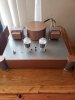
That SE-UL Compactron amp I built has the worst specs of all my amps. 40hz to 18khz response, up to 5% distortion at full output. I never run it to the full 5.5 watts, but I've been using it much more than any of my other amps lately. It just sounds really good. Even with crappy specs.
 
That SE-UL Compactron amp I built has the worst specs of all my amps. 40hz to 18khz response, up to 5% distortion at full output. I never run it to the full 5.5 watts, but I've been using it much more than any of my other amps lately. It just sounds really good. Even with crappy specs.

Dumb question perhaps, but what tubes does that amp use?
 
TV sweep tubes. 6LR8's. They have a triode and pentode in one bottle. So just one tube per channel. Driver and output in one tube.
 

Attachments

  • 20190922_103428.jpg
    20190922_103428.jpg
    49.4 KB · Views: 27
Back
Top Bottom