• The move to the new server is done. There are some software and database maintenance updates in process. This has us passing the hat around to help out. We appreciate any donations. Seriously, even a dollar helps. The payment page may be found here - https://www.audiokarma.org/support.html

PSA: Chemi-Con Capacitors in early 70s Pioneer Gear

Sterling245

AK Subscriber
Subscriber
Just wanted to put this out there in case it could help someone! Yesterday I was working on a SX-1000tw. Although working, it showed signs of needing a recap. During that process, I began to notice that nearly all the old Chemi-Con capacitors I pulled out were either bulging or actively leaking electrolyte on the board. Not badly, but it was clearly noticeable once the cap was removed. Nearly all of these still tested good, except for a few that tested completely open! (The ones that tested open still looked okay from the top as well, but once pulled from the board it was obvious that they were bad).

Out of curiosity, I then checked an SX-990 that I have. This one was all-original and working perfectly, and from the surface the power supply board looked good. Once again though, after pulling the Chemi-Con caps, more than 2/3 of them had begun to leak electrolyte onto the board.

All this is to say that if you have an older Pioneer machine, you may want to consider changing out or at least inspecting these Chemi-Con caps. It could save you a lot of trouble in the future!
 
Register to hide this ad
Yes, 40+ year old electrolytic caps should definitely be replaced.

But I haven't really seen much leakage onto the boards during my restorations. Are you sure it was actually leakage from within the caps, as many of the original caps (especially the larger ones) were glued to the boards in the factory with a sticky amber colored glue?
 
I've been pretty much convinced that 40-year old caps (to say nothing of your 50 year old ones), should just be replaced as a matter of course. Just did an early 80's HK receiver and recapping the tuner made a big difference even though the caps that came out all tested within tolerances. Some of them may have been a bit electrically leaky but I hooked a few of them up to a bench power supply and microammeter. The ones I checked didn't look all that bad. But recapping totally restored the sensitivity of the receiver to what it should be. If you're tearing into a unit anyway, just do it. You'll probably notice a difference even if you thought it was fine before.

+1 on the glue. It would be a bit strange for 2/3 of them to be leaking electrolyte. That glue needs to be removed. It becomes conductive and corrosive when it ages. You may find some nearby components with the glue on them that have had legs partially (or fully) eaten away by it. The glue can usually be removed by scraping off most of it and then using acetone and q-tips to get the rest.
 
Last edited:
Yes, 40+ year old electrolytic caps should definitely be replaced.

But I haven't really seen much leakage onto the boards during my restorations. Are you sure it was actually leakage from within the caps, as many of the original caps (especially the larger ones) were glued to the boards in the factory with a sticky amber colored glue?
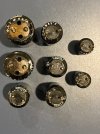
It was definitely leakage. I have worked on many units with circuit glue and this doesn't look like anything I've seen at least. None of these were leaking very much (not noticeable unless you pull the cap from the board). I will try and get photos of some of the ones I pulled later today.
 
Here is a pic of a few of the caps I pulled. Notice on some around the edges of the label there is leakage. (I know its pretty difficult to see in the pic... I tried my best)
 

Attachments

  • Pioneer Caps.jpg
    Pioneer Caps.jpg
    78.9 KB · Views: 46
I've been pretty much convinced that 40-year old caps (to say nothing of your 50 year old ones), should just be replaced as a matter of course. Just did an early 80's HK receiver and recapping the tuner made a big difference even though the caps that came out all tested within tolerances. Some of them may have been a bit electrically leaky but I hooked a few of them up to a bench power supply and microammeter. The ones I checked didn't look all that bad. But recapping totally restored the sensitivity of the receiver to what it should be. If you're tearing into a unit anyway, just do it. You'll probably notice a difference even if you thought it was fine before.

+1 on the glue. It would be a bit strange for 2/3 of them to be leaking electrolyte. That glue needs to be removed. It becomes conductive and corrosive when it ages. You may find some nearby components with the glue on them that have had legs partially (or fully) eaten away by it. The glue can usually be removed by scraping off most of it and then using acetone and q-tips to get the rest.

ESPECIALLY the power supply caps, as they're subject to ripple current, which can heat them up, and dry them out.
 
Back
Top Bottom