


mrehorst
Super Member
I just acquired a pair of ESL-988s, one working perfectly, and the other making popping noises as well as playing music very nicely. It's probably a torn diaphragm or a stator that has come unglued. Fortunately, I have the materials and the experience to make the necessary repairs.
I like the look- much more modern, if not brutal, than the ESL-63:

I opened up the good speaker and found the neon lamp that connects the bias supply to the speaker diaphragms flashing once every 20 seconds or so, so it seems to be OK. The dust covers are intact and wrinkle free, so I'm going to leave that speaker alone.
Here's a view of the naked backside of the speaker with the sock pulled down (yes, I know how that sounds...)

The driver panels appear to use fewer ribs to support the stators than were used in the ESL-63. The protective perforated mesh is full of circular holes instead of the square hole mesh used in some ESL-63s (at least, that's what they used in mine- it varied depending on when the speaker was made) and appears to have a larger open ratio. You can see that the mesh has two folds to stiffen it instead of the metal rods that were installed to support the mesh in the ESL-63. The side rails of the frame seem to be much more solid than the thin aluminum extrusions that were used in the ESL-63.
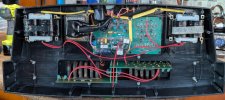
I opened the bottom of the speaker (17 screws!) to get a look at the circuit boards and see what else might be different. The two audio transformers seem to be different from those used in the ESL-63, and the protection, bias supply, and LV power supply circuits are all on one PCB now. The delay lines are still a separate assembly with their own circuit boards.
My first impression is that these speakers are built much more solidly than the ESL-63s.
One thing that was especially awful in the 63s was the way the dust covers were mounted. It was nearly impossible to get them in and out without destroying them, and putting in a new one without any wrinkles was equally difficult. When I repair the other speaker I will find out about the dust cover situation. I may have to develop a jig to stretch the film and then set the speaker down on it or set the jig in the speaker to transfer the stretched film to the dust cover frame.
Another awful thing about the ESL-63s is the amount of foam tape that was used inside them. The foam rotted and could potentially get into the drivers and cause all sorts of problems, and the adhesive turned into a sticky mess. Cleaning all that stuff out of the speakers was a LOT of work. I am hoping Quad was more sensible with these speakers.
There will be a blog post with all the trials and tribulations and lots of pictures.
I like the look- much more modern, if not brutal, than the ESL-63:
I opened up the good speaker and found the neon lamp that connects the bias supply to the speaker diaphragms flashing once every 20 seconds or so, so it seems to be OK. The dust covers are intact and wrinkle free, so I'm going to leave that speaker alone.
Here's a view of the naked backside of the speaker with the sock pulled down (yes, I know how that sounds...)
The driver panels appear to use fewer ribs to support the stators than were used in the ESL-63. The protective perforated mesh is full of circular holes instead of the square hole mesh used in some ESL-63s (at least, that's what they used in mine- it varied depending on when the speaker was made) and appears to have a larger open ratio. You can see that the mesh has two folds to stiffen it instead of the metal rods that were installed to support the mesh in the ESL-63. The side rails of the frame seem to be much more solid than the thin aluminum extrusions that were used in the ESL-63.
I opened the bottom of the speaker (17 screws!) to get a look at the circuit boards and see what else might be different. The two audio transformers seem to be different from those used in the ESL-63, and the protection, bias supply, and LV power supply circuits are all on one PCB now. The delay lines are still a separate assembly with their own circuit boards.
My first impression is that these speakers are built much more solidly than the ESL-63s.
One thing that was especially awful in the 63s was the way the dust covers were mounted. It was nearly impossible to get them in and out without destroying them, and putting in a new one without any wrinkles was equally difficult. When I repair the other speaker I will find out about the dust cover situation. I may have to develop a jig to stretch the film and then set the speaker down on it or set the jig in the speaker to transfer the stretched film to the dust cover frame.
Another awful thing about the ESL-63s is the amount of foam tape that was used inside them. The foam rotted and could potentially get into the drivers and cause all sorts of problems, and the adhesive turned into a sticky mess. Cleaning all that stuff out of the speakers was a LOT of work. I am hoping Quad was more sensible with these speakers.
There will be a blog post with all the trials and tribulations and lots of pictures.