• The move to the new server is done. There are some software and database maintenance updates in process. This has us passing the hat around to help out. We appreciate any donations. Seriously, even a dollar helps. The payment page may be found here - https://www.audiokarma.org/support.html

Quality of older and newer recordings

Judas Priest

Super Member
I just listened to a FLAC rip of Brahms Violin Concerto in D Major, Op. 77. Phillips CD 442 9788.

The original recording is from 1958, and I think it sounds fantastic. There MIGHT be a bit of hiss/background noise at around the 19:00- 20:00 mark, but its till sounds great.

I don´t have a more modern recording of this piece to compare it too. Are modern recordings generally better? I suspect that they have the potential to be better. What do you think?
 
Register to hide this ad
I have older recordings that sound great and some not so much. It's the same with newer recordings too. There are a bunch of variables that can affect a recordings sound. How was it miked, what type of mike, the mix down engineers opinion of what sounds good. If it's vinyl the cutting lathe and the mastering process will have a big affect on the final sound. I have noticed that record companies seem to take more care with Classical and Jazz than with other forms of music.
 
As bigaltx24 said, there are too many variables to make a categorical statement; I think it's safe to say that there are going to be many modern recordings that are better than a 1958 recording, which is almost certainly mono. I have many CDs of remastered recordings that were originally older analog recordings, and they can sound very good indeed. Some modern ones will sound even better -- some, but not all.

You don't say who the performer is on the one you have; likelihood is, whether you'll like a different recording better is more likely to depend on the performance than it is on the fidelity of the recording. ;) However, it's probably a good idea for you to get a couple of other more modern recordings of it if you really like that work, if only to see how others have approached it, and how they render it a little differently.
 
I have a copy of MJQ's European Concert on Atlantic from 1960. Produced by Nesui Ertegun and engineered by RVG (or such is my recollection and I'm too lazy to go look) and I will bet you that Milt Jackson's vibes on that recording will shatter glass when it is played on any competent mid-fi system.

Mind you, this is a live concert recording.
 
I don't know much about classical recordings, but I collect a lot of jazz and many of the older recordings sound fantastic. As far as the jazz genre, at least as far as recording acoustic type stuff, I'm not sure that the tech (or the technique) has really gotten that much better since the late 50s...
 
I just picked up a new pressing of a Little Feat album and it doesn't sound as good as the original 45 year old LP I have. Sure its background is a little quitter but it sounds more like the cd release than the original analog goodness.
 
I just picked up a new pressing of a Little Feat album and it doesn't sound as good as the original 45 year old LP I have. Sure its background is a little quitter but it sounds more like the cd release than the original analog goodness.

I was in a record store a few months ago and the owner was telling me that some of the new vinyl being released is mastered from CDs, not the original master tape. To say the least he was not fan of this process.
 
It´s stereo :)

Does it explicitly state that? It's certainly possible that stereo masters existed from 1958 for it, and that the FLAC was made from them, but there were very, very few commercial stereo recordings in 1958.

And, yeah, I think I should try to find a few other copies of it :)View attachment 1793091

Obviously, Grumiaux was one of the greatest violinists of the 20th century. It's probably pointless to try to recommend other recordings, because there are so many, and which ones are "better" is largely a matter of taste and one's personal preferences. But, if you really like that work a lot you probably owe it to yourself to pick up at least a couple of other versions just to hear the differences. (I probably have maybe six of the Brahms violin concerto.) Classical recordings can often be picked up second-hand as cheap as dirt now. For my own part, I tend to find that the one that I "grew up with" -- i.e., whichever one was the first one to strike me as really impressive -- tends to get fixed in my mind as "iconic", so it's not often that one I've really loved for a long time gets supplanted by another. ;) Probably just a peculiarity of human psychology, really.
 
Last edited:
I just listened to a FLAC rip of Brahms Violin Concerto in D Major, Op. 77. Phillips CD 442 9788.

The original recording is from 1958, and I think it sounds fantastic. There MIGHT be a bit of hiss/background noise at around the 19:00- 20:00 mark, but its till sounds great.

I don´t have a more modern recording of this piece to compare it too. Are modern recordings generally better? I suspect that they have the potential to be better. What do you think?

I don’t own the 1958 recording of Brahms Violin Concerto by Arthur Grumiaux and the Concertgebouw Orchestra, Amsterdam. I’m therefore not equipped to compare its audio quality with other recordings.

I currently own two recordings of Brahms Violin Concerto:
  • 1955 recording by Heifetz and the Chicago Symphony Orchestra. (I have a 1950s era LP pressing, and the SACD.)
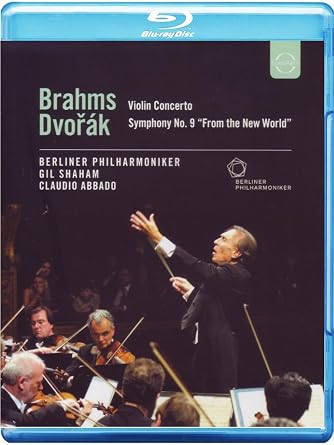
  • 2002 audio/video recording by Gil Shaham and the Berlin Philharmonic, delivered on DVD.
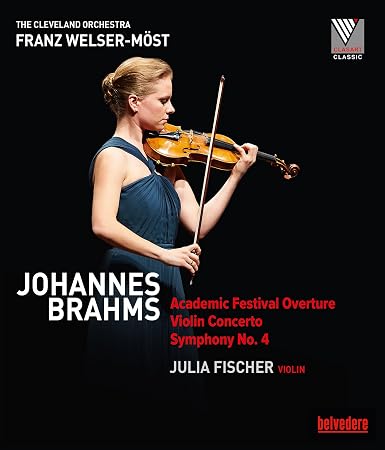
I have on order the following two Blu-ray audio/video recordings that include Brahms Violin Concerto:

61KULBDyw-L._SY445_.jpg


71x-EU8cyvL._SX385_.jpg


I’ll report on the comparative audio quality of these recordings after I receive the Blu-rays.

My goal is for music reproduced in my home to remind me of my experiences in the symphony hall and opera house. (This season I have 30 live classical concerts on my calendar.) I find that modern hi-res recordings are usually the best at creating the illusion that I’m in the concert hall.

Classical music lovers sometimes must decide which is more important: performance quality, or audio quality of a recording. I’m not a music scholar, and I’m not hyper-critical of a performance. Very often I enjoy modern performances of classical music. However, I have no tolerance for poor audio quality. I therefore usually choose modern performances of classical music that were recorded in hi-res.

Older recordings (including LPs) can deliver significant enjoyment, and are of course the only choice for historically significant performances. With that said, if you listen solely to decades old recordings, you’re limited to what was state-of-the-art technology decades ago. Provenance of the recording is extremely important. For decades-old recordings, the quality of the original recording is the ultimate limiting factor. A decades-old recording will not have state-of-the-art audio quality – even if it has been remastered.

Some high-quality vintage analog master tapes have been digitized at hi-res, and remastered, with surprisingly good results. For example, some RCA Living Stereo recordings from the 1950s that were originally recorded in 3 channels (left, center, right) have been remastered from the original analog tapes, and delivered as 3 channel recordings on SACD. (Similarly, I have some Mercury Living Presence vintage recordings (e.g., Janos Starker) that were recorded on 35mm magnetic film, and some of these recordings have been remastered and delivered on SACD in the original 3 channel format.) However, IME/IMO old recordings generally cannot match the best modern recordings in terms of audio quality.

Last year I conducted brief, informal listening assessments of the audio quality of 15 different digital recordings that I own of Beethoven Symphony 9, recorded from 1942 to 2015, including every decade in between.

  • CD (Archipel) of a 1942 performance by Wilhelm Furtwängler and the Berliner Philharmoniker

  • SACD (tahra) of a 1954 performance by Wilhelm Furtwängler and the Philharmonia Orchestra London

  • CD (Testament | EMI) of a 1957 performance by Otto Klemperer and the Philharmonia Chorus & Orchestra

  • CD (Chesky) of a 1961 performance by Rene Leibowitz and the Royal Philharmonic Orchestra

  • SACD (DG) of a 1962 performance by Herbert Von Karajan and the Berliner Philharmoniker

  • CD (Penguin Classics) of a 1972 performance by Sir Georg Solti and the Chicago Symphony Orchestra

  • CD (Seraphim Classics) of a 1988 performance by Riccardo Muti and The Philadelphia Orchestra

  • DVD (Euroarts) of a 2000 performance by Claudio Abbado and the Berliner Philharmoniker (PCM stereo and Dolby Digital 5.1 tracks)

  • 24bit/96kHz FLAC download (DG) from HDTracks.com of a 2002 performance by Claudio Abbado (stereo only)

  • SACD (BIS) of a 2006 performance by Osmo Vanska and the Minnesota Orchestra (stereo and 5.1 tracks)

  • Blu-ray (DRS | Dacapo Records) box set of 2013 performances of all Beethoven symphonies by Rafael Frühbeck de Burgos and the Danish National Symphony Orchestra (DTS-HD MA 5.0/5.1 and PCM Stereo)

  • Blu-ray (Cmajor) box set of 2008 – 2010 performances of all Beethoven symphonies by Christian Thielemann and the Wiener Philharmoniker recorded at the Goldener Saal der Gesellschaft der Musikfreunde in Vienna (DTS-HD MA 5.0 and PCM Stereo).

  • Blu-ray (ARTHAUS MUSIK) box set of 2012 performances of all Beethoven symphonies by Mariss Jansons and the Bavarian Radio Symphony Orchestra recorded in Tokyo Suntory Hall (DTS-HD MA 5.0 and PCM Stereo).

  • Blu-ray (ARTHAUS MUSIK) box set of 2014 – 2015 performances of all Beethoven symphonies by Philippe Jordan conducting the Orchestra and Chorus of the Opera national de Paris (DTS-HD MA 5.1 and PCM Stereo).

IMO - the modern recordings delivered on Blu-ray have superior audio quality compared with the older recordings – even if the older recordings were remastered. (I also prefer Blu-ray to LPs.) Moreover, the modern Blu-ray recordings feature surround-sound, and high-definition video, which both significantly increase my enjoyment of the recording.

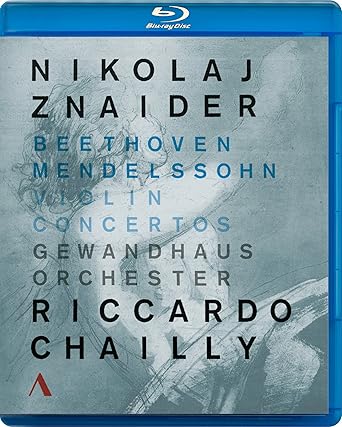
I recently received the following Blu-ray of 2012 and 2014 performances of Beethoven and Mendelssohn Violin Concertos. These are modern recordings, captured, mastered, and delivered in hi-res audio and high-definition video.

91udD6BopHL._SX342_.jpg


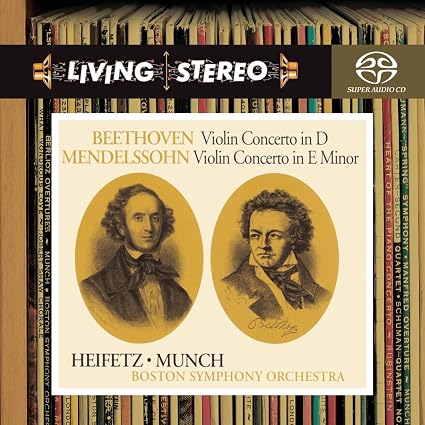
I also have the following SACD, and the corresponding 1950s era LP pressing, of these same Beethoven and Mendelssohn Violin Concertos. (The Mendelssohn Violin Concerto performed by Heifetz was originally recorded by RCA in 3 channels (left, center, right) on analog tape, and the SACD delivers the original 3 channels. The Technical Notes state: “In remastering these tapes, we kept the signal path as short as possible.” “No signal processing was necessary to ‘improve’ these extraordinary tapes.”)

81pPrXfldCL._SX425_.jpg


I recently listened to excerpts from the LP and SACD of these 1950s era RCA Living Stereo recordings (which are highly regarded for their audio quality), and the modern Blu-ray. IME/IMO, there is no comparison – the modern Blu-ray recordings have superior audio quality. Moreover, the Blu-ray recordings feature surround-sound, and high-definition video. The 1950s era RCA Living Stereo LP (100% analog) sound surprisingly good considering their age, but IMO they pale in comparison to modern Blu-ray.

In addition to the Blu-ray recordings listed above, I have Blu-ray audio/video box sets of all symphonies by Tchaikovsky, Sibelius, Brahms (x 2), Bruckner, Schumann (x 2), and Mahler. Plus, numerous other classical concerts on Blu-ray. Plus, numerous modern opera and ballet audio/video recordings on Blu-ray. And a few in Ultra HD Blu-ray. Plus, some Pure Audio Blu-ray (i.e., no video). Plus, many classical recordings on SACD. The vast majority of these are modern recordings that have state-of-the-art audio (including stereo and multi-channel (usually 5.0 or 5.1) audio tracks), or audio/video.

I employ an Oppo UDP-205 (and earlier variants) to play all of the available digital audio and audio/video formats, including Blu-ray, Ultra HD Blu-ray, Pure Audio Blu-ray, SACD, CD, DVD, and hi-res downloads. I connect the Oppo’s analog audio outputs to vintage tube amps, in both stereo, and multi-channel configurations. (I do not use an AVR or pre-processor. Multi-channel pre-processing is built into the Oppo machines, and analog audio is delivered in up to 7.1 channels via built-in “audiophile-grade” DACs.)

Bottom line: My favorite format for recordings of classical music is Blu-ray (or Ultra HD Blu-ray), featuring high-definition video, and DTS HD MA 5.0 or 5.1 surround sound. (There are only a few Ultra HD Blu-ray classical titles currently available.) Blu-ray audio/video is indispensable for visual art forms such as opera and ballet, and IMO very enjoyable for orchestral music - i.e., watching the conductor and musicians, and seeing the symphony hall. Moreover, hi-def video can be very useful by displaying an opera’s libretto (in one of several languages) on the HDTV screen.

Even when you set aside the benefits (to me) of high-def video and surround-sound, IME/IMO modern hi-res recordings generally have superior audio quality.

I’ll report back after I receive the Blu-rays that include Brahms Violin Concerto.

 
Does it explicitly state that? It's certainly possible that stereo masters existed from 1958 for it, and that the FLAC was made from them, but there were very, very few commercial stereo recordings in 1958.
You may be right, I usually can´t stand mono recordings at all, but this one really didn´t sound mono . Usually the sound just comes from exactly between the speakers, and that bothers me, a LOT. This one sounds really wide. I´ll give it another listen tomorrow.

Looking at thewave forms with audacity, it sure looks mono.

Edit: I´m also not an expert when it comes to a "good" performance. The recording quality is more important to me, too.

Brahms.JPG

@robert: Thanks for your comments :)
 
Last edited:
You may be right, I usually can´t stand mono recordings at all, but this one really didn´t sound mono . Usually the sound just comes from exactly between the speakers, and that bothers me, a LOT. This one sounds really wide. I´ll give it another listen tomorrow.
IME, a polarity reversal on one channel gives a really wide, 'sound from everywhere' effect. I suppose it's possible that a recording could be issued that way.
 
For my own part, I tend to find that the one that I "grew up with" -- i.e., whichever one was the first one to strike me as really impressive -- tends to get fixed in my mind as "iconic", so it's not often that one I've really loved for a long time gets supplanted by another. ;) Probably just a peculiarity of human psychology, really.
Agree! One of my favorites is Holst The Planets and have three different versions in both LP and digital (44/16 and 96/24). It's the Ormandy version from 1976 I first heard that remains my reference. Naturally the newer 24 bit version is sonically better in some respects.
 
Does it explicitly state that? It's certainly possible that stereo masters existed from 1958 for it, and that the FLAC was made from them, but there were very, very few commercial stereo recordings in 1958.

Nothing to add here, just inquiring if your avatar is Evan Parker? If so, I'm impressed! One of my faves.

Edit: Upon closer inspection, I don't think so. Sorry to interrupt.
 
For any classical music lover who is interested in exploring recording formats that are newer than the almost-40-year-old CD (e.g., Blu-ray variants, SACD, hi-res downloads), if you don’t currently have a “universal player”, and you need only 2-channel (i.e., stereo) analog audio connections (i.e. not multi-channel surround-sound), and $280 fits your budget, consider the Sony UBP-X1000ES 4K Ultra HD Blu-ray Disc Player. (The newer Sony UBP-X1100ES is available for $500.)

These Sony universal players will play almost any digital audio and audio/video format (CDs, downloaded hi-res PCM (e.g., 24bit/192kHz or 24bit/96kHz FLAC), downloaded hi-res DSD, DVD, DVD-Audio, SACD, Pure Audio Blu-ray, Blu-ray, and Ultra HD Blu-ray), and provide “old fashion” analog stereo audio outputs. The Sony UBP-X1000ES (i.e., one generation older model) is available on eBay as a “manufacturer refurbished” unit for $280, including shipping in the USA. (I have no affiliation with the seller, or with Sony.) I have no experience with these Sony universal players, but they have received good reviews on AK.

I use Oppo players, but they are no longer manufactured, and used units are commanding premium prices. The Oppo UDP-205 plays all formats, and provides analog audio connections for up to 7.1 via its internal “audiophile-grade” DACs and analog circuitry. The earlier BDP-105 and BDP-95 models play everything except Ultra HD Blu-ray.

If you want to experience what Blu-ray can offer for classical music – i.e., excellent audio (and video) quality - then I suggest the following Blu-ray box set as an excellent introduction to hi-res audio/video classical orchestral recordings. (I can also recommend opera and ballet Blu-rays for anyone interested.) Moreover, IMO this box set is an excellent value. ($37.22 for 12 major classical compositions, totaling 553 minutes running time. That’s more than 9 hours of popular classical orchestral compositions, delivered in top-quality hi-res DTS-HD MA 5.1 audio (plus a stereo track), and high-definition video.)

https://www.amazon.com/Ludwig-van-B...+Danish+NSO&qid=1580738742&s=movies-tv&sr=1-1

71K%2BxzY7iWL._SX466_.jpg


Blu-ray and SACD discs are easy to use. SACD and Pure Audio Blu-ray discs do NOT require a video monitor to play – i.e., they have the same ease of use as a CD. OTOH, Blu-ray audio/video discs have easy to follow menus on the HDTV screen (which IME is much easier to see from across the room than the display on the front panel of a disc player).

Bottom line, there are many modern hi-res classical recordings (i.e., not remastered old recordings), including audio-only and audio/video, and IMO the price of admission is reasonable.
 
IME, a polarity reversal on one channel gives a really wide, 'sound from everywhere' effect. I suppose it's possible that a recording could be issued that way.
Maybe they did do that, because, when I was listening to it, I was amazed at how "big" it sounded.

edit: I must add that, usually, mono recordings stick out like a sore thumb to me. If I hear mono, I stop listening. But I didn´t even notice it this time. I am curious to my reaction tomorrow when I listen to this CD again.
 
Last edited:
Nothing to add here, just inquiring if your avatar is Evan Parker? If so, I'm impressed! One of my faves.

Edit: Upon closer inspection, I don't think so. Sorry to interrupt.

No, it's me. Alas, I'm a rank amateur. ;) But I do have one Evan Parker album -- he's good!
 
Last edited:
As I said earlier, some forms of classical music involve a significant visual component – e.g., ballet and opera. Are you content to listen to a CD and not see the ballet dancers? Are you content to listen to a CD and not see the actors (and scenery) in an opera? (That would be like listening to a Hollywood movie via CD, and not seeing it.)

Even for orchestral music, I enjoy seeing the conductor, and musicians (particularly soloists), and concert hall. (Some venues are beautiful.)

Would you rather just listen to a CD, or hear and see Pepe Romero in excellent Blu-ray audio/video quality (which is only approximated via this youtube video). (FWIW, I like the slow movement that begins at 7:25.)


Would you rather just listen to a CD, or hear and see Angela Gheorghiu in excellent Blu-ray audio/video quality (which is only approximated via this youtube video):


Would you rather just listen to a CD, or hear and see Elīna Garanča in excellent Blu-ray audio/video quality (which is only approximated via this youtube video):


Would you rather just listen to a CD, or hear and see Anna Netrebko in excellent Blu-ray audio/video quality (which is only approximated via these youtube videos):


Would you rather just listen to a CD, or hear and see Kathia Buniatishvili in excellent Blu-ray audio/video quality (which is only approximated via these youtube videos):

https://www.youtube.com/watch?v=Y9aSruT1zwI

https://www.youtube.com/watch?v=DBl2ClXzt3U

Would you rather just listen to a CD, or hear and see Juga Wang in excellent DVD audio/video quality (which is only approximated via this youtube video). (I like the slow movement that begins at 6:50.)

https://www.youtube.com/watch?v=2GGx8TRWFVA

Would you rather just listen to a CD, or hear and see Ying Huang in excellent Blu-ray audio/video quality in Madama Butterfly (which is only approximated via this youtube video):

https://www.youtube.com/watch?v=bkUq98oiyRc

Would you rather just listen to a CD, or hear and see the “Entrance of the Shades” in La Bayadère:

https://www.youtube.com/watch?v=rihCj92hBko

Would you rather just listen to a CD, or hear and see Swan Lake in excellent Blu-ray audio/video quality:

https://www.youtube.com/watch?v=0SKgGF4v8_c


Etc. … etc. …
 
Last edited:
I almost always listen to music with my eyes closed. I use my imagination, and feel like I´m "there".

Sometimes seeing minimizes my enjoyment of the music.

It´s like reading a book or seeing the movie. The book always wins.

This also reminds me of the discussion of what are your goals with your system. Usually the answer is "to sound like a live performance". Well, I´ve only been to a few live classical music concerts. And to me, the live performance doesn´t sound better that listening at home. Different, yes, but better? I don´t know. I really enjoy a live performance, though.

I guess I´ll have to give up my audiophile badge now :)
 
Back
Top Bottom