• The move to the new server is done. There are some software and database maintenance updates in process. This has us passing the hat around to help out. We appreciate any donations. Seriously, even a dollar helps. The payment page may be found here - https://www.audiokarma.org/support.html

Question about crossovers and phase

You'll never get it "right" for all conditions.

With low-slope crossovers, there's major overlap of driver response in the crossover region(s). Horizontal displacement (front to rear, primarily) of the driver acoustic centers is also a significant factor. There are phase interference issues no matter the connection, and having the same absolute phase of all drivers may not be optimum.

The best compromise will be determined at normal listening distance and height, and an RTA analysis from there will show you immediately what's going on with respect to phase. Even then, however, the findings may not be definitive, in which case you'll just have to go with what sounds best to you. Move the speakers or listen from another location, and the results will likely be different.

It's one reason first order has largely been abandoned. The woofer-mid transition is more significant than mid/high, typically. Install phase inversion switches on the mid and high drivers, and diddle with them forever, maybe.... :p:

There is some disagreement whether 1st-order crossovers are superior or not. Some say they definitely are, and that higher-order crossovers are flawed in comparison.

The other side says that you can't hear the difference, and that high-order crossovers give you more flexibility in choice of drivers, plus increase the power handling of a system.

I prefer speakers with 1st-order crossovers, but I acknowledge that people like Linkwitz make many valid points too.
 
Linkwitz has it right, IMHO. If you keep the time delay vs. frequency variations tightly constrained within small values, then the crossover phase response is more of an academic issue. It's nice to try to optimize everything... but, it gets to a point of diminishing returns...

So, higher order crossovers above, say, 1KHz are a LOT more benign than they are, below 200 Hz... the time delay due to phase shift of an inversion at 200 Hz, is around 5ms... that's almost UNDOUBTEDLY audible. The same phase shift at 2KHz is .5ms... that might or might not be heard, AT ALL...

Regards,
Gordon.
 
I never assumed building speakers was easy, it was more that I assumed the builder I bought it from had done all the tough stuff for me!

I haven't quite given up on the drivers yet... I'll see what I get when I've done the work to get the best I can out of them, and if it doesn't work out well, then I'll explore other options for making use of the cabinets...

I have no experience with the distributed port thing, but it'd certainly be interesting if you'd measure the resultant box tuning. It's hard to know what would be optimum for that particular woofer without its T/S parameters, but knowing the actual result would give some indication as to whether the distributed port approach is actually working. :yes:

I just measured the impedance with the woofer in the box, and there are indeed two peaks at 45hz and 85hz, and the minimum between them is 60hz. Is that a typical and/or acceptable tuning?

When I have a bit more time, I will measure the woofer out of the cabinet, and extrapolate the T/S parameters.

As for the crossover slope, I'm going with 1st order for now since it's my first project and I'd like to make it simple (and cheap). I'm glad to hear, though, that not everyone thinks higher-order crossovers are better.
 
I just measured the impedance with the woofer in the box, and there are indeed two peaks at 45hz and 85hz, and the minimum between them is 60hz. Is that a typical and/or acceptable tuning?
Generally speaking, that'd be typical for the era, yes. They'd depend upon corner loading to enhance the bass response. Your findings are better than what I was expecting, actually. The distributed port is working, just not very low, is all.

If what I envision those cabinets to be is correct, using a contemporary bass driver, the tuning would be as much as an octave lower. Let's see what the woofer Fs turns out to be.... :yes:
 
OK, I measured the woofer out of the cabinet, and the impedance spike was at 60hz. I extrapolated the T/S parameters, and this is what the software gave me:

fS= 59.159
QMS= 9.288
QES= 0.461
QTS= 0.439
RES= 143.757
LE= 0.056
n = 0.584

I don't really know what they mean, but I will do a little research to see what I can find out.
 
Efficiency Bandwidth Product:

EBP = Fs/Qes = 128.33 = >100, so it's a vented box driver. :yes:

More?
 
OK, I measured the woofer out of the cabinet, and the impedance spike was at 60hz. I extrapolated the T/S parameters, and this is what the software gave me:

fS= 59.159
QMS= 9.288
QES= 0.461
QTS= 0.439
RES= 143.757
LE= 0.056
n = 0.584

I don't really know what they mean, but I will do a little research to see what I can find out.
Hmmm. I hate to be the bearer of bad news, but from what I've seen a qts of around 4 is great for bass, but the fs of 59.1 is definitely not good. I just tried it in LEAP quick design, with a sealed box, it's -3 @ 100, and -10 @ 50. In a vented box, it would be -3 @ 60 and -10 @ 40. The problem is, is that the lowest tuning freq. would be 47 Hz. The lowest note on a Fender Precision electric bass, is about 41. With a vented box, the driver will start to go out of control on what are only mid bass notes by today's standards. You could try this: Similar to an "extended Bass shelf alignment,"......to hell with the standard alignments, and tune it to 40-45 HZ. It'll still be -10 at 40, but it would stand up pretty well to a typical bass recording. If you're going to put them in the corners of the room, it just might work. :) You could also use them for mid-bass with a sub also. Or, you could calculate the internal dimensions of the box, and subtract the bracing, and driver size. If you can do that there are probably 2 dozen drivers that would work real well in that box.

I'm working with a pair of JBL D130's. It's a superb, 15" driver, but the bottom line is, by todays audio standards, you can't get any bass out of those either, within their linear operating range. The FS is 49, and in the 4.5 cu' cabinet that they came in tuned to 40 Hz, there is almost no bass at all. They should be fS=40 Hz, but I think age tightened them up, and I can't get them to loosen up! :( On Norah Jones track 3 "Cold Cold Heart" with that beautiful bass recording, the fundamental is gone.
As for xovers, IMO to cross a large driver over at any more than 400 Hz is not good, because of the cone breakup. I would also use a steep xover on the bass driver because of that. I don't want to insult anyone who may own the JBL C-36's that I just scored, but they are the D130 crossed to an 075 at 2,500HZ. I don't like the way they sound at all. I THINK it's because they're running a big 15" up that high, where it breaks up, and starts to beam. To me, that sytem needed a midrange.
 
Thanks for the comments. Interestingly, I got the same sort of beaming, harsh midrange sound as well when I experimented with crossing these woofers over at 3000, and running them as a two-way. The response curves showed decent frequency response up there, so I thought I might eliminate the mid altogether. No luck. Running them three-way, crossed over at 500 and 3500, sounded much better, so that's what I plan use for crossovers.

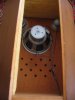
I'm not sure how I could re-tune the venting, since it is distributed among 18 holes in the baffle. If the impedance curve with driver in box spikes at 45 and 85, does that mean the box is tuned to 45, or is it tuned to 60 (the low-point between the spikes, and the Fs of the driver)?

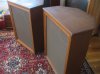
I measured the boxes, and estimated the volume at 4.8 cubic feet. I still plan to go through with building the crossovers and seeing what these can do, but does anyone have recommendations for drivers to look out for that might work out well? I was thinking a coaxial or triaxial might be fun to try out, but I'm open to anything really.

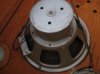
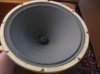
Here's some pics. I changed out the tweeter horns to some Olson horns of about the same size, since one of the tweeters wasn't working up to snuff. I also isolated the midrange. Any suggestions on additional bracing or damping? I was thinking of just adding roofing felt for panel damping, rather than adding additional bracing, and adding insulation on all panels for standing waves (right now there's only insulation on every other panel).
 

Attachments

  • IMG_1860.jpg
    IMG_1860.jpg
    176.9 KB · Views: 512
  • IMG_1861.jpg
    IMG_1861.jpg
    113 KB · Views: 20
  • IMG_1863.jpg
    IMG_1863.jpg
    118.2 KB · Views: 12
  • IMG_1868.jpg
    IMG_1868.jpg
    137.5 KB · Views: 10
  • IMG_1864.jpg
    IMG_1864.jpg
    104.2 KB · Views: 11
  • IMG_1869.jpg
    IMG_1869.jpg
    117.8 KB · Views: 9
I'm not sure how I could re-tune the venting, since it is distributed among 18 holes in the baffle. If the impedance curve with driver in box spikes at 45 and 85, does that mean the box is tuned to 45, or is it tuned to 60 (the low-point between the spikes, and the Fs of the driver)?
I hope I'm not adding to your confusion:) You could just glue a slab of MDF or something over it, and cut a new hole for the vent. I would go with a minimum of 4-5" wide. The wider you go, the longer, but that's a big box so the total vent length won't be so long. Yes it's tuned to the saddle, or lowest point between the two bumps.
I measured the boxes, and estimated the volume at 4.8 cubic feet. I still plan to go through with building the crossovers and seeing what these can do, but does anyone have recommendations for drivers to look out for that might work out well? I was thinking a coaxial or triaxial might be fun to try out, but I'm open to anything really.
Personally I would sell the Jensens and start over. $300 will but you some good stuff! I'm thinking two smaller woofers per box, like 2 Peerless tens per box. With a passive crossover, it always seemed to me like I never was getting enough bass, with three drivers of the same efficiency.

The next thought is how much do you want to spend? How loud do you want them, and what size room are you going to be listening them in? Also the boxes are made for room corners, so can you put them in the corners and live with them? I hate to answer question's with more questions, but if you are doing your own, you might as well make them so they integrate well in to your personal space. If you value tight bass over bass extension, then you could design the whole thing as a sealed box. I'll give you an example: I'm using 2 Peerless 260 SWR's in 6.5 cu' sealed enclosures. A total of four tens. You could use those, cross them over to the Dayton 2" metal dome, and from there we'll figure out the tweeter. Also how loud do you want them? Say if you want them as loud as vintage JBLs, then that might rule out a ribbon tweet.

Here's some pics. I changed out the tweeter horns to some Olson horns of about the same size, since one of the tweeters wasn't working up to snuff. I also isolated the midrange. Any suggestions on additional bracing or damping? I was thinking of just adding roofing felt for panel damping, rather than adding additional bracing, and adding insulation on all panels for standing waves (right now there's only insulation on every other panel).
Yes I see how that would be easier than bracing, because they are already built. With a box that big, I would add an x brace, made of 2x2 oak to all side panels, and connected to the top and bottom also. With the box already done, that is harder to do, but you can do it. Also I'm big on stuffing. The general rule has always been, in a vented enclosure, to just use it on the sides. Not me. Not B&W with their matrix enclosure either. What I would do, is pretty much load it on the insides, and leave room around the vent. I weigh out the stuffing for each box so that the impedances match. This increases the effective size of the box a lot more, and will kill of the standing waves inside to almost nothing. Edited to add: Wait until you get all the feedback from everyone else here! LOL I hope that helped. :)
 
I'm not sure how I could re-tune the venting, since it is distributed among 18 holes in the baffle.

If you just want to mess around with the tuning to see what it does, then use some Mortite (rope caulk) and fill in some of the holes. It's easy to stuff in there and easy to remove so you haven't permanently changed your box. If you fill a hole, measure, fill the next, measure, etc. then you can see what happens to the response as your vent gets smaller with the same length.

Ray
 
Hmmm, seeing how much one of those sold for, if the crossover rebuild and cabinet bracing don't work out like I'm hoping, maybe I can sell the drivers and use the money to start over with a new baffle and a simpler, 2-way system. Whatever the case may be, these cabinets are too nice to not be put to good use.
As suggested, and confirmed by your measurements, (good work on that, BTW, :thmbsp:) the Jensen turns out more a mid-bass driver than a woofer by current standards. There appears to be a market for them as guitar speakers, which can fund a workable project solution for your cabinets. I'd sell the other drivers, as well.

Your speculation above suggests that the baffles are removeable. If that's the case, then with 4.8 CF, many options open up for you, and you'll also have access to the inside to beef up the bracing and general construction as you contemplate. I'd look at devising better closure for the rear as part of that. The present edge-screwed scheme is not adequate; you need some angled strips glued to the edges there and blocks top and bottom for a solid attachment and seal.

I'm going to disagree with 400 Hz being the maximum useable frequency for large low-frequency drivers. While D130 at 2.5 kHz is a WAY long stretch, there are plenty of 15" and smaller drivers that will play competently into the 800 - 1.2 kHz range and mate smoothly with a variety of compression driver/horn combinations for two-ways. That's what I do, mostly.

Coax/triax, you REALLY need to look at the compatibility of specific ones in relation to the boxes you have. If you simply assume you'll be able to put 15TRXBs and ports in there and be done, for example, it's not going to work any better than what you already have, and you may as well stick with that. Yes, they used to do it, and also mate D130 with 075 @ 2.5 kHz, as well, but the result is not high fidelity by today's standards. Vintage design practice is rarely a suitable model without confirmation using the newer methods.

I'm working with a pair of JBL D130's. It's a superb, 15" driver, but the bottom line is, by todays audio standards, you can't get any bass out of those either, within their linear operating range. The FS is 49, and in the 4.5 cu' cabinet that they came in tuned to 40 Hz, there is almost no bass at all. They should be fS=40 Hz, but I think age tightened them up, and I can't get them to loosen up! :( On Norah Jones track 3 "Cold Cold Heart" with that beautiful bass recording, the fundamental is gone.
Yup, it's just doesn't happen, and despite wishful claims to the contrary, never did. Redboy's going to be working through that in his Barzilay project two-ways soon, too.... :yes:
 
Thanks for all the advice guys! I'll go with trying to optimize these as they are for now, and report back when I get them up and running and see how they turn out. I imagine I'll probably end up selling the drivers and recycling the cabinets, but for now I just want to hear what they have to offer (and if I end up really digging the sound, maybe I'll go for a subwoofer to pick up the slack in the bottom end).
 
Back
Top Bottom