• The move to the new server is done. There are some software and database maintenance updates in process. This has us passing the hat around to help out. We appreciate any donations. Seriously, even a dollar helps. The payment page may be found here - https://www.audiokarma.org/support.html

Question about NAD 7020 rev 2 recap

clockspot

New Member
Hello all!

I'm adopting my parents' old NAD 7020 rev 2 as the hub of my small hifi/phono system. One of the channels is very flaky (as I recall – only tried it a few times after pulling it from storage) so I'm getting ready to do a full recap on it.

(For posterity and others' use, here is my working parts list (Google spreadsheet) – with many thanks and gratitude to Tim D for finding and uploading the rev 2 service manual and leesonic for suggested replacement caps from this thread – many thanks y'all, if you see this! I'm a programmer who's comfortable with soldering/desoldering and have done recaps before, but not so much with the "why" of hardware circuit design. I'm also looking at this walkthrough, which is mainly on the same page.)

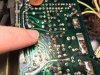
I found something strange on the power daughterboard (in the regulator section) I'm hoping someone here can shed some light on (see pics attached, or here).

The "matching" C901 and C902 are different: one is 330µF (agreeing with the parts list) while the other is 470µF. Should I replace them with these values, or get a matching pair, and if so, which?

Also, on the "correct" 330µF side, looks like things got hot at some point – the PCB is blackened beneath C904/R902/R904/Q902/ZD901, and in the same spot on the other side, the coating/shellac(?) looks crackly. Would anyone here recommend replacing any of these components at the same time as the caps? The pads and traces look alright, and so do the components, except C904's sleeve is more pink than the rest.

Thank you in advance for any suggestions or advice – and many thanks again for the wealth of knowledge already here, I hope this thread can contribute a bit!

Luke
 

Attachments

  • power daughterboard front.jpg
    power daughterboard front.jpg
    113.1 KB · Views: 113
  • power daughterboard back.jpg
    power daughterboard back.jpg
    129.2 KB · Views: 103
  • power daughterboard schematic.jpg
    power daughterboard schematic.jpg
    93.5 KB · Views: 97
Register to hide this ad
You can up the value of C1 and C2 to 680uF, just be careful of the size because space is tight. Add some heatsinks onto those power supply transistors, and maybe install some higher wattage dropper resistors, and mount them off the board to improve air circulation.

Oh, and it's a NAD. That means it will kick the ass of more expensive and exotic brands...

Lee.
 
Thanks Lee! I really appreciate it!

Forgive my ignorance – by power supply transistors you mean the rectangular ones (Q901/902)? Which resistors are the dropper ones, R901-904 or maybe 905-906 (the bigger white ones to the sides)?

I was thinking of adding a silent little case fan to induce some airflow, wired into the backlight bulb circuit (as I read that's DC and my bulb needs replacing anyway). Good idea? Bad idea? Not worth the trouble?

I do look forward to enjoying the NAD again – many fond memories of it as a kid (I used to spin the tuning knob to fling the needle back and forth and watch the tuning lights twinkle... will probably lay off that) and it does seem well-regarded for what it is. Lucky me!

Cheers
Luke
 
Luke,

Let me welcome you to AK. Good luck. I will enjoying hearing about your project. The NAD 7020 is a fine receiver.
 
Thanks Tim, I'm glad to be here – and thanks again for your 7020 thread and finding the schematic, it is most informative!

I've had (inherited) a few other vintage receivers that worked more or less well, including a Marantz 2220B and B&O Beocenter 3500... but I like the modesty and cleverness of the little NAD and am looking forward to hearing how it sounds after the recap. I'll be sure to post updates.

I once went to a super high-end audio store here in Dallas, listened to setups worth more than everything I own... and suddenly spotted a 7020 on a bookshelf. "I've got one of those!" I said. The guy replied, "Oh, yeah, that's... our legacy wall." Even if it doesn't blow minds, it certainly seems to command some respect.

Did you end up getting one of those Hakko desoldering guns? I'm waiting for delivery of one of those right now, which should make this project, and others in future, roughly 500 times easier.
 
Thanks Lee! I really appreciate it!

Forgive my ignorance – by power supply transistors you mean the rectangular ones (Q901/902)? Which resistors are the dropper ones, R901-904 or maybe 905-906 (the bigger white ones to the sides)?

I was thinking of adding a silent little case fan to induce some airflow, wired into the backlight bulb circuit (as I read that's DC and my bulb needs replacing anyway). Good idea? Bad idea? Not worth the trouble?

I do look forward to enjoying the NAD again – many fond memories of it as a kid (I used to spin the tuning knob to fling the needle back and forth and watch the tuning lights twinkle... will probably lay off that) and it does seem well-regarded for what it is. Lucky me!

Cheers
Luke

Q901 and Q902 yes. Together with R905 and R906 (10ohm 1watt) they drop down the 35v from the transformer into a regulated +29v and -26v approx. Whatever you can do to reduce heat in this area, go for it. Some small heatsinks, and upping the resistors to 2 or 3 watts. You could use a fan, but probably unnecessary. You might want to add a heatsink to Q801 as well, and maybe up R801 in wattage? Putting in larger resistors doesn't make them dissipate any less heat. What it does is not run them quite so near their limits, and using new resistors you can mount them on long legs to keep the heat away from the board. Using new transistors also helps with longer legs. The 7020 is worse in that respect than the 3020 because the way the board is mounted vertically (at least in the later versions like yours).

Hope this helps,

Lee.
 
Thanks NAD80!

leesonic – that's very helpful indeed, explains everything perfectly – thanks so much! I'll get these parts ordered and post an update soon.
 
Thanks Tim, I'm glad to be here – and thanks again for your 7020 thread and finding the schematic, it is most informative!

I've had (inherited) a few other vintage receivers that worked more or less well, including a Marantz 2220B and B&O Beocenter 3500... but I like the modesty and cleverness of the little NAD and am looking forward to hearing how it sounds after the recap. I'll be sure to post updates.

I once went to a super high-end audio store here in Dallas, listened to setups worth more than everything I own... and suddenly spotted a 7020 on a bookshelf. "I've got one of those!" I said. The guy replied, "Oh, yeah, that's... our legacy wall." Even if it doesn't blow minds, it certainly seems to command some respect.

Did you end up getting one of those Hakko desoldering guns? I'm waiting for delivery of one of those right now, which should make this project, and others in future, roughly 500 times easier.

Didn't get a Hakko desoldering station, but I picked up a cheap desoldering iron with an integrated syringe solder sucker. It was so much cheaper.

You're going to like the Marantz 2220B. I've got one too and it's sweet too.
 
You're going to like the Marantz 2220B. I've got one too and it's sweet too.

Oh the Marantz was years ago, it was lovely but regrettably I sold it before I really knew what I had. At least it went to someone who was very excited to have it. Still have the B&O (and a parts unit), it's what the NAD will be replacing – it's been great except for the slightly flaky integrated turntable and proprietary cartridge. It needs a recap also, which I might tackle next.
 
So I'm building my order at Mouser/Digikey and running into a few interesting things...

Some caps aren't available in the suggested replacement type at the original specs. My understanding is it's safe to go up in voltage as long as the cap still fits physically, so that's what I'm doing (as shown in the "Exception" column here) – it's usually about 2x, but in some cases as much as 10x. Is this ever a bad idea? Would it be preferable to choose a cap of a different type that's closer to the "right" specs?

In particular, I'm having trouble finding 50V 3300µF for the big power caps – their "audio-grade" ones (KW,KA,FW) are all "on order" for months – and I can't go up in voltage or capacitance or the cap gets too big (18mm max). Should I wait/look elsewhere for the proper thing, or can I drop to 35V or 2200µF? (I am not a loud listener.) And either way, is it worth going to a different cap type that's rated for 105C (such as KA 50V 2200µF), per below?

I've also read about selecting temp ratings according to function – 85C for signal path (for better sound, as suggested here) and 105C for power (for better heat tolerance, as suggested by an engineer acquaintance). A good idea? I started to spec for this, but I'm not sure exactly which caps do what (yet) so can only judge function crudely by location.

I know I'm overthinking all this, but it's interesting to explore these details and I like to try to understand. Thanks again in advance for any suggestions!
Luke
 
Last edited:
Sorry to resurrect an old thread, but how did the recap go? I recently picked up a 7020 and on inspection my 901 and 902 caps are blown and not even close to the schematic value (ones a 1000uF and ones a 470). going to peruse your parts list closely as I build up my list as well!
 
Hello all!

I'm adopting my parents' old NAD 7020 rev 2 as the hub of my small hifi/phono system. One of the channels is very flaky (as I recall – only tried it a few times after pulling it from storage) so I'm getting ready to do a full recap on it.

(For posterity and others' use, here is my working parts list (Google spreadsheet) – with many thanks and gratitude to Tim D for finding and uploading the rev 2 service manual and leesonic for suggested replacement caps from this thread – many thanks y'all, if you see this! I'm a programmer who's comfortable with soldering/desoldering and have done recaps before, but not so much with the "why" of hardware circuit design. I'm also looking at this walkthrough, which is mainly on the same page.)

I found something strange on the power daughterboard (in the regulator section) I'm hoping someone here can shed some light on (see pics attached, or here).

The "matching" C901 and C902 are different: one is 330µF (agreeing with the parts list) while the other is 470µF. Should I replace them with these values, or get a matching pair, and if so, which?

Also, on the "correct" 330µF side, looks like things got hot at some point – the PCB is blackened beneath C904/R902/R904/Q902/ZD901, and in the same spot on the other side, the coating/shellac(?) looks crackly. Would anyone here recommend replacing any of these components at the same time as the caps? The pads and traces look alright, and so do the components, except C904's sleeve is more pink than the rest.

Thank you in advance for any suggestions or advice – and many thanks again for the wealth of knowledge already here, I hope this thread can contribute a bit!

Luke
Hi Clockspot

can you share the Rev 2 Service manual pls?? i`ve been looking for one all over the world!!

thanks
 
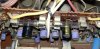
This thread helped with my NAD 7020 recently. I have the “rev2” version with the vertical power daughter board as it’s referred to above. All functions worked on initial testing but it had a hum in both channels that only went away if the speakers were not selected. Visual inspection showed c901 and c902 blackened at the pcb. Mine also had the same mismatched values noted here with one 330uF and one 470uF.

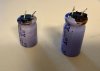
I’m not an expert with the soldering iron but these were pretty easy to remove/replace without removing the pcb since they are at the top of the board. I pulled the two nearby fuses first to get better access. You can see the black/gold replacements that I used in the photo below. I didn’t make any other changes or do any other testing but after replacing these two caps the hum is now gone.

I’m using this to drive some JBL L110 that I recently fixed up. The NAD may be underpowered overall but it sounds excellent at moderate volumes.

AF4E7E6E-8555-4278-BE12-005335681C4A.jpeg 6E5EB526-56EB-4EA7-95DA-C8074899C8FC.jpeg
 
Last edited:
This thread helped with my NAD 7020 recently. I have the “rev2” version with the vertical power daughter board as it’s referred to above. All functions worked on initial testing but it had a hum in both channels that only went away if the speakers were not selected. Visual inspection showed c901 and c902 blackened at the pcb. Mine also had the same mismatched values noted here with one 330uF and one 470uF.

I’m not an expert with the soldering iron but these were pretty easy to remove/replace without removing the pcb since they are at the top of the board. I pulled the two nearby fuses first to get better access. You can see the black/gold replacements that I used in the photo below. I didn’t make any other changes or do any other testing but after replacing these two caps the hum is now gone.

I’m using this to drive some JBL L110 that I recently fixed up. The NAD may be underpowered overall but it sounds excellent at moderate volumes.

View attachment 2406775 View attachment 2406776
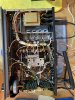
Also replace all the large ceramics that shunt to ground and your noise floor will drop dramatically. I did a total recap on one and it improved dramatically after replacing the ceramics with COGS
 
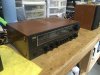
I used better quality parts than originals and the sonic results were quite impressive. I rebuilt the 7020 on a flyer just to see what is possible and refinished the cabinet in hammered copper.
upload_2021-11-28_8-24-17.jpeg
upload_2021-11-28_8-24-55.jpeg
 
Back
Top Bottom