• The move to the new server is done. There are some software and database maintenance updates in process. This has us passing the hat around to help out. We appreciate any donations. Seriously, even a dollar helps. The payment page may be found here - https://www.audiokarma.org/support.html

Question about protecting my stereo with a surge protecter.

DoctorJon

Member
Hi all,

I have a question about how you protect your home from a stereo that is older from burning out when you are unexpecting it. I have a Pioneer SX-3700 reciever that I want to protect both from a surge and the chance that it would have heat sink problem that would result in electrical damage in the home. Is there anything that would prevent this reciever from overheating and sending electricity into hazardous areas. My first thought is a surge protector but im more worried about the reciever burning out and damaging the electrical of the other units I have attached to it and in the home.

Any advice would be apprieciated greatly,

Thanks
 
Register to hide this ad
A surge protector is a good way to go, for the surge protection that it offers, but perhaps even more importantly, you can leave your receiver switch in the “on position”, and use the surge protector power switch instead to power your receiver up and down. Many vintage receivers have especially weak designs in their power switches. By using this method, you eliminate further wear on the receiver switch. You also know that no power is getting to the unit (at all) when it is not in use - which should give you further peace of mind when it is unattended. I use this method on all of my vintage gear. Better safe than sorry!
 
Hi all,

I have a question about how you protect your home from a stereo that is older from burning out when you are unexpecting it. I have a Pioneer SX-3700 reciever that I want to protect both from a surge and the chance that it would have heat sink problem that would result in electrical damage in the home. Is there anything that would prevent this reciever from overheating and sending electricity into hazardous areas. My first thought is a surge protector but im more worried about the reciever burning out and damaging the electrical of the other units I have attached to it and in the home.

Any advice would be apprieciated greatly,

Thanks

A quality surge protector is recommended for all of your equipment. But it will not protect the equipment from overheating. The only ways to protect from that is to make sure all components have proper ventilation per their instructions and to turn them off when not in use.
 
I totally agree with those who say a surge protector is a requirement!!!
Take a look at "Brick Wall" surge suppressors. They have no sacrificial components, which means they last practically indefinitely.
I also suggest a "double conversion" power supply. These (1) take A/C from the wall, (2) convert that to D/C, (3) charge the battery pack with the D/C, and (4) then convert the D/C from the battery pack back to controlled sine wave A/C. This means you are ALWAYS working from the battery pack. NO "change-over" time. And the A/C from the unit is controlled true sine wave.
I have two "Brick Wall" surge protectors in series in front of the double conversion power supply.
That gives me pretty well assured protection from any problems from the Electrical Utility company.
Thanks,
Jim
 
I totally agree with those who say a surge protector is a requirement!!!
Take a look at "Brick Wall" surge suppressors. They have no sacrificial components, which means they last practically indefinitely.
I also suggest a "double conversion" power supply. These (1) take A/C from the wall, (2) convert that to D/C, (3) charge the battery pack with the D/C, and (4) then convert the D/C from the battery pack back to controlled sine wave A/C. This means you are ALWAYS working from the battery pack. NO "change-over" time. And the A/C from the unit is controlled true sine wave.
I have two "Brick Wall" surge protectors in series in front of the double conversion power supply.
That gives me pretty well assured protection from any problems from the Electrical Utility company.
Thanks,
Jim

Sounds like the battery pack would be the weak link on a "double conversion" power supply. Doubt if it will last indefinitely.
 
In a true double conversion (aka dual conversion) unit the battery is constantly being charged.It is ALWAYS supplying power, it is only running on its own power for the times when the utility company power goes out. It is not made for extended use (unless you are talking about military spec equipment).
These began for the PC computer industry using switching power supplies. Some switching power supplies are VERY sensitive to the smallest variation in power from the utility company (i.e., microsecond or even a millisecond interruption).
Even though you are always running on the battery, the power supply provides only protection for brief interruptions. Typically the units are for less than 30 minutes to let the computer systems to be shut down in an orderly fashion with no loss of data.
The big advantage of the dual conversion is that the audio/video equipment is always receiving pure regulated sine wave power, despite the vagaries of the local utility company (our local power company is sometimes referred to as "flicker on & off" rather than the official name Florida Power Company). This is because the source of the power to the audio equipment is ALWAYS coming from the battery pack through the D/C to A/C regulator no matter how "grungy" (or dirty) the local power supply.
There are also "line interactive" backup power systems. But these do not switch to the battery until power fluctuates. Thus, one is at the mercy of how the "switchover" software/mechanism is designed and how long that takes. I do not trust "line interactive" power backup systems.
We learned this "the hard way" with our servers at the office cutting out when we did not realize there was a problem with the utility company power (i.e., the lights in the office did not flicker).
Living on the Gulf of Mexico we are subject to hurricanes, thunderstorms, tornadoes, "thunder bumpers," etc., all of which wreak havoc with the electrical grid. The dual conversion power supply gives us time to properly shut down the computer system when local utility fails. We have several in our office, and I use a 3000 VA one in my home audio system. Most reasonably priced power backups are only 90% efficient, meaning a 3000 VA unit will only supply 2700 watts of regulated sine wave A/C power.
For audio/video the advantage is the pure sign wave regulated power to the equipment.
Thanks,
Jim
 
In a true double conversion (aka dual conversion) unit the battery is constantly being charged.It is ALWAYS supplying power, it is only running on its own power for the times when the utility company power goes out. It is not made for extended use (unless you are talking about military spec equipment).
These began for the PC computer industry using switching power supplies. Some switching power supplies are VERY sensitive to the smallest variation in power from the utility company (i.e., microsecond or even a millisecond interruption).
Even though you are always running on the battery, the power supply provides only protection for brief interruptions. Typically the units are for less than 30 minutes to let the computer systems to be shut down in an orderly fashion with no loss of data.
The big advantage of the dual conversion is that the audio/video equipment is always receiving pure regulated sine wave power, despite the vagaries of the local utility company (our local power company is sometimes referred to as "flicker on & off" rather than the official name Florida Power Company). This is because the source of the power to the audio equipment is ALWAYS coming from the battery pack through the D/C to A/C regulator no matter how "grungy" (or dirty) the local power supply.
There are also "line interactive" backup power systems. But these do not switch to the battery until power fluctuates. Thus, one is at the mercy of how the "switchover" software/mechanism is designed and how long that takes. I do not trust "line interactive" power backup systems.
We learned this "the hard way" with our servers at the office cutting out when we did not realize there was a problem with the utility company power (i.e., the lights in the office did not flicker).
Living on the Gulf of Mexico we are subject to hurricanes, thunderstorms, tornadoes, "thunder bumpers," etc., all of which wreak havoc with the electrical grid. The dual conversion power supply gives us time to properly shut down the computer system when local utility fails. We have several in our office, and I use a 3000 VA one in my home audio system. Most reasonably priced power backups are only 90% efficient, meaning a 3000 VA unit will only supply 2700 watts of regulated sine wave A/C power.
For audio/video the advantage is the pure sign wave regulated power to the equipment.
Thanks,
Jim
Hi, I live in HI with same issues. What units do you recommend for this purpose? I already lost a receiver, NAS and backup UPS from Costco, a Cyberpower 1500,clearly not up to the task. BTW, FPL tried to take over our UT but was rejected by PUC. However, same hurricane force winds that took out my units took out Lahaina, Maui with fire and our Hawaiian Electric with post fire lawsuits.
 
Hi, I live in HI with same issues. What units do you recommend for this purpose? I already lost a receiver, NAS and backup UPS from Costco, a Cyberpower 1500,clearly not up to the task. BTW, FPL tried to take over our UT but was rejected by PUC. However, same hurricane force winds that took out my units took out Lahaina, Maui with fire and our Hawaiian Electric with post fire lawsuits.
For many decades, I`ve had very successful surge/spike protection using various models of Tripp-Lite, Panamax, and APC brand UPS`.
My first purchased UPS was a Cyberpower and the first strong lightning storm`s nearby strike in 2002`s surge/spike killed it !

So I never replaced it with another Cyberpower, but instead a APC brand, that other than replacing its batteries 3 times since purchase in 2002 is still functioning perfectly.

With no electrical/electronic losses other than the undersized cheap provided with various low powered devices SMPS wall wart, that after replacing the handful of failures with mildly up rated in wattage capacity ones from Amazon, no more failures, even though their powered up 24/7/365 through very frequent intense lightning storms here in NE/FL.

I start protecting my house`s tens of thousands of dollars of valued electrical/electronic equipment with my 1997 utility Co. purchased power meter based whole house surge/spike protector, and then that`s followed up with a whole house circuit panel installed type one from Leviton, and then at each of my house`s room`s A/V systems have their own HQ endpoint surge/spike protectors, and some of my house`s room`s A/V systems also have a AVR to keep the line voltage in the 120v area for the occasional low voltage brown outs, and to help with the AC voltage during times when I`m on my 1999 purchased 25kw whole house automatic switchover generator.

What is also very important is to make sure to surge/spike protect all cables feeding from outside and any that are run through the attic like outside antennas (sat. dish, cable TV, OTA, and copper wire land line telephone), plus any ethernet cables feeding any rooms from a router, modem that connect to electronic equipment, for failure to do so will most certainly provide a path for a nearby lightning strike`s destructive energy`s to damage or destroy all devices cable connected with them while it`s looking for ground.

Good luck.
 
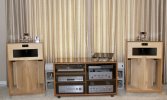
I run dual APC Line-R 1200 voltage regulator and line conditioners sitting on cement blocks with my "vintage" system, along with a small portable fan on the backside of the cabinet aimed toward the amps. Never had a problem before hooking up the APCs, but figure it wouldn't hurt either - as the old saying goes "better safe than sorry!"
2023 HiFi.jpeg
 
I run dual APC Line-R 1200 voltage regulator and line conditioners sitting on cement blocks with my "vintage" system, along with a small portable fan on the backside of the cabinet aimed toward the amps. Never had a problem before hooking up the APCs, but figure it wouldn't hurt either - as the old saying goes "better safe than sorry!"
View attachment 3189703
One of the best & most cost effective methods of electronic/electrical damage prevention methods one can do, IMO based on multi decades of experience !
And when done correctly has no detrimental effects on the quality of the audio and or video electronics utilizing "quality" methods.
 
I would agree with Bill & Dee. People tend to concentrate on surges, but low voltage, much less common, but can do damage too.
 
What kind of speakers are those?
One of the best & most cost effective methods of electronic/electrical damage prevention methods one can do, IMO based on multi decades of experience !
And when done correctly has no detrimental effects on the quality of the audio and or video electronics utilizing "quality" methods.
 
I run dual APC Line-R 1200 voltage regulator and line conditioners sitting on cement blocks with my "vintage" system, along with a small portable fan on the backside of the cabinet aimed toward the amps. Never had a problem before hooking up the APCs, but figure it wouldn't hurt either - as the old saying goes "better safe than sorry!"
View attachment 3189703
What speakers are those?
 
Back
Top Bottom