• The move to the new server is done. There are some software and database maintenance updates in process. This has us passing the hat around to help out. We appreciate any donations. Seriously, even a dollar helps. The payment page may be found here - https://www.audiokarma.org/support.html

Question on Ohms, Denon dra-635r

Status
Not open for further replies.

jonklaus

New Member
Hi, everybody.

Nearly a year ago, I posted a thread asking "Help! Why does my system sound so bad?" Now, I'm finally back to experimenting with my home stereo system, and would once again like your help. (And I'm still really a noob, so please be patient when I say stupid things!

Most of the previous folks were suggesting that I try a different receiver for a setup. I've now swapped out the receiver, and am dismayed to report that things still sound bad to me: The speakers are exceedingly bright, no matter how I turn the various pots, and they've got basically no bass response. Here's the specs:

Amp: Denon DRA-635r (80WPC)
Speakers: RTR EXP-8v

Since I'd swapped the receiver, I thought that I might head out to Goodwill and hunt for some replacement speakers. Alas, the 2nd-hand gods weren't good to me---I didn't find any good, matching speakers (or rather---those I found were pretty dilapidated). So I decided to pick up a subwoofer, in the hopes that adding one might help balance out the treble-heavy response that I'm complaining about from the RTRs. (I have no idea if that's a stupid idea or not. Just experimenting.)

Now I've gotten home and looked at the back of the Denon, and am worried about impedance. The rating on the receiver says "A or B = 6-16 OHMS/SPEAKER, A+B, 12-16 OHMS/SPEAKER." So I take it to mean that the receiver has a minimum impedance of between 3 and 4 OHMS ((12*12)/(12+12)=6; 6/2=3; (16*16)/(16+16)=8; 8/2=4). Somebody tell me if I'm wrong!

The subwoofer that I bought is rated at 8 OHMS. If my math is right (again---I'm a noob, and might not be doing this right), that brings me to an impedance of 2.667 ((8*8)/(8+8)=8; 8/1.5 = 2.667). Here, finally are my questions:

  • Is parallel wiring (just hooking the subwoofer up to the B connectors) a really bad idea? 2.667 < 3 (obviously). Is this going to make my receiver explode?
  • Total series wiring will far exceed the maximum recommended impedance of 8 OHMS. Is that going to make the amp sound like it's 200 miles away?
  • A mixture of series and parallel wiring appears to be possible, but that's going to drive one speaker (the subwoofer, presumably) pretty heavily.
  • Or should I give up and just hunt down new speakers. (Don't worry: Today's Goodwill purchase cost... wait for it ... $4. So I'm not heartbroken if you tell me that my idea is bonkers.)
Thanks, everybody. Sorry for the novel-length posting!
 
Register to hide this ad
Several things, in no particular order.

First, that 8 ohms stated is not a maximum impedance. You don't have to worry about too much impedance. Too low, yes.

Second, I don't see how you arrive at that 3 ohm figure. I see it more like 6 ohms. Try this: http://www.sadowsky.com/audio/impedance.html

For series connection, the impedances of the speakers as simply added.

Third, you can hook up a POWERED subwoofer anywhere. It's a high enough impedance to effectively have no affect on the overall impedance. A passive subwoofer follows the same rules as other speakers.

Fourth, a subwoofer will only extend the low end. It won't do a damn thing for the upper bass, midrange, or high end.

Finally, lack of power is not your problem. If you don't like the sound, replace the speakers. No amp will make speakers you don't like sound good.
 
Last edited:
Thank you for your wisdom, Skipper!

Replies:
1) On 8 ohms as "max" --- Yes, I know that I don't have to worry about hurting things with too much impedance. But won't I have to crank up the volume really loud to get it to a listening level if the impedance is too high?
2) On minimum impedance --- I'm sure that I'm doing something wrong, but I still get 3OHMS total impedance, including using the calculator that you linked to. To make it simpler: For the A Speakers only, the receiver says that one can use 6OHMS/speaker. That translates to 3OHMS total impedance for the system with two speakers. Right? Four speakers @ 12OHMS apiece gives the same result. Four speakers @ 16OHMS apiece gives 4 OHMS total. Unless I'm doing something stupid...
3) I might look into a powered woofer. Or just bigger speakers. Which brings us to
4) If I don't like the sound, just replace the speakers. This is sage advice, to be sure. So: Anybody want to buy a pair of vintage RTR speakers? ;-)

Several things, in no particular order.

First, that 8 ohms stated is not a maximum impedance. You don't have to worry about too much impedance. Too low, yes.

Second, I don't see how you arrive at that 3 ohm figure. I see it more like 6 ohms. Try this: http://www.sadowsky.com/audio/impedance.html

For series connection, the impedances of the speakers as simply added.

Third, you can hook up a POWERED subwoofer anywhere. It's a high enough impedance to effectively have no affect on the overall impedance.

A passive subwoofer follows the same rules as other speakers.

Finally, lack of power is not your problem. If you don't like the sound, replace the speakers. No amp will make speakers you don't like sound good.
 
Sigh...

Remember, this only counts speakers on the same channel. Speakers on separate channels don't affect the other channel.

So, your receiver says, and I quite your post "A or B = 6-16 OHMS/SPEAKER, A+B, 12-16 OHMS/SPEAKER."

Note the word "OR" as opposed to the "+" sign. Big difference. One means one speaker OR the other running at one time. The other means both running at the same time.

The formula for parallel impedance is ((r1 x r2) / (r1 + r2)), or, using 8 ohm speakers as a guide, ((8 X 8) / (8 + 8)) or (64 / 16) or 4 ohms. That's it. There ain't no mo.

For different impedances, use that calculator I linked. I'm not gonna go through every possible combination for you..
 
Last edited:
Sigh. My turn to sigh. At myself...

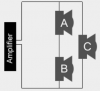
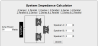
I think I understand now. So a graphic like this is referring to a single channel:
upload_2016-6-23_23-20-54.png

I somehow thought that it was two, but I realize now how silly that was.

So: When people say, "Can your amp handle a 4 OHM load," they mean per channel. Somehow this hadn't clicked...

Let me re-do my math now:
  • Minimum per channel impedance is 6 ohms, considering A or B = minimum 6 ohms/speaker, and A+B = minimum 12 ohms/speaker.
  • The parallel wiring scenario under consideration was as follows
    • Channel L: 1 8 ohm speaker = 8 ohm impedance
    • Channel R: 1 8 ohm speaker (on "A Speakers") + 1 8 ohm woofer (on "B Speakers") = 4 ohm impedance.
I've read elsewhere on this Forum that people have used this receiver with 4 OHM speakers with no dire consequences. So this probably isn't going to burn down the house. But I might try series wiring anyway, just to see how it sounds.

Thanks again, Skipper. (And feel free to correct me again if I've gotten something wrong (again).


Sigh...

Remember, this only counts speakers on the same channel. Speakers on separate channels don't affect the other channel.

So, your receiver says, and I quite your post "A or B = 6-16 OHMS/SPEAKER, A+B, 12-16 OHMS/SPEAKER."

Note the word "OR" as opposed to the "+" sign. Big difference. One means one speaker OR the other running at one time. The other means both running at the same time.

The formula for parallel impedance is ((r1 x r2) / (r1 + r2)), or, using 8 ohm speakers as a guide, ((8 X 8) / (8 + 8)) or (64 / 16) or 4 ohms. That's it. There ain't no mo.

For different impedances, use that calculator I linked. I'm not gonna go through every possible combination for you..
 

Attachments

  • upload_2016-6-23_23-20-7.png
    upload_2016-6-23_23-20-7.png
    139 KB · Views: 2
got it.jpg

I think you've got it. That graphic depicts one channel. The two channels are separate entities.

In your pictorial, speakers A and B (series connection) would be added together. That summed number would be in parallel with speaker C

Exactly what "woofer" are you referring to on that "B" channel? Is it a powered subwoofer?.
 
Last edited:
Yes, I do "got" it now. And I do know how to read the wiring chart, and differentiate between series and parallel. In part thanks to you.

And sorry: By "woofer" I meant to type "subwoofer." And no, it's not powered. It's my $4 Goodwill acquisition. Standard speaker wire only.

Thanks again.

View attachment 751939

I think you've got it. That graphic depicts one channel. The two channels are separate entities.

In your pictorial, speakers A and B (series connection) would be added together. That summed number would be in parallel with speaker C

Exactly what "woofer" are you referring to on that "B" channel? Is it a powered subwoofer?.
 
Talking speakers, 6 ohm speakers on a 4 ohm rated receiver is fine. 4 ohm speakers on a 6 ohm rated amp is not. You don't want to use a lower impedance than the amp is rated for. Higher is fine.
 
Yes -- that much I do understand. And that, as I understand it, is why series wiring is always OK. Except that one then has to drive the volume louder to get the speakers going, because wattage to each speaker is reduced. I experimented a bit last night, and found that series wiring with the subwoofer and a spare speaker (to keep the speakers balanced) mellowed out the RTRs quite a bit (good), but also made things sound a little muddy (bad).

Talking speakers, 6 ohm speakers on a 4 ohm rated receiver is fine. 4 ohm speakers on a 6 ohm rated amp is not. You don't want to use a lower impedance than the amp is rated for. Higher is fine.
 
Yes -- that much I do understand. And that, as I understand it, is why series wiring is always OK. Except that one then has to drive the volume louder to get the speakers going, because wattage to each speaker is reduced. I experimented a bit last night, and found that series wiring with the subwoofer and a spare speaker (to keep the speakers balanced) mellowed out the RTRs quite a bit (good), but also made things sound a little muddy (bad).
Stereo = 2 speakers. I wouldn't add a third speaker to the mix unless I was doing something surround-related (surround matrix, true surround, etc.). Even then, stereo music will sound much better with only 2 speakers. A subwoofer is fine, but a third speaker almost always does more harm than good for music. If you need to mellow out your speakers, turn your treble down a tick or two.
 
Thank you, Nightwisher. Here's my logic behind the third (really fourth, if you count the subwoofer) speaker:

All of my speakers are rated at 8 OHMS. This stereo has a minimum impedance of 6 OHMS per channel (as I now, finally, understand). So I can't simply add the 8-OHM subwoofer parallel without pushing one channel down to 4 OHMs. (Some people I've noted on this forum have said that the receiver can handle 4-OHM speakers, no matter what the manual says. But I'm not sure that I want to push it). So: I decided to wire the subwoofer in a series with one of the speakers. But that means that the wattage going to one of the main speakers is now much less than to one of the others. That can't be a good thing, can it? Hence my thought to add a little satellite speaker to the other channel---even a "dummy" (i.e., non-sounding) speaker would work in this scenario, to have the amount of watts pumped to each speaker be the same.

I'm sure that I'm saying all kinds of stupid things. I'm humble about it. So be nice when you school me!


Stereo = 2 speakers. I wouldn't add a third speaker to the mix unless I was doing something surround-related (surround matrix, true surround, etc.). Even then, stereo music will sound much better with only 2 speakers. A subwoofer is fine, but a third speaker almost always does more harm than good for music. If you need to mellow out your speakers, turn your treble down a tick or two.
 
What connections does your sub have on it? Brand/model? How big is the driver (6", 8" etc.)

How big are the woofers in your RTR's? How big are the cabinets and how much do they weigh? I know we never got specs on those but this info can be helpful for educated guessing.

Can you post a pic of one of the speakers w/o the grille on. And maybe the sub you found too.

From your old thread, which you might want to post a link to here, I am still left wondering whether the person who worked on the RTRs connected the woofers out of phase. Unless they are terrible speakers they should make some bass. Since you have a different receiver now it's not the receiver causing the problems.

Actually though, aside from the lack of bass, did the Denon solve the problem with 'massive volume when hardly turning up the volume knob'? I suspect it did, just checking.

Sorry for all the questions, try to answer them all for maximum points. :p
 
Thank you, Nightwisher. Here's my logic behind the third (really fourth, if you count the subwoofer) speaker:

All of my speakers are rated at 8 OHMS. This stereo has a minimum impedance of 6 OHMS per channel (as I now, finally, understand). So I can't simply add the 8-OHM subwoofer parallel without pushing one channel down to 4 OHMs. (Some people I've noted on this forum have said that the receiver can handle 4-OHM speakers, no matter what the manual says. But I'm not sure that I want to push it). So: I decided to wire the subwoofer in a series with one of the speakers. But that means that the wattage going to one of the main speakers is now much less than to one of the others. That can't be a good thing, can it? Hence my thought to add a little satellite speaker to the other channel---even a "dummy" (i.e., non-sounding) speaker would work in this scenario, to have the amount of watts pumped to each speaker be the same.

I'm sure that I'm saying all kinds of stupid things. I'm humble about it. So be nice when you school me!
Ah, I see what you're saying. You are correct - it's good to balance the impendances (ohms) on each channel, because otherwise it would be unbalanced (4 ohms on the sub side, 8 on the other). However, the other way to do that is to connect the RTR speakers to the A terminals and the sub and the 3rd speaker to the B terminals. That would run everything at 8 ohms.

I think what I would do in this situation is just use your RTRs alone for now and then look into a new powered subwoofer. I'm not a fan of passive subs because they are a b*** to get hooked up unless you have a dedicated amp for them and there's no way to control the crossover for them without that dedicated amp connected to a subwoofer pre-out from a receiver (or some other crossover component). That being said, there are some great DIY passive subwoofers, but the low end ones just end up being annoying usually. Those RTRs are supposed to be good speakers (I was just reading an older AK thread on them and the company), so the problem may be that they need some work since they're so old.
 
Last edited:
Nightwisher can you post a link to that thread?

I found this:

http://audiokarma.org/forums/index.php?threads/rtr-exp-12m-any-info-input.170840/page-2

about exp-12M which have a 12" woofer so I suspect these have an 8".

An ebay listing says these are 2-way, 19"H x 11.25"W x 9"D and weigh 22.5 pounds. So not lightweights for the size. I think they should have some decent bass.

I wonder if they have the original woofers. They look like this?

$_1.JPG
 
Nightwisher can you post a link to that thread?

I found this:

http://audiokarma.org/forums/index.php?threads/rtr-exp-12m-any-info-input.170840/page-2

about exp-12M which have a 12" woofer so I suspect these have an 8".

An ebay listing says these are 2-way, 19"H x 11.25"W x 9"D and weigh 22.5 pounds. So not lightweights for the size. I think they should have some decent bass.

I wonder if they have the original woofers. They look like this?

$_1.JPG
Yeah, that's the thread I was reading.

If that EBay listing is correct, then yeah they should be solid speakers. 8" seems like the right size for that cabinet (guesstimating at least). I don't know what the low frequency response of those would be, but it would probably be somewhere around 50 Hz if they're ported, which is pretty low. If they're not ported, then the low frequency response probably wouldn't be as good.
 
Status
Not open for further replies.
Back
Top Bottom