

You are using an out of date browser. It may not display this or other websites correctly.
You should upgrade or use an alternative browser.
You should upgrade or use an alternative browser.
Questions about required test equipment
- Thread starter z-adamson
- Start date


z-adamson
Addicted Member
Not working with tube amps. Is ANYTHING as exciting a year later as it was the day you bought it? No.Ha ha, come back and tell us a year later, if you are still as excited about this next year, we can talk about some more fancy stuffs. Time to get an amp and stick your hands in it........Ha ha, watch out if you do tubes.
I mean your enthusiasm in working on amps, forget about the equipment, those are the means to an end, not the end to the means. They are just tools, nothing more.Not working with tube amps. Is ANYTHING as exciting a year later as it was the day you bought it? No.
Ha ha, if I can get away with only a multi meter, I would!!!There are those of us who really enjoy tools. And audio equipment. And music! They can all be an end in themselves, in one way or another.
When I was working with Walter LeCroy, the founder LeCroy digital scope in 1982, he show me one of the most useful tool for testing for instability of RF circuit........a lead pencil!!! Scope were slow at the time, even most today cannot see oscillation in GHz. they filtered out and presents as DC. You touch with a pencil that is conductive, you change the oscillation and you see a jump in DC. You know there's oscillation.
It's like using burst pulses of very high rise time, large amplitude will likely trigger oscillation if the circuit is at the verge. I even have a cheap circuit using a SS relay to gate the signal for that.

ConradH
Lunatic Member
Brings back memories of testing something-or-other way back in the past. We had a big magnetic contacter (relay) for switching power to machine tools that had a huge inductive kick. We wired it up to sit and switch, putting all sorts of transients on the line. Then we plugged in our DUT to see if it was stable.
Something I've noticed about test equipment over the years is that sometimes its main value is educational. Once you use it and learn how systems or components react and function, you find you don't need it as much as you thought you did.
Something I've noticed about test equipment over the years is that sometimes its main value is educational. Once you use it and learn how systems or components react and function, you find you don't need it as much as you thought you did.
Ha ha, the only thing I am very particular is soldering iron......as you and other people have seen. That is my pet pee. That I consider as an extension of my hands. I want nothing but the best. I have both MetCal and Weller with a Aoyue with fume absorber and desoldering gun.......AND they are all on my bench. Just last night, I have all three on at the same time..... and use them.
Ha ha, I am dead serious. I just walk in and took the picture, you see the Metcal on the left, Aoyue on top of the scope and gun on the right front of the table. The Weller at the back right. The second picture show the three different size of the soldering tip. I have to use all three. I have surface mount components and I need the Metcal and Aoyue. You solder and desolder with both iron one on each side. Then I have 12 gauge wires that need the big Weller. I still have a giant Weller iron that I can pull out if all else fails!!!A row of hot soldering irons jump up and down on the bench, all screaming, "me, me, pick me for that next joint!"
From time to time, I build quite a few boards at a time. Just like a month ago, all the pcb came back and I had to build 12 boards in two or 3 days. It's hours of straight soldering. Little things about the Aoyue got up my nerves. If you restore and fixing, you do maybe a few solder joints here and there. But when you build boards, you solder, one after the other, for hours.
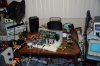
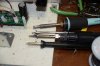
The big guy was complaining he didn't get on the picture!!!! Here is the big guy if all else failed.A row of hot soldering irons jump up and down on the bench, all screaming, "me, me, pick me for that next joint!"


OK, back to more serious talk. To OP, this is nothing fancy but absolutely make your life a lot easier: Adapters. RCA to BNC, BNC to RCA, BNC T, Barrows for BNC and RCA etc. Have plenty of them. I got them cheap on amazon.
Also banana jacks for speakers. You need quite a few BNC cables, with the adapters, you are set to go. Also You should have a good bench power supply that at least have +/-30V adjustable.
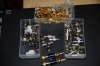
Also banana jacks for speakers. You need quite a few BNC cables, with the adapters, you are set to go. Also You should have a good bench power supply that at least have +/-30V adjustable.
Yep, those adapters are life savers. I remember when I was doing the amp comparison, all of a sudden, I realize I need quite a few long RCA cables, and I need the better ones with RG59 or RG58 instead of the thin cheapy ones come with the VCR and DVD recorders. I literally converted a bunch of BNC cables with BNC to RCA adapters to safe the day.
Another ones that are important to me, but might not be important for straightly restore, repair......set of ratchet crimpers and good wire stripper. It's important if you build amp or need to do wiring, connectors etc. Got to be ratchet type. I have one crimper for making Molex type connectors as seen in the pictures in the past posts, the yellow one is lug crimper for red, blue and yellow lugs. Middle one is the wire stripper. These really make my life a lot easier. Again, nothing fancy.
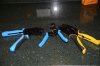
Another ones that are important to me, but might not be important for straightly restore, repair......set of ratchet crimpers and good wire stripper. It's important if you build amp or need to do wiring, connectors etc. Got to be ratchet type. I have one crimper for making Molex type connectors as seen in the pictures in the past posts, the yellow one is lug crimper for red, blue and yellow lugs. Middle one is the wire stripper. These really make my life a lot easier. Again, nothing fancy.

Roy Skinner
Active Member
What model wire stripper is that? My phone doesn't show it clearly.
Roy Skinner
Active Member
Having read this thread, I am still unclear as to the need for a frequency counter. If I am using an audio frequency signal generator that uses a pointer, how do I know it is accurate, and is exactness that important for tube radios, or SS receivers?