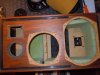
After doing my trusty pulse test, I discovered that simply swapping the inputs on one speaker resolved the polarity problem that I'd first observed, but hadn't been able to put my finger on, out in the function room.
Impressions:
These speakers, while physically large, are really relatively small scale two way monitors. Where the LS3/5A and JR-149s consist of KEF T27s and B110 5" bextrene woofers, the 104aB consists of KEF T27s and B200 8" bextrene woofers. While the woofer is an 8" woofer, I sense no gaps in the crossover while transitioning to the tweeter, and I don't get any sense of a narrowing radiation pattern as the frequencies go higher on the woofer. With the caps on the crossover replaced, there is no longer any woofer beaminess or directionality, which I'd called honkiness.
This is not my first experience with a pair of B200s. I had a Fried Model H subwoofer that used them in a transmission line configuration. I'd never spent much time hearing them go over about 75hz though.
Replacing the crossover caps removed the honkiness and directionality that I'd heard in the midrange prior to the recap. I actually didn't expect them to sound as good as they do. Now I'm really enjoying them. They may not be the last word in resolution, may not deliver the fastest transients or perform feats of reality suspension, but they are eminently listenable.
I've felt for quite a while that the ship has sailed on vintage speaker quality compared to newer speakers. While I do still find it to be almost universally true that driver materials and cabinet bracing of new speakers are superior, with these speakers I am reminded of the outright craftsmanship and artistry of what has come before from the best of the best manufacturers and has led to the quality that we take for granted in better speakers such as Spendors, Harbeths, better B&Ws, Wharfdales, Revels, Sonus Faber, Tidals, a host of others, and especially Magicos.
Of course, these are a mid '70s KEF design, which means that computer design was used in the driver design, probably cabinet design, crossover design, as well as testing.
As I write this, I am listening to Willie Nelson's "Red Headed Stranger". Now Willie's voice can be hard to love on less than excellent speakers and here his voice's reedy accuracy is portrayed with fine expression. Reverb trails on the guitar are not overbearing, but are present. The harmonica is not shouty at all and the piano notes are delicate and clear. On my Spendor A9s, which are wonderful, the mid-treble energy of today's more accurate voicing makes the voice just slightly nasal, where these speakers portray the chest resonance of his weed smoked lungs while making his nasal delivery far better than just palatable.
The KEF 104aB is a small scale speaker. It does not get super loud. It is not the 104/2. The 104/2 is a much more large scale speaker.
I have played Opeth, Mahler, and Mel Torme on the 104aBs today and the pair, in a near-field application, do render those musicians in a way that makes me want to continue to listen.
Bass is linear and extended, but not thumpy. I've moved the midrange control back to the middle position from the + position. After 9+ hours of listening today, I'm not fatigued and the crossovers aren't even broken in yet.
These speakers are keepers and will be coming with me to the next Frankenfest. Also, they will get the full treatment to restore the enclosures. I don't think they'll ever be the party speakers I was intending to place out in the 26x13 function room, but they will have a place in my heart, in my life, and in one of my systems.
The tweeters are a bit below my ear listening level, and this setup cannot remain after this week, but I sure am enjoying it now. Other listeners have been correct. In near-field listening, these are great.
I'm going to look and see if Falcon Acoustics has cap kits for my JR-149s now :scratch2: